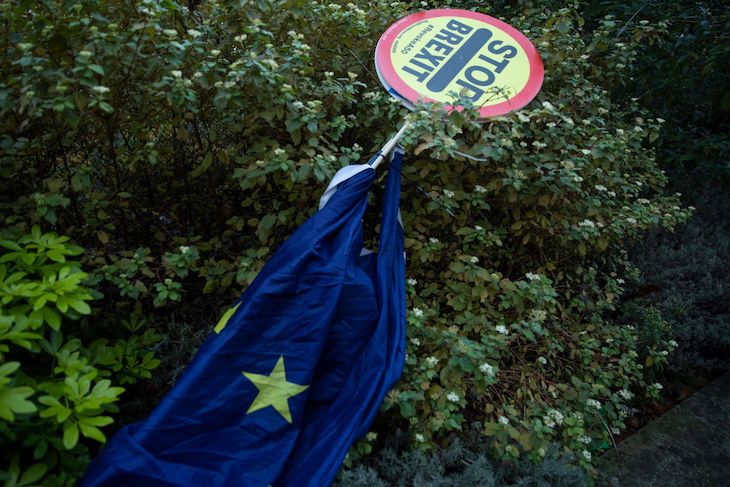
What will Andy Burnham’s EU reset cost? And which budgets will be raided to pay for it? The UK-EU reset conference in Brussels on 20 November will have very few price tags and costings attached to it to avoid frightening the horses.
British Foreign Secretary Ed Miliband did at least admit yesterday that a closer relationship with the EU will come at a cost to Britain. With public finances in a desperate state, it is only right that the country be given itemised costings for the reset. The Prime Minister has committed to an ‘honest discussion’ about closer relations with Europe and the financial dimension is a necessary condition of that exchange. In all likelihood, though, it will be the missing dimension. So let us have a peek at how things look from Brussels’s point of view.
The EU Commission is at present preparing its budget for 2028 to 2034. It is set to almost double to €2 trillion (£1.7 trillion), no longer requiring member states to pay in 0.9 per cent of GDP, as in 2019, but 1.26 per cent. Other than the usual overgenerous expenditure on the Common Agricultural Policy and Covid, new expensive tax-raising powers have grafted themselves onto the Commission’s ever-expanding remit, from carbon emissions trading to electrical waste and a new EU company tax, not to mention an extended membership of the bloc. The latter is set to include Albania, Moldova and the western Balkans, all of whom will be net beneficiaries of EU largesse.
The Labour government has already begun drip-feeding monies to the EU
France’s position is instructive as a state of similar wealth and size to the UK. A French Senate finance report analysed France’s future budgetary contribution to the EU, which increased dramatically this year by 24.6 per cent. French contributions to the EU were the second-largest expenditure of the 2026 budget (up €5.7 billion – the equivalent of £4.8 billion). The report explains the reasons for the increase as being the EU’s new competencies ‘considerably worsened by the United Kingdom’s departure from the European Union’. Furthermore, the Senate calculates that France’s contribution will continue to grow substantially in coming years.

Given France’s stricken public finances, such dramatic increases are a source of considerable alarm, even for such an unflappable body as the French upper chamber. Partly prompted by this increase, the presidential favourite Marine Le Pen is promising to halve France’s net contribution of €13 billion (£10.9 billion) to the EU budget, the second largest after Germany.
The EU is beginning to panic. How could the shortfall be made up? Step forward, Andy Burnham.
The Labour government’s cap-in-hand request to reset relations with the EU is a godsend for the Commission. Here is a Brexit-despising government that yearns, irrespective of cost, to inveigle its way back into the EU fold via ‘reset’ and ‘rejoin’ just as the Brussels budget is desperate for cash. Little wonder that the Czech prime minister Andrej Babiš last month welcomed the prospect of Britain rejoining ‘because we need more money’.
The Labour government as supplicant has already begun drip-feeding monies to the EU as part of its reset. From 1 January, Britain will have rejoined the EU Erasmus scheme for student exchange at a cost calculated by the House of Commons Library to be £570 million for the first year.
This is a vast hidden subsidy to Brussels, as anyone who has worked in the British university sector knows that Erasmus was largely a one-way traffic of EU students coming to the UK and few British students wishing to study in the EU. As the Guardian reported on 1 November, Burnham has also indicated that Britain is prepared to spend up to £450 million a year to give EU students discounted university tuition fees.
Last week Hamish Falconer, the cabinet minister in charge of EU talks, said Britain was willing to discuss payment to EU infrastructure schemes for poorer parts of the bloc. The fund’s budget has increased by 79.5 per cent between this year and last, according to the French Senate, so Britain’s payment would be sizeable. Burnham is also expected to sign an agreement allowing EU nationals under 30 to live, work and study in Britain for three years, reciprocated for young Britons. Again, the balance is an indirect subsidy to the EU, given Britain’s 69.9 million population versus the EU’s 450 million, potentially allowing in 80,000 Europeans.
‘An honest discussion’ with the British people on relations with the EU – reset or rejoin – requires the financial costs to be spelled out. And they will be vast. What will the British people be asked to sacrifice to pay for them?






Comments