
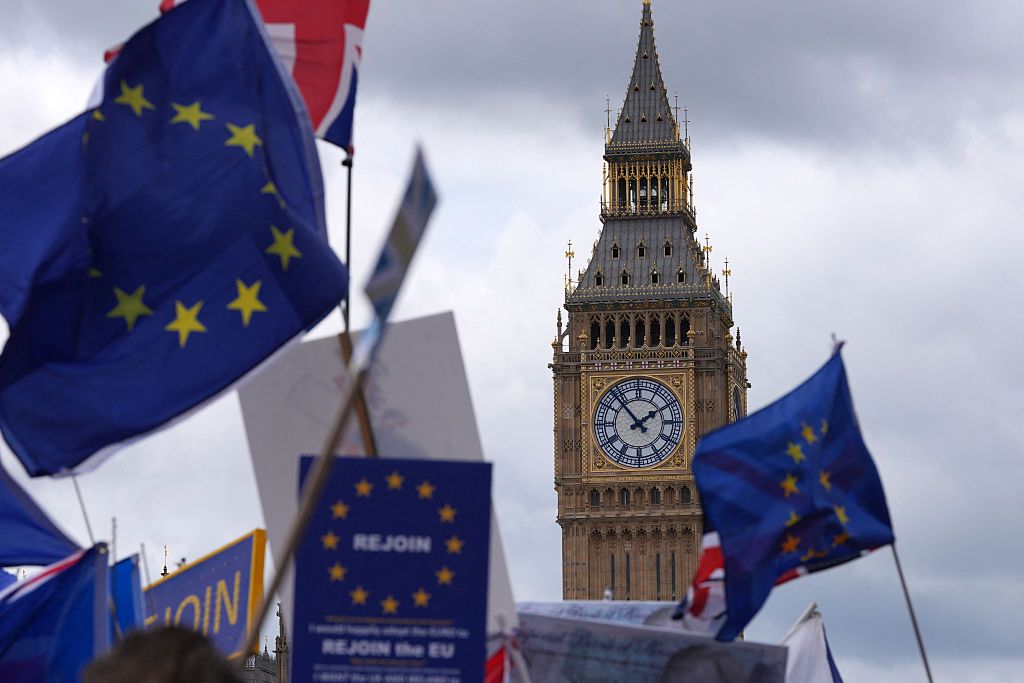
Brexiteers behind Vote Leave’s victory in the 2016 referendum launched a new campaign group to keep the UK out of the European Union – by hitting Andy Burnham with the claim that going back in would cost Britain £750 million a week.
Vote Leave’s internal mantra was always ‘double down’ when under pressure, so rather than resile from the notorious (but perfectly defendable) claim on the side of the famous red campaign bus, that EU membership in 2016 cost £350 million a week, they have come out firing, with calculations that changes to the EU would be more than double.
The £750 million a week figure is based on expected gross budget contributions to Brussels of £39 billion a year, up from £19.1 billion in 2016
Stay Out, the new campaign group, will be run by Oliver Lewis, who was head of research for Vote Leave (and came up with the £350 million gross figure for UK contributions in 2016). He was then David Frost’s deputy during Boris Johnson’s negotiations of the final deal in 2019, and then a key adviser to Rishi Sunak when he tweaked the arrangements for Northern Ireland at the start of 2023. ‘Sonic’, as he is known, is a very smart guy and devised some clever compromise arrangements.
Dominic Cummings is not part of Stay Out, but he and other key figures from Vote Leave have been consulted by those behind the launch and he regards it as ‘a good idea’. The group already has five or six donors. The launch video features a voiceover by Cleo Watson, who worked closely with Cummings in Vote Leave and was deputy chief of staff in Johnson’s Downing Street. The comms operation is also likely to be run by a leading Vote Leave alumnus. The slogan for the start-up is ‘Stay Out: our money, our priorities’.
The £750 million a week figure is based on expected gross budget contributions to Brussels of £39 billion a year, up from £19.1 billion in 2016. The bill is higher for three key reasons:
● The EU’s budget is set to almost double to €2 trillion, with the Commission forecasting that it will need 1.26 per cent of members’ gross national income in 2028, against about 0.9 per cent in 2019.
● The cost of servicing the EU’s pandemic borrowing is set to double, rising from €9.9 billion in 2027 to €24 billion in 2028.
● The rebate Britain negotiated by Margaret Thatcher in 1985 would not return. Michel Barnier, the EU’s former chief negotiator, has said a new UK rebate would be ‘off the table’.
The Commission has also proposed six new charges on member states, covering emissions trading, carbon-intensive imports, electrical waste, tobacco and large companies. If these are not agreed and the current rules remain, the UK’s bill would rise to about £803 million a week, because more of the budget would be raised in proportion to national income.
The launch of Stay Out has been timed to pre-empt a speech on foreign policy by Andy Burnham on Monday and his trip to a UK-EU summit in Brussels next Friday, where details of some of Labour’s current renegotiation will be finalised and a road map for future talks outlined in public for the first time. It is also a response to criticism that there has not been much organised pushback against Burnham’s positioning from the opposition parties.
It is also significant in that it gives the Vote Leave crew first mover advantage over whatever Nigel Farage is planning to do. In 2015, Vote Leave was caught flat-footed when Farage launched a rival organisation, Leave.EU, before what would become the official No campaign had got off the ground.
The launch video hammers the £750 million cost but also features a warning about uncontrolled immigration from countries, including Albania, which are in a queue to join the EU – a clear echo of Vote Leave’s warnings about Turks coming to Britain in 2016. It includes footage of the Czech President saying he wanted Britain to rejoin because ‘we need more money’. The video repeats the theme, aired by David Cameron last week, that Britain doesn’t need another decade of bitter turmoil, by clipping various bitter exchanges from the Commons. And it also contrasts Burnham’s pledge not to reopen the debate with him then reneging on that promise. It concludes: ‘Let’s focus on our priorities, cutting bills, easing the cost of living and stopping the boats. Stay out. Our money. Our priorities.’
Lewis says: ‘The EU that Britain would be rejoining is more indebted, divided and expensive than the one we left, and on the Commission’s own numbers it would cost us £750 million a week, with no rebate. The bloc is also getting bigger, with Albania, Moldova and the western Balkans all in the queue to join, and Brussels wants Britain back in as one of the few countries rich enough to pay for it.’
Michael Gove, the Vote Leave stalwart and Spectator Editor, adds: ‘Rejoining would mean handing back control of our laws, borders, money and trade, and paying a good deal more for membership than we did before. Families worried about their mortgages, energy bills and the weekly shop want a government that spends its time and their money on easing the cost of living. Sending £750 million a week to Brussels would do nothing to help with any of this. Reopening this question would just commit the country to another decade of fractious negotiations and a return to the divisions we have spent years putting behind us, at the very moment people are desperate for Westminster to get on with delivering on their priorities.’
One of those involved in the campaign says, ‘We’re going to shit [Burnham] up a bit. It will be quite punchy. I don’t think he’ll have answers to the questions he is asked.’
Andy Burnham’s decision to reopen the issue of Brexit was always likely to mean opening Pandora’s Box and the demons unleashed in 2016 have now flown out. I’m not alone in thinking the Prime Minister may have bitten off more than he can chew and that the ‘new politics’ consensus seeking vibes he likes to give off will be in trouble against some of the best campaigners I’ve ever met in politics.
Those of us who spent a decade buried deep in the debates and psychodrama of the Brexit wars know that Burnham was absent without a trace and rather wondered what on earth he was playing at, beyond trying to win back voters from the left with some pro-EU vibes.
My view, and that of the Brexiteer campaigners, is that when Burnham is exposed to a) the difficulty of the negotiations and b) the immense power the money and immigration arguments have on British voters, the whole enterprise will start to look a lot less attractive to the PM. The polls suggest voters think it was a mistake to leave and, in principle, would like to rejoin. But most pollsters think the numbers are very soft indeed and when informed what this would mean, support will collapse like a cheap deck chair.
One of those involved in the campaign says: ‘Mr Burnham rather sat out the Brexit wars, sitting around in Manchester thinking about buses. It may be working for him to consolidate the left bloc but when push comes to shove it will get a lot more complicated. The point is to make him think this isn’t a very good idea. We’re going to shit him up a bit. It will be quite punchy. I don’t think he’ll have answers to the questions he is asked.’
It feels like the political equivalent of the moment in a test match where the batsman who has been happily playing the spinners around the ground has to face the return of the opening fast bowler, who is well rested and is keen to supply some chin music. Game on.



Comments