
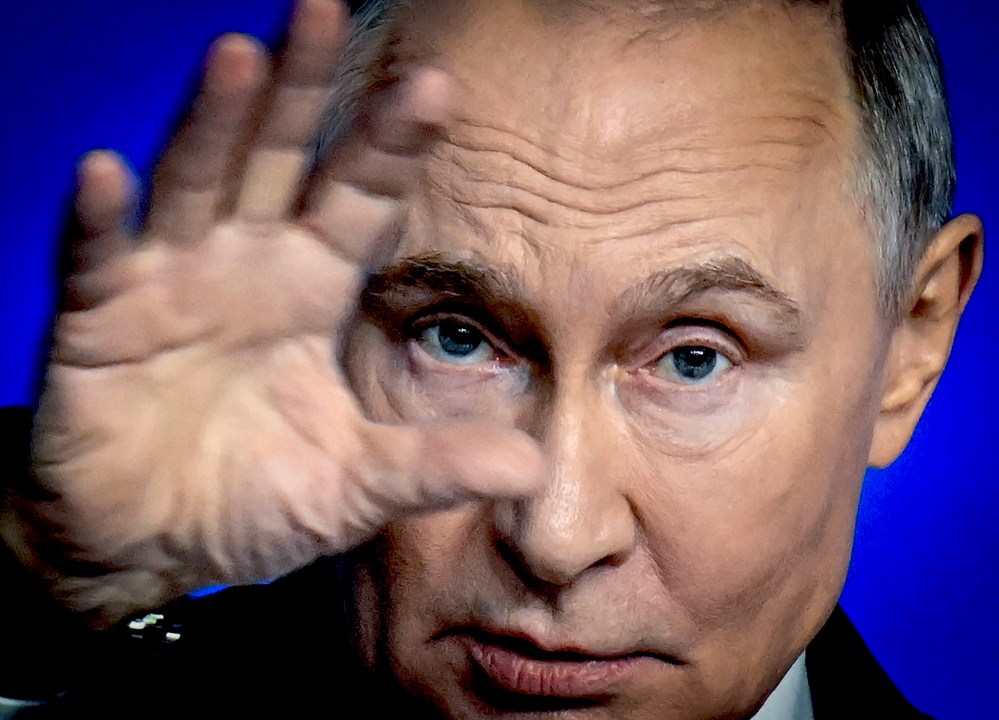
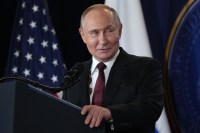
As the Russian-Ukrainian full-scale war nears its fourth anniversary, Vladimir Putin looks confident, even cocky. It is not that he has achieved great breakthroughs on the battlefield. The Russians have managed, haltingly, to occupy a little more of Donbas, but one would have to zoom in on the map to see these gains, which amount perhaps to 1 per cent of the (now hopelessly ruined) Ukrainian territory – paid for with hundreds of thousands of lives of Russian soldiers.
True, these things are never linear, and no one could rule out that this war of attrition will still lead to Ukraine’s military defeat. Putin probably feels that the goal is within his reach, or, if he doesn’t, he would like us to think that he does because such perceptions – i.e. the idea that ‘time is on Russia’s side’ – feed into defeatist attitudes in Ukraine and, broadly, in the West.

But that’s not the only reason for Putin’s swagger. This year marked a remarkable turn in Russia’s global fortunes. The biggest political gain was the arrival of Donald J. Trump in the White House. It was not obvious that Trump would necessarily deliver for Russia. His first administration was less of a godsend in this regard than the Kremlin may have hoped. Trump’s admiration for Putin’s methods did not prevent his administration from targeting Russia’s economic interests (for example, sanctioning the Nord Stream 2 pipeline) or providing lethal aid to Ukraine.
This time, too, apprehensions about Trump’s possible concessions to the Russians went hand-in-hand for many observers with a more optimistic view that maybe, just maybe, he would not do that. Surely, the American President did not want to go down in history as the man who brought an aggressive Russia in from exile and gave away Ukraine’s sovereignty. Trump’s occasional outbursts directed at Putin have fed the hope that he would find his footing and let the Russians have it.
Yet the record of the last few months suggests that the pessimists were probably right. Driven by an evidently obsessive interest in bringing ‘Biden’s war in Ukraine’ to an end, and advised by a negotiating team that at times appears lamentably under-resourced and possibly riven by internal tensions, President Trump has upped the pressure on Kyiv to give in to the Russians on some of their key demands.
The peace talks, conducted under US auspices, have not yet produced meaningful results, mainly because Putin has refused to back down from any of his maximalist political and military demands, which would leave Ukraine territorially truncated, without any viable security guarantees or, indeed, an ability to defend itself. The Russian leader is clearly not averse to a negotiated outcome, as long as the other side makes all the concessions. Conscious of Trump’s evident desperation for something that could be presented to the world as an American-brokered peace, Putin can afford to wait for the ripened fruit to fall into his lap.
For Putin, however, Ukraine has always been just a means to an end. True, he is interested in imposing his control on what he regards as properly a part of the broader Russian imperial space. But he has also tried to use the war as a wedge for sowing divisions within Europe and undermining the transatlantic alliance. Some of these efforts could yet pay off.
For example, Russia’s hybrid war against Europe, which includes flying drones and aircraft into the European airspace, and Putin’s saber-rattling (when he promises the Europeans a big war if the Continent does not back down), have fueled apprehensions among some EU member states.
Notably, Hungarian Prime Minister leader Viktor Orban has gone out of his way to emphasise his country’s disagreement with the EU’s general line on Russia, which, he says, risks dragging the bloc into a direct conflict with its neighbour. Budapest has done more than most in the EU to obstruct collective decisions on sanctions-related issues.
Orban’s proclivities in this regard have long been known, but it was more surprising to see Belgium so intimidated by Russia’s threats to retaliate against the confiscation of the Kremlin’s frozen assets. It has repeatedly frustrated the EU’s efforts give the money to Ukraine.
Putin cannot say that it’s all been going well for him in Europe, because Brussels has in fact maintained, and even strengthened, a robust sanctions regime. (There have been 19 sanctions packages so far.) It is also evident that at least some in Europe are committed to keeping Ukraine in the fight by providing direct financial assistance and paying for its weapons. The Russians have railed against these European ‘warmongers’, cunningly claiming that they were undermining President Trump’s well-meaning peace initiatives.
The transatlantic rift has widened significantly since Trump’s arrival on the scene, not so much because of Russia as due to the twists and turns of US political discourse. The new National Security Strategy, which practically identified the EU as America’s enemy (while rightly or wrongly downplaying the Russian threat) has become the most recent episode of the ongoing American culture war, of which Europe is now a key theatre.
Putin can stand aside and watch the slowly unfolding trainwreck of the transatlantic relationship
The Russians have pragmatically concurred themselves with Washington’s alarmist rhetoric about Europe’s civilizational decline and the criticism of European migration and regulatory policies. This bizarre Russian-American alignment of values is perhaps the biggest shock of 2025.
But, for Putin, the ideological alignment is but a part of a broader strategy aimed at finally shaking Nato loose. Putting an end to the US presence in Europe has always been a major goal of the Kremlin’s foreign policy. Now that the United States itself is turning inward and asking the Europeans to do more for its own defence (possibly even assuming full responsibility for Nato’s conventional posture as early as 2027), the Russians appear closer to this goal than at any time since Nato’s creation in 1949.
There is an old adage, attributed to Napoleon Bonaparte, about the importance of never interrupting an enemy when he is making a mistake. Putin can stand aside and watch the slowly unfolding trainwreck of the transatlantic relationship. He can even cheer for Trump.
‘Is Putin just lucky?’ I recently asked a Russian academic involved in track 2.0 dialogue with the US. ‘Ha. It’s called strategy,’ he smugly replied. I shook my head. ‘Luck. Nothing but luck.’
Comments