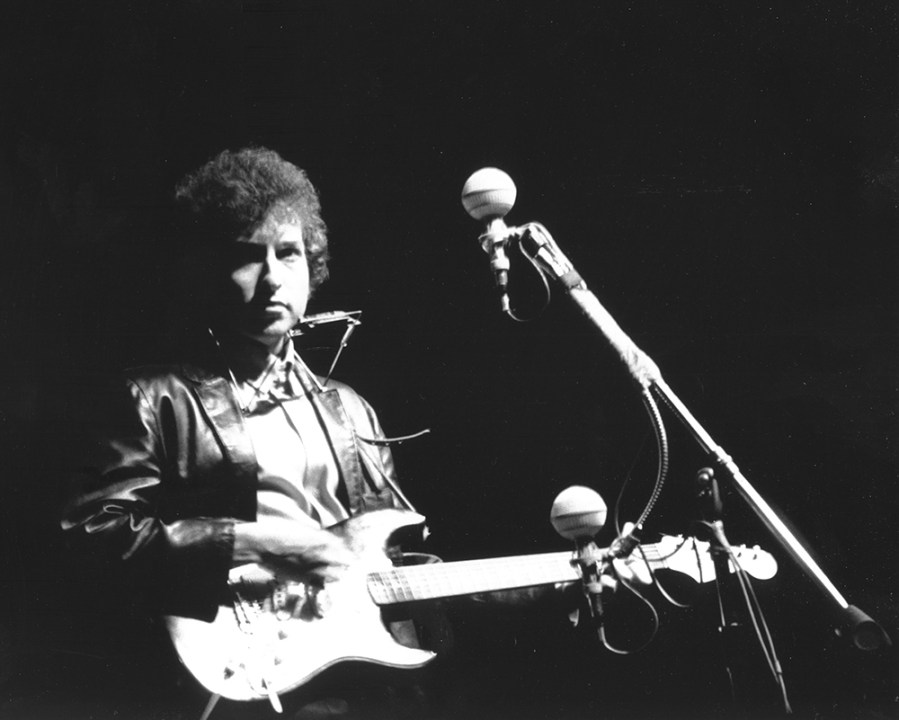
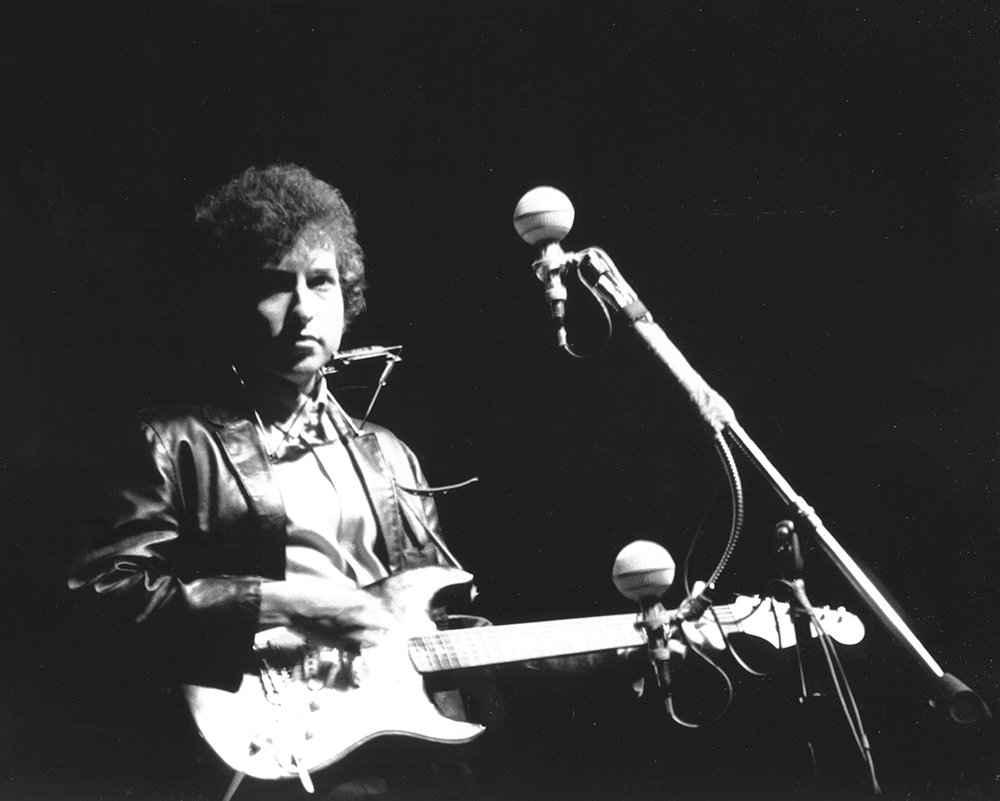
Ron Rosenbaum is a man of galactic learning. Theology, neuroscience, American history, psychology, Shakespeare, cosmology, ‘all of Dickens’, nuclear weapons, quantum theory, iron ore – nothing escapes his hungry eye. Except, perhaps, Bob Dylan. Which is unfortunate, given that he’s written a book about him.
What is it about Dylan that sends writers mad? Christopher Ricks’s usual mellifluousness succumbs to a pun-overdose; Clinton Heylin’s blindingly completist biographies are as impenetrable as their subject; Sean Wilentz lurches from the unlikely to the banal. With Things Have Changed, Ron Rosenbaum, the de facto ‘Dylan correspondent’ for the Village Voice in the early 1970s, proves that even ‘being there’ confers no immunity. As the conductor of the longest interview Dylan has ever granted (1977) – and witness to many seminal Dylan moments, including the debut of ‘Desolation Row’ – Rosenbaum has the chops to deliver a good book. Instead, he writes what feels like one long voice-note after the pub, full of bluster, conspiracy and giddy conjecture.
It is hard to say with any confidence what this book is about. Even Rosenbaum seems unsure. It is a ‘sort-of biography’, a cultural history, a history of culture, a ‘kind of follow-up’ to the recent Dylan biopic, a pitch to revive Dylan’s four-hour film flop Renaldo and Clara; ‘a biography of Dylan’s impact on the consciousness of the culture’; and an opportunity to advertise Rosenbaum’s other works (‘I’ve written a 600-page book on Shakespeare… I think you’re unlikely to find a better brief study’). We might wonder how successfully a book is doing any of these things if, more than 200 pages in, its author is still telling us what he ‘will do’ or what the book, in fact, ‘is about’.
There are some interesting ideas: on the distinction between authenticity and performed sincerity; on ‘the foundational Dylan trope, the “put-on’”; on the grouping of Dylan’s so-called ‘lynching songs’. But they are buried in the landslide.
The prose is stop-start. Jerky. Moves off in random directions like a simile that doesn’t work. The editing is non-existent. Rosenbaum’s broadside against the term ‘Dylan-ologists’ is repeated almost word for word three times in five pages. After the phrase ‘whole other level’ had cropped up ten times, I stopped counting. And there’s so much throat-clearing that you feel the need to hose yourself down after each chapter.
What of the arguments?
Two seem to predominate. The first is that Dylan, born a Jew, is obsessed with the Holocaust. How do we know this? Unhelpfully, the lyrics barely mention it, so instead Rosenbaum hangs his argument on a single quote plucked from Dylan’s aborted, and ‘otherwise gibberish-filled’, fiction Tarantula, written when he was 24: ‘Hitler didn’t change history/ Hitler was history.’
From this thin plank, Rosenbaum attempts to construct a cathedral of meaning. But it’s almost all supposition. Mights, mays and probablys litter the text. After a riff trying to connect the magnetism of the ‘iron ore-filled Mesabi Range’ near where Dylan grew up and Dylan’s going electric, Rosenbaum reflects: ‘Do I know absolutely that Dylan was moved by the northern lights? No, but I’m willing to go out on a limb. And if he wasn’t, he might as well have been.’
Some mysteries, however, are easy to clear up. ‘Things Have Changed’ was not ‘unaccountably left off 1999’s Time Out of Mind album’, because Time out of Mind was released in 1997 and ‘Things Have Changed’ hadn’t been written yet. Changing of the Guards is not a Dylan album from the late 1970s but a song off Street Legal (1978). The list continues. Pedantic? Perhaps. But since we’re asked to go along with Rosenbaum’s airy conjectures, we should at least be confident that he’s on solid ground.
The second argument concerns Dylan’s 1978 conversion to a Bible-thumping brand of Christianity, which saw him release three explicitly religious albums and deliver lengthy sermons to bewildered audiences. Rosenbaum takes Dylan’s conversion personally. He scolds those ‘stupid folkie’ fans who didn’t get Dylan going electric, but Dylan going Christian? Judas! Because the problem with the conversion, Rosenbaum argues, is that it is a ‘cultural crime’: it destroys the art, and destroys Dylan.
This is very harsh on the ‘holy trinity’ of Christian albums. The greatest religious art offers the listener the opportunity to enter into an imaginative community with the believer, to discover how faith might feel, and allows us to sympathise with intuitions that may not be our own but which have shaped mankind for millennia. It is, in short, a gift – one Dylan extends to us.
And to those who can only hear terrifying betrayal in this period, listen again to those early folk songs with their biblical morality, or the mid-1960s work that spins God round in the cultural kaleidoscope as well as man. Indeed, it is Dylan’s ability to wed the modern to the sacred order and simultaneously subvert it that gives his art such sustained resonance across the decades. It is startlingly new and yet we have been here before.
Despite his vast curiosity about other subjects, Rosenbaum is unwilling to countenance this. He is right that ‘things have changed’ – something older, however, remains.


Comments