

The moment many European leaders had been awaiting with nervous anticipation arrived yesterday evening when the American Under-Secretary of War, Elbridge Colby, announced that the US would, at long last, be undertaking a review of its military presence on the continent as part of its commitment to Nato. Colby said: ‘This will be a real review, designed to ensure that Nato is moving fast and irreversibly toward Europe taking primary responsibility for its conventional defence.’
The US Department of War has been threatening to launch this review for much of this year so far. Secretary of War Pete Hegseth used a meeting of Nato defence ministers in June to confirm that the review would be going ahead imminently. He accused America’s allies of believing that ‘the era of free-riding’ still existed, adding that ‘it’s a review that some countries will fail and others will pass with flying colours.’ If that sounds like a threat, that is because it was: ‘Where other allies do not spend with urgency, our dues contributions will go down. Nato will be a two-way street.’
The past six months have seen a great breakdown in trust between America and its European allies
The Trump administration claims that this review is ultimately being conducted with the best interests of its European Nato allies at heart – although with a healthy dose of ‘America First’ thrown into the mix. Hegseth has spoken more than once about wanting the continent to stand on its own two feet when it comes to defence and not turn ‘Uncle Sam into Uncle Sucker’. Trump, meanwhile, has long complained about what he perceives as Europe’s freeloading, allowing America to shoulder the greatest financial burden for defending the continent.
In his announcement yesterday, Colby stated that the review ‘will further the goal of fully restoring Nato’s character as a powerful warfighting organization – a Nato 3.0.’ In June, Hegseth stated that ‘Nato 3.0’ would be modelled on ‘the Nato 1.0 that won the Cold War, with our allies actually taking the lead in Europe’s conventional defence’.
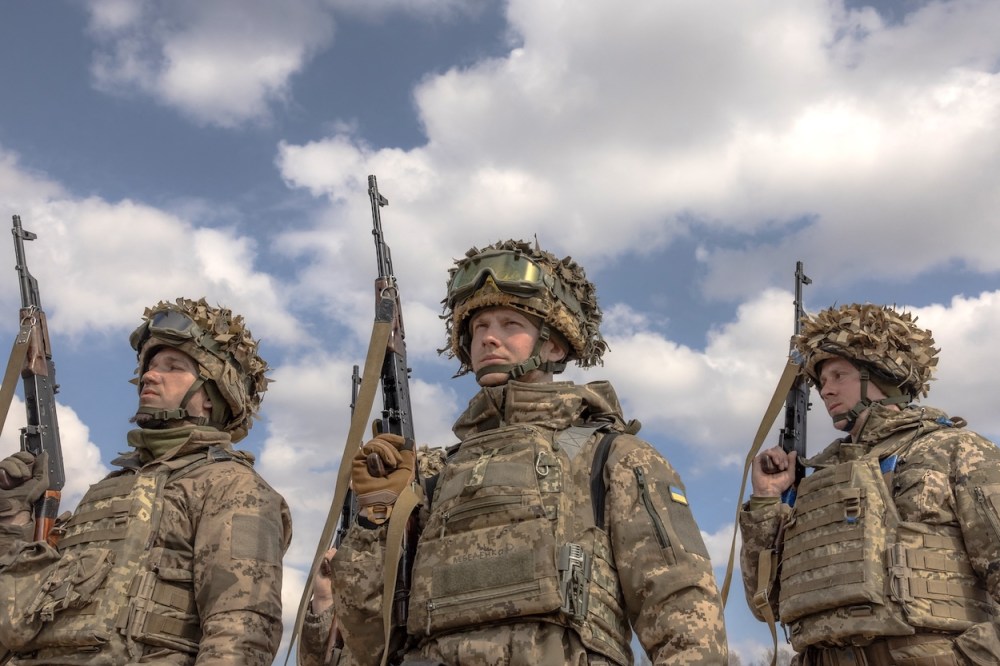
The warning signs that this review was coming down the track have been there for some time. Last autumn, the White House published its National Security Strategy, which outlined Trump’s ambition for Europe to take ‘primary responsibility for its own defence’. Earlier this year also came the National Defence Strategy, In which Hegseth declared that ‘allies will take the lead against threats that are less severe for us but more so for them, with critical but more limited support from the United States’. Colby confirmed yesterday that the review’s conclusion will ‘reflect’ the posture of both documents.
But even before Trump re-entered the White House last January, European diplomats were discussing, behind closed doors, the likelihood of the incoming president withdrawing American troops from the continent or pulling the country out of the Nato alliance entirely. No one in Europe can, therefore, claim to be surprised by Colby’s announcement.
They do, however, have the right to be nervous. Neither Hegseth nor Colby have – publicly at least – elaborated on the parameters of the review or what exactly they expect from ‘Nato 3.0’ in detail. Hegseth stated in June that the review is expected to take up to six months, which means that Europe will ring in the new year with its publication hanging over their heads.
But the past six months in particular have also seen a great breakdown in trust between America and its European allies. Two notable flashpoints have been Trump’s vocal desire to acquire Greenland – whether through buying it or taking it by force – from Denmark on ‘security’ grounds and the reluctance of many Nato allies to fall in behind the American president when he went to war against Iran at the end of February. Trump clearly still feels aggrieved on both fronts, using the Nato summit in Ankara earlier this month to complain at length about these perceived slights to his authority.
Withdrawal of American troops from Europe has already tacitly begun. Troop rotations through Poland, Romania and the Baltics were cancelled last autumn. Earlier this year, it was confirmed that 5,000 soldiers would also be withdrawn from Germany. This leaves an estimated 75,000 American troops stationed across Europe.
Whatever the outcome of Hegseth’s review, it is clear that under Nato 3.0, Europe will be required to shoulder much more of the responsibility for its own defence and security than previously. It is already clear that America’s step backwards from Europe will leave the continent facing potentially considerable gaps in all three prongs of its defence capabilities: personnel, funding and industrial production. European leaders will need to find ways to increase the sizes of their armies, build up ammunition and defensive stockpiles and hammer out conflict-preparation logistics.
For Europe’s leaders, who Trump will reward and punish at the end of this review will remain a source of anxiety. Could the President, for example, use it as a means of exerting pressure on Denmark and its allies to give up Greenland?
For Britain’s new prime minister, Andy Burnham, this presents an added level of challenge to the already difficult task of forging a productive working relationship with the American president. To what extent will Burnham allow Britain to be drawn into helping the US in Iran? In his first week in office, the new prime minister allowed America to use British bases to bomb the country. Will this continue? In the slightly longer term, but no more urgently, having installed former defence secretary John Healey in the Treasury, when and how will Burnham commit to increasing the country’s defence spending?
As America’s review proves, how the Prime Minister tackles these questions won’t just affect Britain – they will have ramifications for our European allies too.






Comments