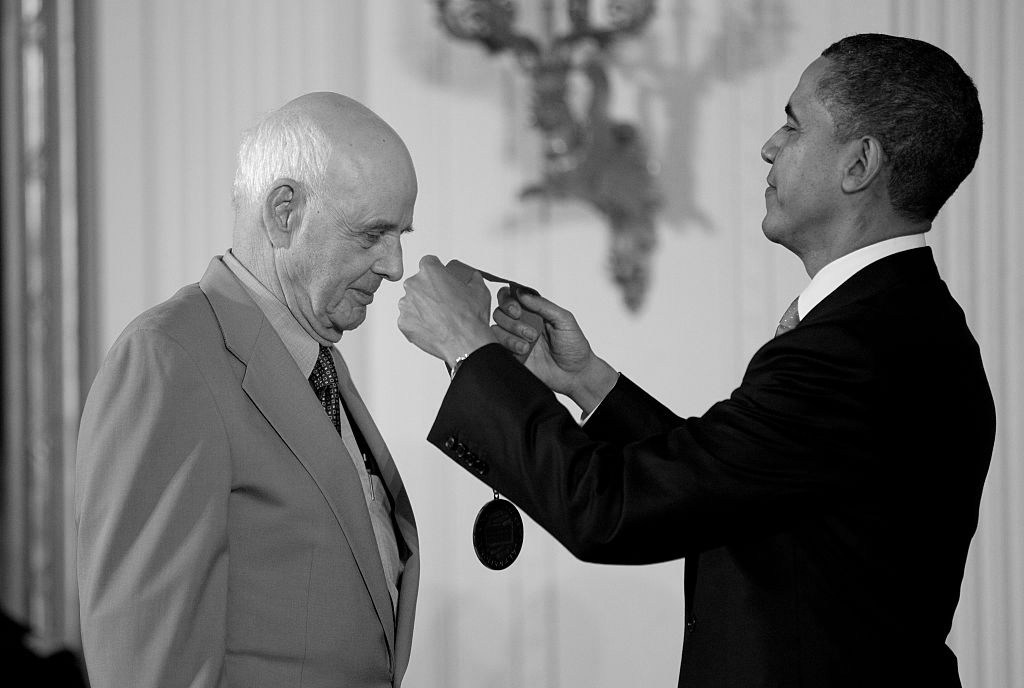
Like most adults who write their thoughts down regularly, I was raised in a home by a mother who maintained piles of books strewn around the house. There were more books than anyone in our home could read combined, but you could find our favorites open on tabletops and dressers with a pencil, or another book, pinned in them to hold a page. Most of these books that were propped open were my mother’s and they included dozens of Wendell Berry’s works.
I slowly absorbed a version of Berry’s way of thinking: through reading, through my mom’s infatuation with his work, through osmosis as I watched Cartoon Network next to open copies of Hannah Coulter and What are People For?
Berry, native to Kentucky, returned to his home of Port Royal in his early thirties with his wife and children, to start a life away from NYU, where he had worked as an English professor. His new, old time in Kentucky reflected the topsoil for which he aggressively advocated: it appeared simple, quiet, and unimportant. But his life and work were not simple at all: together they were the product of dozens of small and essential pieces that gave vitality to so much of what grew around Berry, and to his readers who tried to live the kind of life he advocated. Berry wrote poetry, incisive essays on politics and big agriculture, and created characters in his novels that he’d be accused of fashioning out of his Port Royal neighbors. He did all this while running a farm. Not the kind of farm you’ll see on Instagram, or parodied in a Caro Claire Burke novel,but a real farm, with real work and real animals that made real food for real people. On top of all this, he always remained the kind of character you’ll find teaching at NYU.
In spite of his complicated nature, Berry has begun to suffer the same literary fate as C.S. Lewis: his works are strip-mined for pretty quotes that we can all aspire to and that are attached to picturesque images of the seaside, farms, or sunsets, often misattributed, often misapplied and posted online. His poem, circularly called “How to Be a Poet,” is frequently scrapped for parts, like this one:
There are no unsacred places;
there are only sacred places
and desecrated places.
It’s the perfect trick shot for an algorithm: it’s comforting to someone who lives a hard life on the land in Alberta, but it’s also comforting to read on the train to Montauk and maybe more comforting on the way back to Williamsburg after a long weekend at the beach. It’s comforting in San Francisco as you watch fog roll over the bay, and it’s true when you’re cleaning a suspicious substance off your shoe after walking through Union Square. It’s a tricky quote because, no matter how simple the form it takes, it remains completely true. This can be done to most of Wendell Berry’s writing.
Berry sensed the misuse of his work in advance: “If anything I have written in this place can be taken to countenance the misuse of it… my writing would have been better unwritten. And then to hell with any value anybody may find in it ‘as literature.’”
Berry’s work is most often used to assuage and to comfort. Its bluntest reading says that he was a nice old man who loved animals and Kentucky, imploring us all to move somewhere rural, lay down roots and make it better. I was briefly a victim of this blunt read. Two and a half years ago I chose to move somewhere rural to try to make it good, without any regard for what making a place good meant. During my time in the place I chose, I spent 12 weekends in Philadelphia, eight in Charleston, six in various Californian cities, six in Washington and New York, three in Raleigh, three in Boston, two in Vermont, four in Edinburgh and London, and ten more one-offs. I could feel Berry’s legacy sitting in judgment when I told people that I still enjoyed living there.
When writers are prolific, they become difficult to synthesize. Didion’s chilling reports of Salvadoran death squads are washed away in a deluge of Pinterest mood boards that read, “we tell ourselves stories in order to live.” Tolkien’s long hard look at the ills of industrialization is outrun by cars with bumper stickers that say, “Not all who wander are lost.” As Wendell Berry the man becomes Wendell Berry the idea, the temptation will be strong to lose him behind a quote like, “What I stand for is what I stand on” or “If you don’t know where you’re from, you’ll have a hard time saying where you’re going.”
Now that we know that the last of Berry’s essays have been written, his life’s work can only be understood by trying swallow all of it, piece by piece: his hot rage against mining companies leveling mountains in Appalachia, his watchfulness of demagoguery, his hatred of war, his wrestling with his family’s slaveholding past, the fact that he fled New York for Middle America, but also that he moved to New York at all; his charity towards the uncharitable, the way he could say “piss” and “damn” without indulging any temper, his instructions for keeping streams and rivers clean, his self-consciousness, and, most interestingly of all, his ability to ignore himself when the self stopped being any good.
As Berry’s legacy is invariably reduced to an aphorism, I hope that at least it is this one: “Hovering over nearly everything I have written is the question of how a human economy might be conducted with reverence, and therefore with due respect and kindness toward everything involved. This, if it ever happens, will be the maturation of American culture.”






Comments