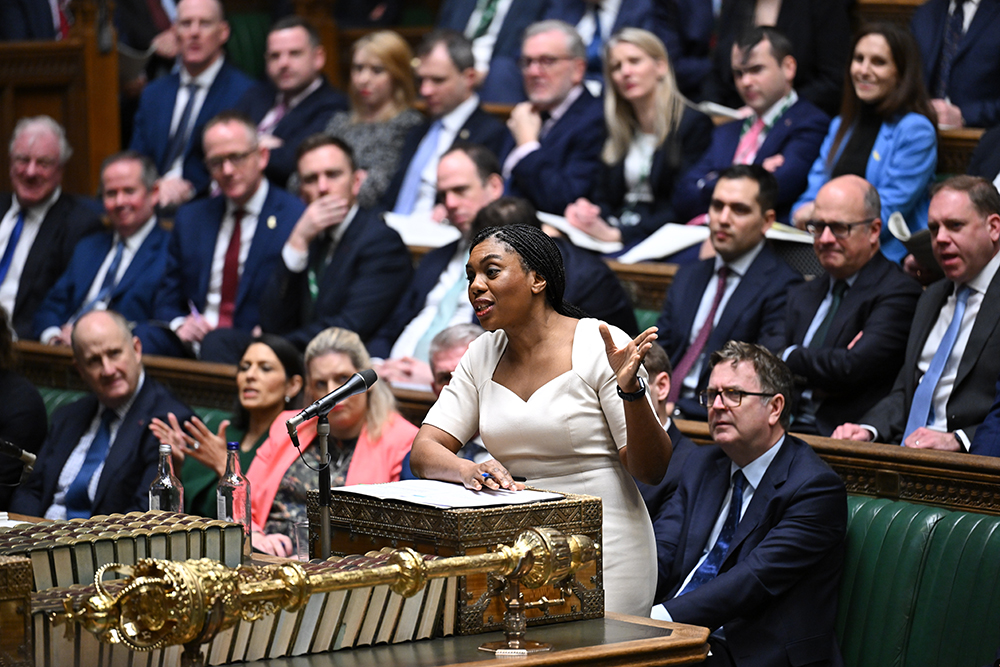


What does a dying government sound like? At 12.08 p.m. on 4 February we got an answer. Keir Starmer admitted to the House of Commons that he knew about Peter Mandelson’s relationship with Jeffrey Epstein when he made him ambassador to the US in 2024. There was a sharp intake of breath from the shocked Labour benches. It was the kind of moment that defines a premiership. And it was also testament to an effective Leader of the Opposition.
In the drama of Mandelson’s disgrace, the Conservative party played its part well. After besting Starmer at Prime Minister’s Questions, Kemi Badenoch turned to coaching the Labour backbenches. She had put down a humble address, urging all correspondence be released between ministers and Mandelson. Would they back her or not? Labour MP after MP stood up to demand their own side do so and the government eventually caved. ‘Total victory,’ texted one Tory afterwards.

Like most political successes, it was a long time in the making. The Tories began planning to force the release of the so-called ‘Mandelson files’ back in September, when the peer was sacked from his job in Washington. After the most recent Epstein emails were released, two days of discussion began on the crafting of the address, led by Katharine Howell, the in-house legislative expert. The Tories cancelled a second motion to enable seven hours of discussion, allowing anger in the Labour party to build.
The whole episode was rich in irony for senior Tories. One noted briefings that suggested Morgan McSweeney no longer bothered watching PMQs, such was Badenoch’s irrelevance: ‘That was obviously pride before a fall.’ Another remembered the Brexit years, when humble addresses were first weaponised by a hitherto-little-known politician called Keir Starmer: ‘They found this ingenious device and now it’s being used against them.’ Having deployed such a weapon in opposition, Labour ministers seemed oblivious to its potential consequences in government.
The handling of the Mandelson affair offers a microcosm for Badenoch’s pitch to the country: expertise, patience and a coherent strategy vs the mistakes, mismanagement and hubris of Labour. But in a crowded political environment, the challenge for the Tories is how best to stand out and make some noise. Parliament offers the most favourable terrain, playing to the party’s strengths and institutional knowledge.
Badenoch’s team is stuffed full of veterans, keen to learn from the lessons of 2010 to 2024. The likes of Alex Burghart, Neil O’Brien and Rebecca Harris all bear the battle scars of those years. ‘There are a lot of people who were middle-ranking in the last administration who learned about how government works and how it doesn’t work,’ reflects one former minister. Another puts it more pithily: ‘We know where the bodies are buried.’
There are new parliamentary operators too. Among the 2024 intake, Rebecca Paul impressed in the assisted dying debates, while Nick Timothy and Katie Lam, among others, have relished their chance to get their hands on the despatch box. It is a stark contrast to the Labour benches, where new MPs complain of being treated like fodder and feel bitter about being told not to put down any amendments on legislation.
Badenoch’s team is stuffed full of veterans, keen to learn from the lessons of 2010 to 2024
There are more opportunities for Tory mischief in the coming weeks, as the end of the parliamentary session means it will be a crunch time for key bills too. ‘Deferred decisions have to be answered or the legislation gets lost,’ notes one Tory. ‘Ping pong and report stages suddenly loom large.’
Badenoch has also sought to impress in parliament more widely. She has attempted to unite the party’s factions. ‘The left has strongly leant into Badenoch’s new authentic direction,’ says one MP who did not vote for her. ‘Meanwhile, the right has dropped shitty and disruptive factionalism.’ The recent vote to elect Baroness Pidding as chair of the Association of Conservative Peers, rather than former cabinet minister Lord McLoughlin, is read in some quarters as a sign of impatience for change.
Badenoch’s position as leader is now seen as secure. When Bob Blackman took over the 1922 Committee of Tory backbenchers in 2024, he found a key in his office but no safe – the traditional repository for letters of no confidence. ‘We haven’t established a need for a safe yet,’ jokes one senior Tory.
The challenge for the party is to ensure that its good work in parliament is rewarded at the polls. Allies argue that this is beginning to be reflected in Badenoch’s favourability ratings. ‘The more people see of her, they like her,’ says one. Polling by More in Common suggests she is now the most popular choice for prime minister when pitted head-to-head against other party leaders, including Nigel Farage.
In previous parliaments, the collapse of a Labour government would have seen a corresponding rise in Tory support. But, with Reform UK, the Conservatives are facing a foe they have not previously encountered. Their turf is the online and media sphere: their divisions are outside parliament, rather than inside. Tory strategists suggest that Reform is more interested in damaging the Conservatives’ electoral chances than Labour’s, taking fire at the party when Starmer is at his weakest. The defection of Danny Kruger in September, at a time when Mandelson was on the ropes, is cited as one such example.
In the coming months, this battle on the right will only intensify. Reform wants to surpass the Tories on each of their metrics of success. Donations is one, after a particularly impressive last quarter. Defections is another: conversations with at least three Tory MPs are believed to be happening. Badenoch’s task is to withstand the next four months and hope that time and events prove her right.
The day after Badenoch’s evisceration of Starmer at PMQs, a group of senior Tories met for breakfast. One drew the parallel with the Westland affair. Forty years ago last month, Margaret Thatcher was on the ropes but Neil Kinnock, by grandstanding, let her get away. Badenoch made no such mistake last week: a sign, her supporters believe, that she is learning what it takes to get to No. 10.
Listen to the latest of James Heale on Coffee House Shots:






Comments