Washington’s UFO speculation: sci-fi movie or cold war thriller?
Mysterious airborne objects are downed by US jets off the Alaskan coast, over the Yukon and over Lake Huron in Michigan. The NORAD commander is asked if aliens could be involved and replies: “I haven’t ruled anything out.”
Washington began this week trying to figure out if it was living through the opening scenes of a sci-fi movie, the first chapter of a Cold War thriller, or something more banal.
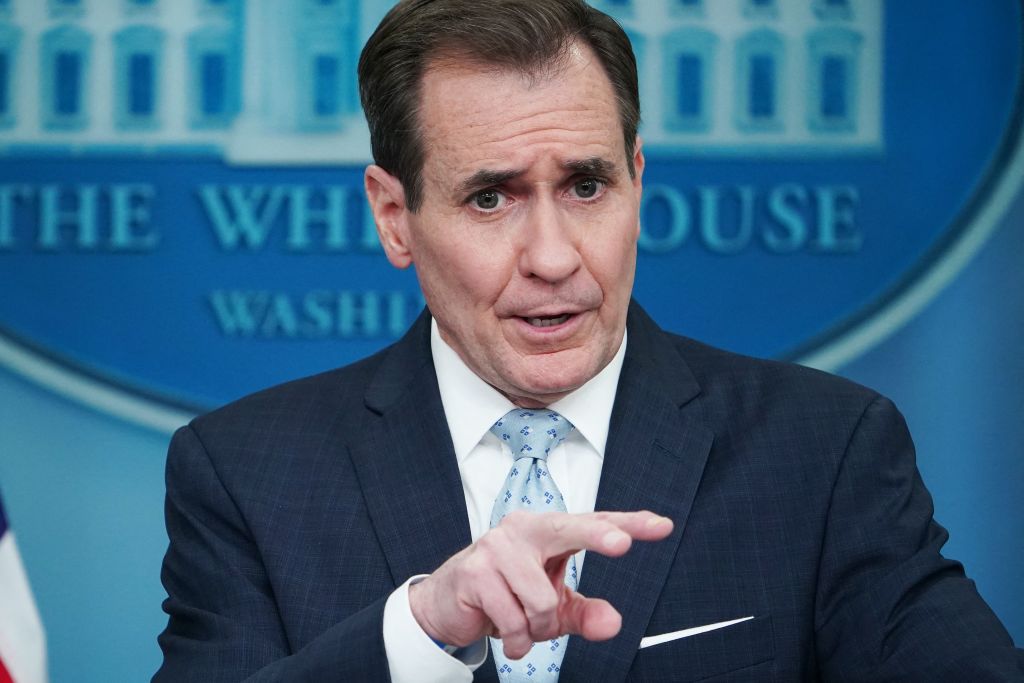
A great deal of speculation filled into the information vacuum that followed the weekend’s news that the US military had shot down three unidentified flying objects. The president has been mum on the incidents in recent days. White House national security spokesman John Kirby added a bit more detail this afternoon, but the picture remains hazy. He said that the three objects shot down this weekend flew lower than the spy balloon that was downed shortly before the State of the Union and that they were not sending out communications signals, did not have people inside and could not maneuver or propel themselves. The decision to shoot down the objects, Kirby said, was taken because they posed a risk to air traffic.
“I don’t think the American people need to worry about aliens, with respect to these craft. Period.” Kirby added. (I can already hear the cries of UFO-watchers: that’s exactly what he would say if these were sent by aliens!)
The details offered by Kirby, however scant, point towards a popular theory that the objects are sent by a foreign adversary to test America’s surveillance technology, given them information about how quickly the US can identify and respond to an intrusion into its airspace. Meanwhile, China has accused the US of sending intelligence-gathering balloons over its airspace, something Kirby denied this morning.
Whatever the full story of the weekend’s incidents, and the spy balloon shot down the weekend before, it’s clear we are in the middle of a major early flare-up in the new cold war, and one that isn’t especially reassuring for the United States. The historian Niall Ferguson argues that the Chinese spy balloon incident should serve as a warning that America is ill-equipped to handle a major conflict with China. At the very least, with US-China relations getting frostier, the balloon and the subsequent, more mysterious, incursions this weekend are a sign of things to come.
*** Sign up to receive the DC Diary in your inbox here ***
Why DeSantis skepticism is unpersuasive
Is Ron DeSantis the real deal? Speculation about Ron versus Don has been Washington’s favorite parlor game for some time, and DeSantis skepticism falls into two camps: there are those who are bearish on the Florida governor because it’s always a mistake to bet against Donald Trump, and there are those who caution that history is littered with early frontrunners and conservative favorites who fizzled fast. A version of this argument was aired last week by Jonah Goldberg for the Dispatch. Is Ron DeSantis just Scott Walker 2.0, he asked. Today, New York Times polling guru Nate Cohn comes armed with the numbers to delivered a resounding no. The simple fact is that DeSantis is just a lot more popular and well-known than many early favorites in past presidential cycles. “Mr. DeSantis has 32 percent support in polls taken since the midterm elections. This is not a fleeting product of a wave of favorable media coverage. Instead, he has made steady gains in the polls over the last two years,” writes Cohn, who points out that this makes him more like Ronald Reagan and Barack Obama than Scott Walker.
Biden and Powell’s delicate inflation dance
Is the confusing economic outlook putting Joe Biden and Jerome Powell on a collision course? The president and the Fed chair have been striking increasingly different tones in reaction to economic news so far this year. Take the recent, surprisingly robust jobs numbers. Biden popped up behind a podium at the White House to claim “the Biden plan” was working, whereas Powell has since cautioned that more strong numbers might force him to raise rates further. On one thing, though, Powell and Biden are rooting for the same outcome: signs that inflation is on the wane. Consumer Price Index data for January will be published tomorrow morning, and everyone will be rooting for signs that price rises are continuing to cool. However, if the numbers suggest otherwise, expect greater tension between the Fed and the White House.
What you should be reading today
Ashley Rindsberg: Why Russiagate was the media’s Vietnam
Jennifer Sey: I’m pro-science. That’s why I’m anti-mask
Mike Tunison: Don’t make Super Bowl Monday a national holiday
Bianca Vázquez Toness and Sharon Lurye, Associated Press: Thousands of kids are missing from school. Where did they go?
Gideon Rachman, Financial Times: It makes no sense to blame the West for the Ukraine war
David Skinner, Washington Free Beacon: The indispensable humorist
Poll watch
President Biden job approval
Approve: 44.3 percent
Disapprove: 51.5 percent
Net approval: -7.2 (RCP average)
Direction of the country
Right direction: 35 percent
Wrong track: 65 percent (Rasmussen)