Those who like their irony dark may appreciate the grotesque juxtaposition of photographs of our Foreign Secretary, gripping and grimacing – though fortunately not grinning – with, Iran’s foreign minister, Abbas Araghchi at the UN General Assembly last week, and the arrest of five suspected terrorists at RAF Fairford in Gloucestershire.
Britain seems incapable of securing its borders. Perhaps not too surprisingly our internal security is now badly compromised
It is, of course, the lot of Foreign Secretaries to have to “sup with the devil”. And we are told by the BBC that Ed Miliband’s message to Araghchi was that “…the UK (has an) unwavering resolve to combat threats from Iranian-linked groups in UK soil, including attacks on the British Jewish community.” Strong words. But while we still don’t know for sure whether Iran was involved in the thwarted attack on the RAF base that is used by the US military, the Iranian Ambassador Seyed Ali Mousavi warned in February that the use of Fairford for attacks on Iran was “…an important matter for our self-defense”. Iran’s foreign ministry has also said the UK was an “accomplice” in the US war, and the Islamic Revolution Guards Corps (IRGC) vowed that any country which supports the US “will be responsible for the consequences and repercussions”. The Iranian embassy in London has said this afternoon that it “categorically rejects” speculation linking the country to the incident.
But coming on the back on numerous Iranian regime-backed terror plots, including a successful cyber attack on a power station in July, it is a reasonable supposition that Iran, perhaps directly, but more probably through a proxy group, may have some involvement in this plot.
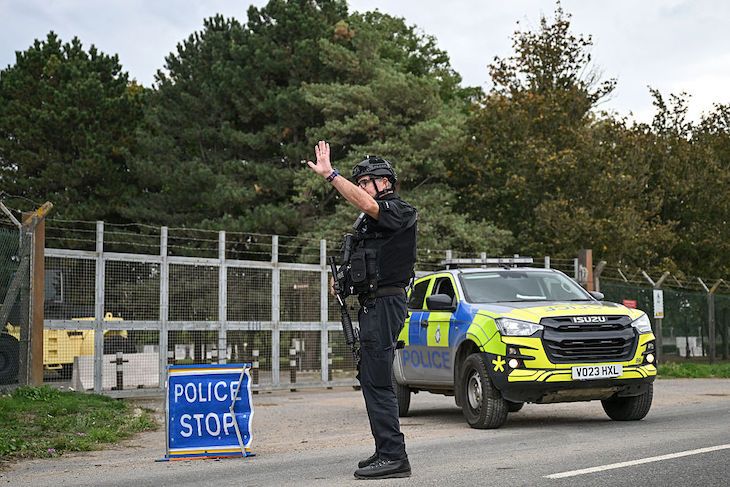
At this stage, not all the details of the attempted attack are clear. It would appear that US and UK authorities were expecting something: locals near to RAF Fairford report that entrances to the airfield had recently been blocked by concrete bollards and heavy machinery, and they had been warned to be extra vigilant.
Once the alert had been successfully raised on Saturday night, the security force reaction was swift and decisive. But the local farmer, who raised the alert on seeing men in black balaclavas and three vans spread-out in a fan shape, blocking a road, said that her first two attempts to raise the alarm, by ringing the MOD Police number that local residents had been given, and then 101, both failed. Ringing 999 worked, but there are questions about how effective security precautions were. The suspected terrorists got to within 300 meters of the base, in a period of heightened alert, without being detected. That does not feel like effective security of a sensitive location; even the most amateur tactician will tell you that to secure a location you need surveillance forward of the perimeter.
That the alleged terrorists did not recognize that physical security of the base had been beefed-up perhaps also points to this being the work of an Iranian-backed proxy group (to the extent that the plot has any links to Iran) rather than the IRGC’s Al Quds force, responsible for the IRGC’s external operations, themselves. The five arrested men are British nationals in their twenties.
Whether or not Iran was involved, a more professionally-trained organization might have recognized the additional security for what it was and perhaps rethought its plans; a disposable, plausibly deniable, group, given only the minimum necessary training would not have seen that the situation had changed and adjusted accordingly. But, in a sense, while on this occasion the attackers failed to achieve their physical aim, the psychological object may still have been achieved; all terror works on the Maoist principle, “Kill one, terrify a hundred”. Even an unsuccessful attack may generate the desired reaction. Social media has, already, many commentators arguing that Britain should not put ourselves in a position whereby we are the proxy targets for a US war; some of those are ‘the usual suspects’ but not all.
How we respond to this thwarted attack is still unclear. Despite the swift response to the emergency call, there are questions about how secure RAF Fairford, and no doubt other US, and indeed UK military bases are: this needs addressing urgently, and we may need to accept that heightened security requires additional surveillance, including intrusive patrolling, close to those locations. That will cost money, but it is the price of a US alliance and the defense of our common values, and so it is one that must be paid.
We should also lose any remaining shreds of doubt that the Iranian regime has any claim to be treated as a normal regime. Even the “Camel Corps”, the Foreign Office’s resident band of so-called Middle East experts, whose proclivity towards appeasement of whatever terror regime or group is making the headlines, apparently gave up on Iran in February this year, after the Iranian Ambassador’s words. This finally broke the dam and, in July this year, the Government announced plans to proscribe state-sponsors of terror, including, finally, the IRGC.
That still leaves numerous proxy groups and “lone wolf” terrorists to be dealt with and we should not be too carping in recognizing the challenge; there are currently, 84, mostly Islamist, proscribed terrorist groups listed by the British Government (excluding another 14 related to Northern Ireland). These groups morph and change with regularity. To give but one example, a group, “Al Ghurabaa”, first proscribed in 2006, has changed names ten times since, and was most recently proscribed as the “The Islamic Thinkers Society” in July. As another indicator of the scale of the problem, there were over 10,000 referrals to the Prevent Program last year, on top of previous referrals. And, if these figures were not terrifying enough, the Iranian regime is suspected of weaponizing illegal immigration to this country, not just for the socially destabilizing effect it is achieving in this country, but very specifically to insert “sleeper” cells for future use.
While details of the attack are still emerging, the overall conclusion should not be a sigh of relief that we got away with a “close shave” – though we did – but we should reflect urgently on how inadequate our security is against bad actors that seek to destabilize our country and our security.
Britain seems incapable of securing its borders. Perhaps not too surprisingly our internal security is now badly compromised. Whether Labour is prepared to meet that challenge, except with rhetoric, is distinctly moot.



Comments