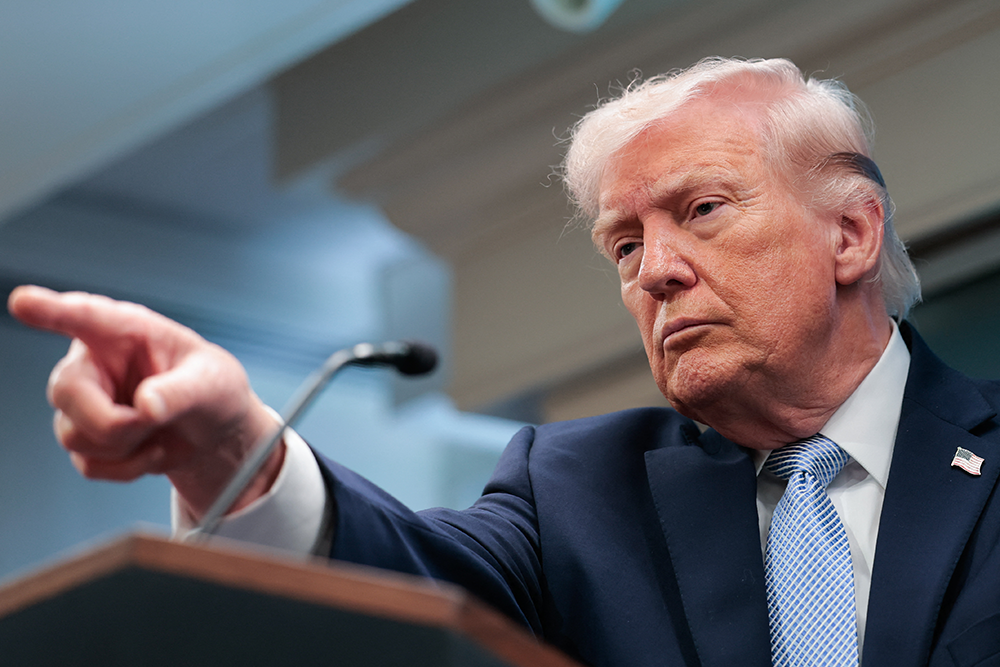
Did Donald Trump ever intend to obliterate Iranian civilisation? Some will see the past week as one in which the world pulled back from the brink, when an unhinged US president experienced a rare moment of lucidity at the last crucial minute.
Trump’s oscillation is, his defenders argue, the ‘madman theory’ in operation. This was the name given to the approach employed by Richard Nixon in Vietnam, when he tried to persuade the North Vietnamese that he had become so unstable he was capable of just about anything – nuclear annihilation included. Nixon believed his foe would have no option but to come to the negotiating table.

Trump has succeeded in convincing many western commentators that he is genuinely on the point of lunacy – heedless of slaughter. Whether he has convinced the ayatollahs is another matter. The essential fault with the madman theory is that it is no match for real madmen: those who really do lack any kind of scruples and for whom mass killing is a vocation. The Iranian regime recently murdered up to 30,000 of its own citizens for the crime of protesting. The ayatollahs really have wiped out a rich civilisation and replaced it with a fundamentalist Islamic state.
The madman theory didn’t – in the end – work for Nixon in Vietnam and now won’t work for Trump in Iran. Trump’s problem is that his unpredictability is becoming all too predictable. Not so much a Genghis Khan capable of anything to achieve victory as a poor man’s Lear threatening the terrors of the earth but incapable of summoning up more than rage. He has fallen into the habit of resorting to idle threats every time he tries to do business with anyone. He did it last year over tariffs; he used the same trick again with his threats to invade Greenland.
In threatening to wipe out Iranian civilisation, Trump has set Iranians against him
When dealing with nations who try to play by the rules Trump can claim success: Europe really has begun to take its own defence far more seriously. Countries which previously levied high tariffs on US goods have been forced into a rethink.
But when you use the same tactic too often it rapidly loses its power. And if your rhetorical shock and awe is never matched with firm actions then people will begin to realise that you never meant it in the first place. That may place a limit on the utility of this tactic economically but it also makes it wildly perilous militarily. Bluffing in auctions against democracies is one thing, brinksmanship in a battle against Islamist fanatics quite another.
Iran’s leaders will surely have only been emboldened by the events of the past week. Next time Trump threatens them they will treat him with contempt. What will he do in two weeks’ time if Iran decides to close the Strait of Hormuz again, now he has used up his rhetorical firepower?
The war against Iran is only worth fighting if it results in regime change. For the first few weeks of the conflict, especially after the assassination of Ayatollah Ali Khamenei, this is what the US and Israel seemed to be focused on. They were unashamedly pursuing a decapitation strategy: eliminating the leaders of the regime and provoking revolution from within.
But now it seems more likely that Iran’s extreme theocracy survives while Trump becomes bored and backs away after declaring some kind of spurious victory. His reputation is built on being a dealmaker but what deal is there to be done with the madmen in Tehran? The reopening of Hormuz can hardly be presented as a great success: the ships were sailing freely before the conflict. Nor will assurances over nuclear weapons count for anything: Iran has made such promises before and failed to live up to them.
To win this war, Trump needs ordinary Iranians on his side. But in threatening to wipe out their civilisation he has set Iranians against him. The opposition wants rid of the country’s leaders, not the eradication of their culture and history. The only thing these threats will achieve is to rally more Iranians behind the current regime.
The conflict is far from over. For the next fortnight, the pause in hostilities may well hold. But what lies at the end of it? More threats from Trump? More deadlines – each of which will be taken less seriously than the last? The US cannot prevail in this war unless it goes back to what seemed to be the original strategy: toppling the ayatollahs for good. That will require hard work and skill, such as the impressive intelligence that led to the eradication of Khamenei.
The US needs precision in its objectives and techniques, not the ranting of a President who has relied upon the madman theory rather too much.



Comments