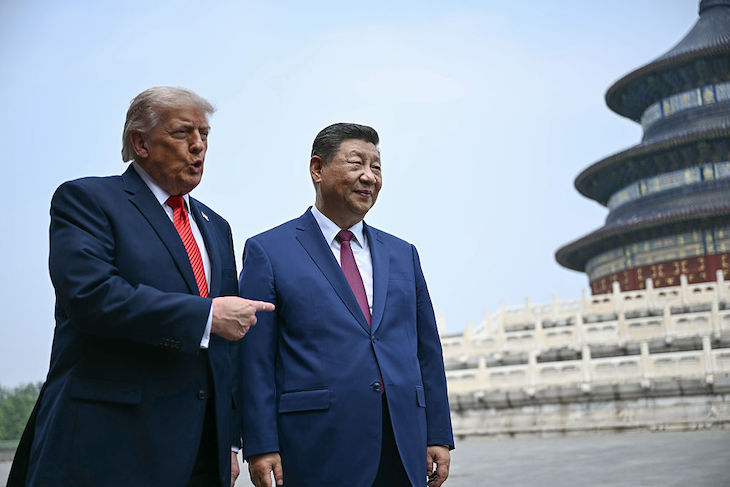
Sir Keir Starmer is not the only world leader fighting for his political future. Although the substance of the Donald Trump-Xi Jinping talks are about tariffs, trade, supply issues (rare earth metals etc), fentanyl, Taiwan, and most importantly Iran, the main purpose of the meeting for both leaders will be their future political survival. This is the essential subtext that you will probably not hear about from the BBC and most legacy media.
Xi needs a successful deal with Trump to show that he is still useful as Secretary General of the CCP
Trump needs to bag wins soon to bring to prevent a Democrat sweep of Congress in November’s midterm elections. Lose both houses of Congress and the US president can be sure that impeachment will follow. As Democrat Illinois representative Delia Ramirez has asserted, the Democratic leadership needs to ‘build up the case [for impeachment] so that when we are in power in January, we’ve created the conditions…we’ve done the factchecking, we’ve done the shadow hearings, everything we need to be able to impeach.’
A beneficial trade deal with China would be a win for Trump, particularly if it was combined with China ceasing to import Iranian oil by train and sending it missiles by return.
Less understood is that Xi needs a successful deal to give him a shot at, not just another five years in office as General Secretary of the CCP (Chinese Communist Party) at the National Congress in 2027, but also a shot at regaining the dictatorial powers that he has lost in the last two years.
To recap in brief the story of Xi’s partial defenestration; at the third plenum in July 2024, Xi, overweight and partial to expensive liquor, particularly the eye-wateringly expensive Kweichow Moutai, was hospitalised with a stroke; his enemies in the Elders, Princelings and Army factions seized power and began the purge of Xi’s placemen in the army; at the fourth plenum in October 2025, Xi was forced to endure a classic Mao Zedong style ‘struggle session’ at which he had to confess his mistakes; after undergoing self-criticism he agreed to accept reduced powers.
An executive group, cumbersomely titled, ‘The Decision and Coordination Committee’, had been set up in June to exert control over Xi and his handpicked Politburo Standing Committee. The key members of this new body were former CCP General Secretary Hu Jintao and former premier Wen Jiabao. To save face, Xi was allowed to remain China’s figurehead.
Xi’s remaining powers were limited to foreign policy, propaganda under Cao Ci, Standing Committee member and de facto chief of staff to Xi. Meanwhile, Wang Xiaohong, Minister of Public Security, remained a key figure in support of Xi in his Beijing kingdom from which he has barely moved since January – with the exception of a recent visit to Shanghai which some have ascribed to his attempt to co-opt the Shanghai faction of former and now deceased paramount leader Jiang Xemin.
In January, Xi tried to break out of his straitjacket by having the vice chairman of the CMC (Central Military Commission) and senior army general, Zhang Youxia, ambushed and disappeared. Although charges were laid against Zhang, including corruption and treasonable leaking of information about China’s nuclear programme, there has been no proof of life since 24 January.
Xi’s decapitation of Zhang was a risky gambit to regain control of the PLA (People’s Liberation Army) and it failed; the elders remained in control of most of the armed forces. With Zhang gone, the role of liaison with the People’s Liberation Army devolved to General Liu Yuan, a staunch anti-Maoist whose father Liu Shaoqi, Mao’s former deputy, was murdered during the Cultural Revolution.
Since January, Xi’s position has weakened further. Wang Xiaohong, minister of public security and a Xi ally, has gone missing. Some reports suggest he has been arrested and is under investigation. Wang, like many of Xi’s purged placemen in the Army and elsewhere was a member of Xi’s Fujain clique – the coastal province that faces Taiwan, where Xi forged his political career.
With his weakened hold on power, Xi needs a successful deal with Trump to show that he is still useful as Secretary General of the CCP. No doubt Xi still harbours hopes of regaining his previous, unrestrained powers.
The opaque nature of Chinese factional politics enables a show of unity and stability to be presented to both China and the world. But a cursory knowledge of Chinese politics shows that bitter infighting, sometimes murder, is a consistent feature of its factional political system at times of crisis; the catastrophe of the Great Leap Forward, the Cultural Revolution, the death of Mao Zedong and the food price inflation which lead to the Tiananmen Square protests in 1989. With a collapsed property market, bankrupted provincial governments, rising youth unemployment, and a deflation caused by over investment and overcapacity in industrial sectors such as automobiles, China is dealing with its most severe economic crisis since the Tiananmen Square debacle.
The political defenestration of Xi Jinping, while at the same time leaving him as a figurehead is not as surprising as might appear to us in the West. An almost identical path to political change was engineered by a group of eight army generals and elders led by Deng Xiaoping who organised the removal of Mao’s successor Hua Guofeng at the third plenum of the 11th National Congress in 1978. Although Hua remained the nominal chairman of the CCP and the Central Military Commission until 1981, the role of paramount leader had already transferred to Deng Xiaoping. The US state department knew this, which is why they rolled out the red carpet and feted Deng Xiaoping big time when he visited the US in January 1979; famously Deng went to a rodeo in Texas and was presented with a ten-gallon Stetson hat.
I believe that team Trump is similarly fully aware of what has happened to Xi within the CCP in the last two years. Trump needs a deal, but Xi needs it more. Trump’s visit to China to meet with Xi is a great opportunity for both men to strike a win-win deal. The bones of a deal have probably been pre-packaged by Treasury Scott Bessent and others. Noticeably two days ago Bessent met his Chinese counterpart for a three-hour meeting at Inchon Airport in South Korea.
Some issues, particularly the future of Taiwan are intractable. Its reintegration is written into China’s constitution, but on the economic front there may well be progress. Unlike the Cold War where there was minimal economic exchange with an autarkic Soviet economy, today’s US-China cold war pitches two countries whose economic interweaving is entirely symbiotic. Matched with the fact that both Trump and Xi need a positive meeting for their own political reasons, barring mishaps, it should be expected that both sides will end up spinning a good news story with some substantive agreements.




Comments