Regional powers at loggerheads. Naval vessels in the east Mediterranean. Allies drawn into the fray with some calling for deescalation. You could be forgiven for thinking I was describing the war in Iran. In fact, these events unfolded during the outbreak of the Peloponnesian War. And the path to war during that conflict well over 2,000 years ago contains a worrying lesson for Keir Starmer as he tries to stay out of the fight.
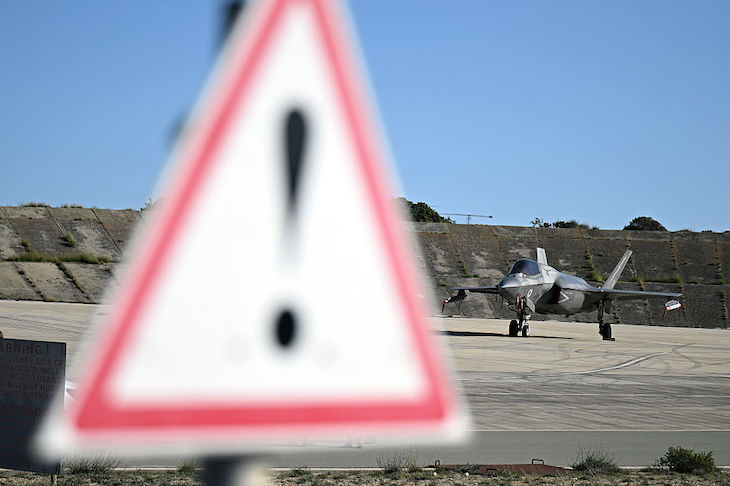
The parallels are certainly uncanny. After the recent Iranian strike on the RAF base at Akrotiri, Cyprus, it was not the Royal Navy but Greek ships that initially came to the island’s aid. It’s an irony that the ancient Athenians, formidable sailors themselves, might have appreciated.
This is the strategic dilemma now facing Britain
The historian Thucydides, who chronicled the Peloponnesian War, made an observation that has retained a stubborn relevance across the centuries: wars are rarely the product of a single deliberate decision. They emerge instead through a sequence of reactions (defensive measures, alliance obligations and retaliations) that gradually narrow the space for neutrality until it disappears altogether.
‘What made war inevitable,’ Thucydides wrote, ‘was the growth of Athenian power and the fear which this caused in Sparta.’ In other words, the strategic logic of events tends to assert itself long before statesmen are willing to acknowledge that they have entered a war at all.
This ancient predicament now confronts our Prime Minister.
From the outset of the conflict, the British Government has been careful to emphasise that the United Kingdom does not wish to be drawn into all-out-war with Iran. We declined to participate in the initial strikes carried out by the United States and Israel against Iranian targets, and the Government has framed its own role in strictly defensive terms. Sir Keir Starmer also insisted he does not support ‘regime change from the skies’.
The preferred language is ‘de-escalation’, a word that tends to appear most frequently at the precise moment when escalation is already underway.
Starmer’s caution would not have surprised the Athenians. At the start of the Peloponnesian War, the city’s leading statesman Pericles adopted a similarly restrained strategy against Sparta. Rather than risk bloodshed against the formidable Spartan army, he withdrew the population of Attica behind Athens’ defensive walls.
However, the sudden crowding of the city is believed to have contributed to the outbreak of the devastating plague of Athens, which Thucydides records in grim detail in Book II of his history – and which would eventually claim Pericles himself. Even the most carefully defensive strategies, it turns out, can produce consequences their architects never intended.
Though their motives are different, like Pericles, Starmer is attempting to avoid a wider confrontation.
Yet the practical realities of the conflict have begun to complicate this position. Iranian attacks have struck a key British installation in the eastern Mediterranean. British aircraft operating from the RAF base at Akrotiri have intercepted Iranian drones and missiles in the region. There are also around 300,000 British citizens living in the Gulf, which has been targeted heavily by Iran.
The Government has now authorised the use of British facilities by the United States for defensive operations against Iranian launch sites following further attacks and additional British military assets have been mobilised. The Government has now confirmed we are ‘working with our allies’ to open the Strait of Hormuz.
None of these steps constitute a formal declaration of war. Each is presented as a limited and defensive measure. Yet taken together they illustrate precisely the process Thucydides described: the gradual erosion of the boundary between involvement and non-involvement.
Though their motives are different, like Pericles, Starmer is attempting to avoid a wider confrontation
A government may begin by insisting that it has no intention of entering a conflict. But if its bases are attacked, its citizens are endangered and its allies request assistance, the distinction between staying out of a war and managing its consequences begins to look rather semantic.
There is, however, a certain irony in the comparison.
Athens could afford such restraint in part because it possessed the most formidable navy in the Greek world, which allowed it to project power even while avoiding direct confrontation on land. Even if Starmer wished to take a more assertive role in securing the Strait of Hormuz, the Royal Navy has been neglected for so long that this would be unlikely to move the dial in any meaningful way.
Thucydides’ account of the Peloponnesian War is, among other things, a study in how such dynamics unfold. Neither Athens nor Sparta initially set out with the conscious objective of plunging the Greek world into a generation-long struggle. Instead, tensions accumulated through a series of disputes, alliances and retaliatory measures.
The historian’s great insight was that the language of defence and deterrence often conceals an underlying reality. States act to protect their interests and credibility; rivals interpret those actions as threats; further responses follow. The result is not a sudden leap into war but a gradual tightening of circumstances in which the option of remaining outside the conflict becomes increasingly difficult to sustain.
This is the strategic dilemma now facing Britain. The Government’s instinctive caution is understandable – the shadow of the Iraq war looms large in the minds of politicians and the public alike to this day.
The shadow of the Iraq war looms large
However, there is a certain inevitability about this predicament. Britain’s alliances, ex-pat community and interests mean that developments in Iran were never going to remain just America and Israel’s problem.
Thucydides’ warning remains instructive thousands of years later. Conflicts often develop their own momentum, and by the time leaders insist that they do not wish to be at war, the logic of events may already have begun to override their intentions.
We shouldn’t doubt the sincerity of Starmer’s determination to keep Britain out of the present conflict. The difficulty, as Thucydides understood two and a half millennia ago, is that wars have a habit of proceeding with a certain indifference to the preferences of statesmen. While the Prime Minister’s limited support in the Strait will not lead to a literal plague, as it did in Athens, the plague of soaring energy prices is a pandemic we will be grappling with for the foreseeable future, whether Starmer likes it or not.






Comments