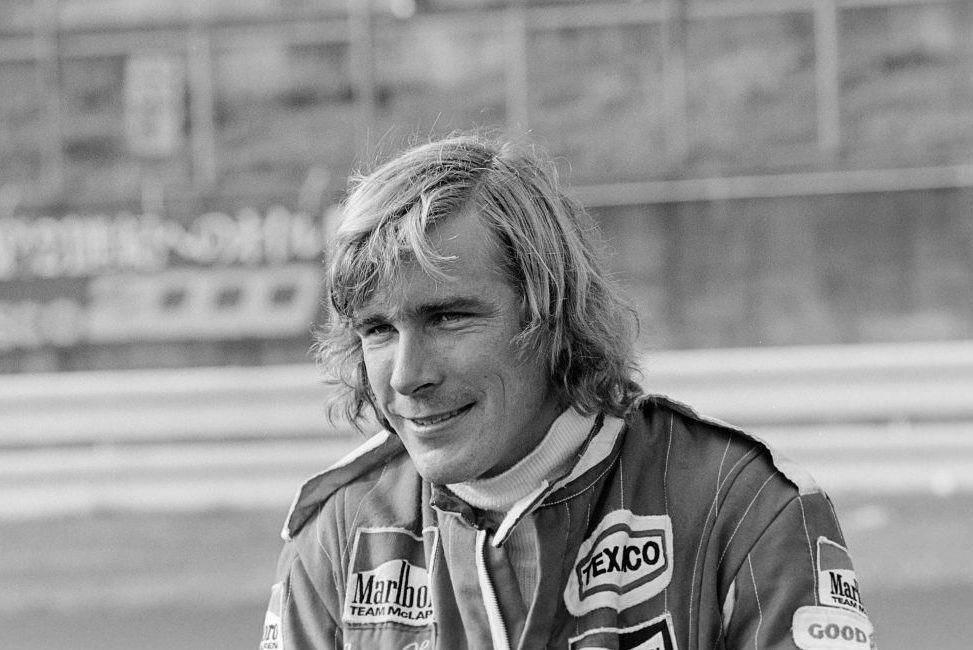
To Formula One fans, Sunday 24 October 1976 was significant for two reasons: it was the first time the sport had been broadcast live from outside of Europe via satellite, and it was the day James Hunt sealed the F1 drivers’ championship. Fifty years have now passed; today, 80 million tune into Grands Prix to watch the clean-living, corporate-trained TikTok generation scuff rubber, but Hunt’s legacy as the patron saint of Marlboro-puffing playboys shows no sign of abating.
He was a man of appetites, as ravenous for claret, cocaine and carnality as he was for speed and glory
In a competition founded upon bravery and testosterone, with a side order of sex appeal, the tall, tousled, blond, broad-chested Englishman left no stone unturned. He was a man of appetites, as ravenous for claret, cocaine and carnality as he was for speed and glory. He was Lord Flashheart in fire-retardant overalls, and a national treasure at just 29.
Born in Sutton two years after the war, Hunt was the son of a stockbroker and perfected his clipped and plummy intonation at Wellington College. Unruly and boisterous, he caught the racing bug relatively late by the standards of motorsport stars today, entering his first club race in a Mini aged 20. He climbed the single-seater ladder from there, earning the nickname ‘Hunt the Shunt’ in the process. Despite his outward confidence, he was a bag of nerves and would vomit before races. In 1973, he graduated to Formula One with the privateer Hesketh team, whose aristocratic owner, Alexander Fermor-Hesketh, 3rd Baron Hesketh, Hunt referred to as ‘The Good Lord’.
The team grabbed headlines with their decadent exploits – turning up to races in choppers and Rolls-Royces with a bevvy of bohemian beauties on their arms. Models outnumbered mechanics in the pits. Hesketh Racing didn’t need the excuse of a podium to spray champagne, and they gorged on lobster and caviar lunches while everyone else made do with spag bol. This frivolity met with the displeasure of ‘serious’ teams like Ferrari and Lotus, which made Hunt and Hesketh’s Dutch Grand Prix win in 1975, along with their eight other podium finishes, all the more difficult to accept. If Enzo Ferrari and Colin Chapman wanted to know the secret, they could’ve just looked at the patch sewn onto Hunt’s red overalls proclaiming ‘Sex: Breakfast of Champions’.
But while his focus wasn’t always on the job, once the visor went down, Hunt was among the most talented in the business. Recognising this, McLaren signed him for 1976, and he took eight pole positions and six Grand Prix victories in the Ford Cosworth-engined, Marlboro-liveried McLaren M23 en route to the season finale, round 16 at the Fuji Speedway – the Formula One Japanese Grand Prix, live on TV for the first time.
Nineteen seventy-six was one of the most dramatic championships in F1’s 76-year history, a story that was brought to the big screen by Ron Howard’s Rush. The battle was between Hunt and 1975 world champion Niki Lauda, who came face to face with death at the Nürburgring that August when his Ferrari 312T crashed and burst into flames. That the Austrian had survived, let alone returned to racing 42 days later, was astonishing. Lauda still had a three-point advantage going into Japan, despite Hunt winning six races to his five.
For Lauda’s fans and the Italian Tifosi, his was a battle against all odds, given his two missed races, blackened lungs and a seeping bandage around his head. For Hunt’s fans and Fleet Street, the plucky Brit was David to the reigning champion and the big-budget Scuderia’s scarlet Goliath. What turbocharged the story was how different the protagonists were. Lauda was aloof and bellicose, felt at home in a boardroom and had a face like a rat. Hunt was blessed with matinée looks and nonchalant charm and would attend black-tie functions in beachwear. The perception was that Lauda went to bed with racing-car schematics and telemetry, while Hunt had better things to do with his evenings than homework. In the run-up to the Fuji showdown, he allegedly bedded 33 British Airways stewardesses in his suite at the Tokyo Hilton.
Weather delayed the start of the Japanese Grand Prix by two hours. No one judged the wet and misty conditions safe, but the broadcast contract that had been negotiated by Bernie Ecclestone meant the race had to happen, and the fading light wasn’t going to help matters. Hunt agreed that, if there was to be a race, he was going to do exactly that. Lauda, who’d perhaps had his priorities adjusted by having the last rites read to him two months earlier, said, ‘My life is worth more than a title’, and retired to the pits after a couple of tentative laps. The door was open. It meant that if Hunt finished fourth or better, the title was his.
Starting P2, he overtook Mario Andretti for the lead. Later, as the storm relented and the track dried, the McLaren’s tyres started to overheat and Hunt was forced to pit. It was a slow stop, and it looked like the title had slipped through his fingers by the time he re-emerged on track in P5 with just four laps to go. With typical bravado, he made a late lunge on Surtees’ Alan Jones and Ferrari’s Clay Regazzoni. Third place was enough, but Hunt didn’t know where he’d finished. On returning to the pits, he angrily berated his pit crew until team principal Teddy Mayer grabbed him by the shoulders and shouted at him repeatedly: ‘James, you’ve won!’
He drank First Class dry on the way back to Heathrow and landed to a hero’s welcome. He quit racing three years later ‘for reasons of self-preservation’, battled the bottle, made some unwise investments, divorced his second wife and suffered deep depressions that even wilder carousing failed to dispel, although, in his last couple of years, he found love with a fine art student, Helen Dyson, and cleaned up his act.
Hunt was felled by a terminal heart attack in 1993, aged 45. Murray Walker, who shared the BBC commentary box with Hunt from 1980 until the latter’s death, described him as ‘the most charismatic personality that’s ever been in Formula One’.
A new feature documentary, Hunt: We Need to Talk About James, has been announced and is set to be released before Christmas.




Comments