
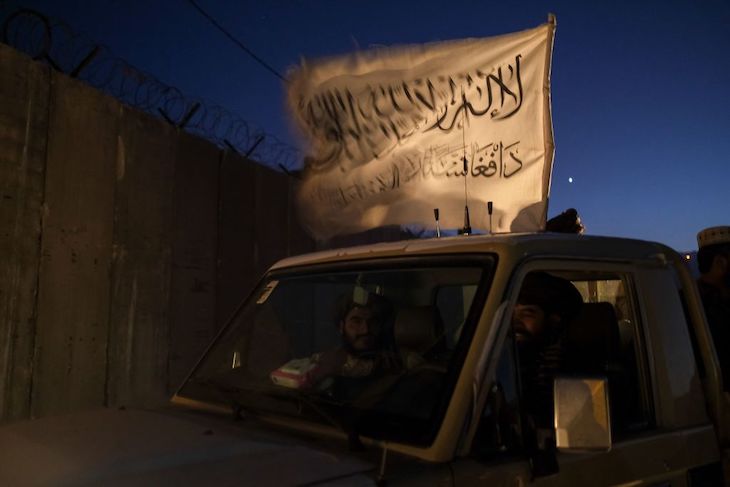
Taliban rule of Afghanistan becomes madder by the day. The only thing they reliably do is find new ways of making life impossible for women. They recently jailed the senior government advisor, Dr Farouq Azam, for more than a month after he made the subversive suggestion that women medical professionals should be sent to assist with earthquake relief. But while the Taliban attempt to portray a united front against the outside world, there is mounting evidence of division at the top of the movement.
Taliban rule of Afghanistan becomes madder by the day. The only thing they reliably do is find new ways of making life impossible for women
Interior minister Sirajuddin Haqqani has weirdly become the unlikely champion of what passes for ‘reform,’ if such a word can be used for a man who leads the fundamentalist Haqqani faction in the Taliban, and once had a multi-million dollar bounty on his head for terrorist attacks that killed thousands of Afghan citizens.
Haqqani publicly split with the Supreme leader Hibatullah Akhunzada last year, and left the country for several months after a senior member of his family was killed by a suicide bomber in Kabul. He was persuaded to return to government, but has found his authority and that of other ‘reformist’ figures in formal government posts constantly undermined by the supreme leader. Akhunzada has attempted to circumvent the formal system of government based in Kabul by ruling through Islamic orders issued by the Chief Justice in Kandahar, spread through mosques and madrasas.
The Kabul politicians, including the son of the founder, Mullah Yaqoob, have retaliated and attempted to wrest back some control. It has emerged that they were behind the decision to restore some internet access only two days after a total shutdown in October. The shutdown was ordered on moral grounds by the Kandahar fundamentalists, but the Kabul ‘reformists’ went to the prime minister, Mullah Hasan Akhund, who is an Akhunzada loyalist, and insisted that the decision be reversed.

It was not a total climbdown. Access is now possible only on 2G, and many sites, including Instagram, Snapchat and Facebook, were not restored. But it was a small victory for the Kabul ‘reformists,’ who are also believed to want an easing of the restrictions on girls’ education, if only in a cynical ploy to secure international recognition of the regime.
The ‘reformists’ know that without some changes, including education for girls and better access for women to jobs, there is no chance of Taliban securing recognition. A number of countries –including China, Pakistan, Russia, Turkey and some Central Asian states – have exchanged what look like ambassadors in an attempt to normalise relations, and of them only Russia has broken ranks against the international isolation of the Taliban by formally recognising the administration.
But there are signs of division in what has been a united line by western countries against recognition. Germany has shamefully given access to two Taliban diplomats in order to return migrants and other European countries are keen to follow. The idea that the Taliban, even the Kabul ‘reformers,’ can be dealt with in any normal way is wishful thinking. Sirajuddin Haqqani is as closely linked to Al Qaeda as the rest of the regime, a connection starkly revealed when the leader of Al Qaeda, Ayman al-Zawahiri, was killed by an American missile staying in a guest house owned by Haqqani in 2022. Afghanistan is now the global headquarters of Al Qaeda and its South Asian offshoot, Al Qaeda in the Indian Subcontinent. Allowing Taliban diplomats into western embassies would provide outposts for a global terrorist organisation.
The Pakistani Taliban, the TTP, also have bases deep inside Afghanistan, which was the main cause of fighting with Pakistan last year. The border with Pakistan remains closed since the cross-border clashes, described by a UN report as the ‘greatest threat’ to the stability of the country, and the end of trade has further wrecked a stagnant economy. The forced return of 4.5 million refugees from Pakistan and Iran has had the double impact of ending the money they sent back to their families from outside, while putting new pressure on frail public services. Growth fell by 6.5 per cent in the first half of 2025, and 90 per cent of the population are dependent on food aid which has been reduced because of huge cuts in international aid. Mismanagement of scarce water resources has led to fears that Kabul could become the first capital city in the modern age to run out of water.
Kabul could become the first capital city in the modern age to run out of water
The economic crisis is having an impact on the Taliban’s ability to project force to control the population. With the government budget under strain, thousands of troops, including senior commanders, have lost their jobs; most of those thrown out are from non-Pashtun tribes, further marginalising these minorities, and emphasising the dominance of Pashtuns in Taliban ranks. This presents an opportunity for recruitment for opposition groups among disaffected former Taliban fighters, particularly non-Pashtuns. Since the Taliban took over in 2021 armed opposition has been limited to small scale hit-and-run attacks – killing a police officer in one place, seizing vehicles or a few weapons in another. But this could change in 2026.
The increasing isolation of the Taliban leadership, out of touch with the wider nation, isolated from most of the world, and facing internal divisions, with a collapsing economy and weaker armed forces, provides an opportunity for the opposition. The Taliban have refused all attempts to negotiate for a more inclusive government, and it has become clear that positive change will come only through force, providing that use of force is allied with a coherent political alternative.
In the thirty years since the Taliban first emerged like a whirlwind from Kandahar to seize Kabul they have successfully retained remarkable cohesion under whoever was the supreme leader at the time: the Amir ul-Muminin, ‘commander of the faithful.’ But as fractures increase there could now be a window of opportunity for real change.



Comments