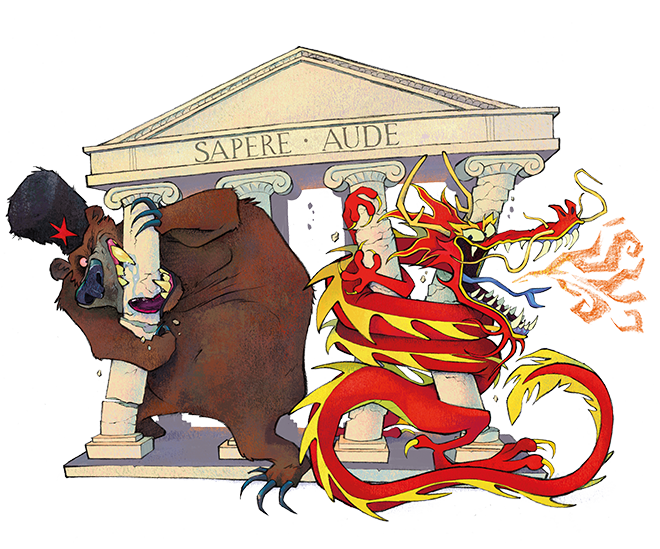
When The Spectator asked me whether I would write an essay on ‘Why we need to strengthen the West’, I was delighted – and bemused. Why is this even up for debate? That we must explain and justify ‘the West’ at all indicates just how weak it has become. It would be better if it did not need strengthening at all but the truth is that the West has become an invalid.
What exactly, though, needs to be strengthened? The West is an idea, not a location. It is not a matter of geography, it is a way of life. The idea of the West rests on four pillars: Athens – where democracy was born. Rome – the cradle of the rule of law. Jerusalem – where Judeo-Christian values placed the inviolable dignity of the individual at the centre. And finally, the Enlightenment – whose great thinkers in London, Paris and Königsberg anchored humanism, individual civil liberties, the separation of powers and the division of church and state.
Herodotus observed a phenomenon after the fall of the Peisistratid tyranny which remains the most vital lesson in political philosophy to this day. The Athenians, he noted, had fought no better than their neighbours as long as they were ruled by tyrants. Yet the moment they threw off the yoke of tyranny, every individual was motivated to give his utmost, proving decisively stronger and more successful in battle. Why? Because he was now working for himself, not for a master. In that single observation Herodotus formulated the timeless argument in favour of self-determination and liberty – the core idea of the West.
This idea also shapes a view of humanity articulated by Immanuel Kant. Man is not perfect. Kant famously wrote that ‘out of the crooked timber of humanity, no straight thing was ever made’. In the western mind, the implication is: nor should it ever be.
Freedom’s most important word is ‘no’. Dissent is self-determination. It is liberating to say: ‘No, I see it differently.’ With ‘no’, the freedom to think and act begins. The freedom to say ‘no’ stands in stark contrast to the unfreedom of having to say ‘yes’. Democracies are no-saying societies, while dictatorships are yes-saying. Liberty is inherently critical of authority: it permits and encourages contradiction – precisely that which autocrats cannot abide. That is why dictators wish to weaken the West. And it begins, as so often, with words.
The word ‘West’ has become suspect and has long been cancelled in politically correct circles. The mandated terms in geopolitical discourse are now the ‘Global South’ and the ‘Global North’. For those using the phrase ‘Global South’, linking the West to colonial guilt is no accident – it is the very purpose of the narrative. UN Secretary-General António Guterres put it bluntly in 2020: ‘The Global North, specifically my own continent of Europe, imposed colonial rule on much of the Global South for centuries, through violence and coercion.’
There are growing indications that China is actively fuelling AI-sceptical sentiment across western social media
The goal is to weaken the idea of the West through the association with guilt. Yet this new terminology is intellectually absurd. It possesses neither moral nor geographical logic: what does China have in common with Peru, Qatar with Haiti or Thailand with Sierra Leone? Where is the common denominator regarding human rights and the rule of law?
As a community of ideas, however, vastly different nations such as Japan, Singapore, New Zealand, the United States or those of Europe can readily identify with the concept of the West.
Yet in academia, ‘cancelling the West’ has become mainstream. Entire movements (‘epistemologies of the South’, ‘decolonising sociology’) rest on the claim that academic sociology’s focus on the modern ‘West’ is itself the problem. The West is asked within its own universities to apologise for its mere existence.
That the West – an open society based on liberty, the rule of law and human rights – is on the defensive is simply a fact. According to data gathered over decades by the thinktank Freedom House, global freedom declined in 2025 for the 20th consecutive year – deteriorating in 54 countries while improving in only 35. The most damning finding is that a mere 21 per cent of the world’s population currently lives in countries classified as ‘free’, compared with 46 per cent two decades ago. The number of countries designated as ‘not free’ has risen over the course of 20 years from 45 to 59, and autocracies have grown more numerous, more repressive at home and more aggressive abroad.
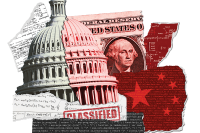
The West is currently threatened and weakened from both without and within. Its three great external adversaries are China, Russia and Islamism – particularly Iran and its terrorist networks. China, Russia and Islamist dictatorships share a common objective: to divide the West in order to weaken it.
China is now the world’s second-largest economy. Its goal is to become the leading global economy by 2049 at the latest – the centenary of the People’s Republic. The combination of communist autocracy and turbo-charged state capitalism has proved remarkably effective, not least because the West made itself a useful idiot in this story of growth. In hindsight, admitting China as a full member of the World Trade Organisation in December 2001 was the single greatest blunder of western trade policy. The naivety or shortsightedness lay in granting membership to a major non-democratic state that was neither able nor willing to abide by the rules of free trade – while simultaneously blessing it with developing-nation status, thereby conferring all manner of exemptions and preferences. It was akin to giving the most ruthless bully in the playground special rights to beat up his playmates. It had little to do with fair competition. China was thus able to exploit the principle of free trade to further its rise to global economic prominence. In 2001, China accounted for just 3.9 per cent of global GDP. Twenty years later, that figure was 18.3 per cent. Over the same period, the US share fell from 31.4 per cent to 24.2 per cent, and that of the EU from 21.9 per cent to 17.8 per cent.
The outcome of this experiment was predictable: in the short term, it brought growth and prosperity to all parties; in the long term, it shifted the global balance of power, creating perilous dependencies in America and Europe. The most tragic example is the German automotive industry. For decades Germany’s industrial giants banked on cheap manufacturing and lucrative consumer markets in China. In doing so, they failed to grasp the difference between good business relations and strategic dependence. Friendly cooperation ended the moment China acquired the requisite know-how to launch a heavily subsidised assault on the German car industry, even as Chinese domestic markets were quietly closed off. A Chinese masterclass in expansive geopolitics carried out by capitalist means. Wandel durch Handel (‘change through trade’) – the naive hope of the 1990s – became distorted. Change occurred, but not towards greater freedom, rather towards greater unfreedom, to the detriment of the West.
This trajectory is now accelerated by the AI arms race between America and China. The US still holds the upper hand but China, through the surveillance of its population, enjoys vastly greater access to data, unencumbered as it is by regulatory or ethical constraints. Moreover, American platform operators report that China is actively fuelling AI-sceptical sentiment across western social media. Propaganda aimed at inducing anxiety and slowing down rivals is taking its toll. There are growing indications that America is becoming ever-more tech-sceptic and it is not impossible that the next presidential campaign will hinge partly on which party promises to better protect voters from AI. Beijing understands that whoever dominates artificial intelligence will dominate economically and politically. It seems only a matter of time before China leads in this area too.
While America has recognised this challenge and reacted with varying degrees of success, Europe continues to deny the bitter reality. Beneath the soothing bromides of the EU, the continent is gradually drifting towards becoming an amusement park for Asian tourists, offering high quality of life paired with diminishing productivity and value creation.
The global trend is clear. Democratic economies are becoming weaker, non-democratic ones stronger. In this significant shift, the implications for military power are routinely underestimated. China is still viewed by many as a militarily passive, purely economic power. That picture is false.
The Chinese military budget doubled from $145 billion in 2015 to $281 billion in 2026 – fuelled by its economic growth. The ultimate test case will be Taiwan. Annexing this democratic, western-leaning island nation and integrating it into a monolithic communist republic is one of Xi Jinping’s central missions. China will strike as soon as the odds are high enough that America lacks the strength to intervene – perhaps because western resources have been depleted across the theatres of conflict in Ukraine and the Middle East. Should China achieve its objective without effective western resistance, the global order will be fundamentally altered.
The woke movement has become the Trojan horse of the anti-westernism loved by dictators and autocrats
Vladimir Putin’s war in Ukraine plays a remarkably helpful role in this strategy. Even if the war is far from a military success for Putin, he has achieved two vital objectives: dividing the West by driving the US and the EU further apart and exhausting American and European military stockpiles. Yet this war of aggression could have been the West’s finest hour. Putin underestimated Ukrainian resilience; had Nato members and the Ramstein Coalition seized the momentum of those early weeks to provide Ukraine with every conceivable resource to fight back, the domestic political pressure on Putin would have grown so immense that he could have been forced to order a swift retreat under flimsy propaganda pretences. Instead, the West remained half-hearted, allowed itself to be intimidated by flawed escalation scenarios and did too little. Putin – ever the student of western weakness – tested how far he could go, and went remarkably far. Now that Ukraine has proved to be the master of modern AI warfare, Putin is turning to a weaker target in the form of hybrid warfare against Germany and other EU nations which promise less resistance and greater prestige at home.
Putin finds ready allies in Iran and other Islamist-dominated regimes. Islamism hijacks religion for terrorist ends. The primary enemy of fanatical Islam is the world of those they deem godless – the Judeo-Christian West. Article 7 of the founding Hamas Charter of 1988 explicitly states: ‘The Day of Judgement will not come about until Moslems fight the Jews, when the Jew will hide behind stones and trees. The stones and trees will say O Moslems, O Abdulla, there is a Jew behind me, come and kill him.’ The destruction of Israel and all Jews is merely the first step. The next is the weakening, infiltration and violent re-education of Europe, and ultimately America. The very same article of the charter notes: ‘Since Moslems who adopt the ways of the Islamic Resistance Movement are spread all over the world… the Movement is a universal one.’ Meeting the Islamist threat with a policy of appeasement is like feeding a crocodile in the hope that it eats you last.
It remains difficult to fathom that the genocidal attack on Israel by Hamas led not to a global wave of solidarity with Israel, but to a massive surge in anti-Semitism. The weakest justification is the claim that Israel’s retaliatory measures in Gaza after 7 October exceeded all bounds, or that its domestic and foreign policy are deeply questionable. Has the Israeli government made mistakes? Undoubtedly. Is that a reason to be anti-Semitic, transferring criticism of Israel onto all Jews? Absolutely not. Yet the trend persists. Anti-Semitism has become a pop-cultural zeitgeist, particularly among the young. Germany, of all nations, recorded 8,725 anti-Semitic incidents in 2025 – the highest figure among the seven countries examined by the 2026 Annual Report on Antisemitism, ahead of the US (6,274) and the UK (3,700). The trajectory is the key: from 2021 to 2025, incidents rose by 124 per cent in France, 131 per cent in the US, and 215 per cent in Germany.
The primary cause of this development is a reckless, runaway migration policy. Islamist milieus – including strategically placed jihadists – have spent years undermining western societies and their foundational values. Pointing this out is not Islamophobic. True Islamophobia lies in failing to distinguish between those who wish to integrate peacefully into western societies and those who enter to abuse its systems and destroy its values. Under the guise of compassion and humanitarian relief, uncontrolled and frequently illegal immigration contributes not only to the West’s cultural self-abandonment, but fuels – by way of reaction – the rise of right- and left-wing populism and extremism.
Is its current crisis the very medicine required for the West’s renewal? That is the best-case scenario
Michel Houellebecq provided the dystopian vision for this in his 2015 novel Submission. He describes a France where the Muslim Brotherhood has taken power: a frightened country where women wear progressively longer dresses and unsuccessful white men rejoice at enjoying multiple marriages with underage wives without interference and where news of Islamist terror attacks is eventually suppressed so as not to alarm the populace. The book depicts the exhaustion of western society. Reality appears to be mimicking fiction in the most gruesome fashion.
The woke movement has become the Trojan horse of this anti-westernism. It is the epitome of the anti-freedom triangle, seamlessly intertwining anti-Semitism, anti-Americanism and anti-capitalism. It has brought about the inversion of western values with remarkable dexterity. Its stated goals bear the hallmark of good intentions: fighting racism, protecting sexual minorities, fighting climate change, questioning privilege and confronting colonial history. Its methods, however, are overwhelmingly authoritarian. Its self-loathing cultural relativism is toxic. The result is the inversion of almost every core value and objective of civilisation.
In the competition for victimhood status, the concepts of progress, competition, growth and prosperity have been eroded. In the West, being successful was once better than being unsuccessful. Wealth was better than poverty. Beauty was better than ugliness. Under woke ideology, all of this is reversed. It resembles a manual for western self-abolition, born out of the self-hatred of the privileged.
Even among America’s ‘Democratic Socialists’ – an offshoot of the woke movement – the strongest support does not come from the needy, the impoverished, or genuine victims. Its most passionate advocates are to be found among the daughters of the upper classes.
Is the West, rendered comfortable and tired, ultimately weakening itself out of a bad conscience? Will we realise what we stood to lose only once it is too late? Or is the crisis the West currently finds itself in the very stimulus required for its renewal? That would be the best-case scenario: that just in time we finally grasp what is at stake and realise that the alternatives are far worse. Why do we need to strengthen the West? Because otherwise, the tyrants win.





Comments