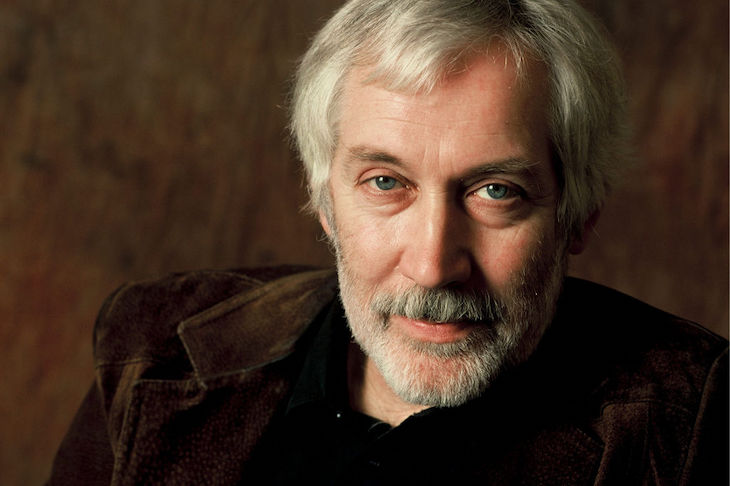
Since Russia’s invasion of Ukraine in 2022, Estonia – a potential flashpoint, we’re told, for a future Russian invasion – has been much in the news. But what do most people actually know about the country and its culture? A good place to start is the poetry of Jaan Kaplinski, who died five years ago today.
Kaplinski, born in 1941, lived through many of Estonia’s twentieth-century traumas. Great tracts of his native city Tartu were wiped out by Soviet bombing, while the country was subsumed, brutally, into the USSR. His father, a literature lecturer, died in a Stalinist gulag, his mother was blacklisted as a teacher, while he himself was dogged for decades by the KGB.
Forests have been the Estonians’ defence in times of peril, their constant means of escape
Yet the poems he wrote throughout established him, in composer Arvo Pärt’s words, as ‘a great cultural treasure of Estonia,’ a writer whose work was translated into numerous languages and who was nominated for the Nobel Prize.
For anyone who has spent time in that country (I lived there for two years in the 1990s), no writer is better at evoking the atmosphere of Estonia and the reserved, self-sufficient, sometimes bloody-minded spirit of its people. He describes the winter Baltic beaches, the billowing spring, the kitchen-gardens and beehives, and takes you into those houses which smell inside of old Estonian timber and where your feet thock gently against the floor.
Kaplinski is often spoken of as a Zen Buddhist poet or as obsessed with ancient cultures but this is misleading, making him sound esoteric and obscure. Much of his work is rooted in a world we all know and in which he’s always passionately present. He writes, he said, about ‘doing laundry, cooking cereal, going for walks with the children, skiing, writing, news on the radio,’ and preserves each moment in the most infectious way. The atmospheres he evokes – fleeting, unrepeatable – are captured with a simplicity which makes you think of ancient Chinese poetry.

‘The strange in the ordinary the ordinary in the strange,’ Kaplinski wrote, and if he’s able to find a universe in the miniscule, this is something many of his countrymen share – the by-product, perhaps, of living in such a tiny country.
One Estonian friend, back in the nineties, told me of the fifteen different types of snow she’d identified – ‘snow to walk to school in, snow for feeling nostalgic, snow to help you forget yourself’ and so on. She also wrote me a description of Drumlin Land, an area in South Estonia unremarkable to an English eye but which, merely by describing the changing weather in one afternoon, she managed to make seem as dramatic as King Lear. Like Kaplinski (prevented till the age of 45 from leaving the Soviet Union) she’d been forced to look for an entire world in this country of 1.5 million people and had found it.
In this they’re hugely helped by the forests which cover half of the country. As a poem by Kaplinski puts it: ‘I could not go to Sweden; so I have come to this forest.’ Forests have been the Estonians’ defence in times of peril, their constant means of escape. One way of coping with stress, a Tallinn businessman told me, was to lose yourself in the middle of one and take a day getting out.
‘The forest is my church,’ he muttered, while another friend, when I groused about the two-facedness sometimes of Tallinn’s citizens, gave an explanation: ‘Remember we are forest people, and fight from undercover.’
No one has written about such things with more haunting precision than Jaan Kaplinski. The long title-poem of his Through the Forest – the most enjoyable of his poetry collections – recounts a slow, meditative walk through the woods in which he becomes our eyes and ears for every telling detail. For Kaplinski, it’s a world where borders collapse, where the sound of television coming from a far-off house is as significant as the growth of sphagnum moss, the rotting old birches or distant croak of a lake frog, ‘the green frog that lives in water.’ He can name every plant and insect and knows what the loss of such knowledge has done to us. The material world which came clamouring for Estonians after the downfall of communism was a thin gruel, sundering them from their ‘past… ancestors…songs… souls,’ and leaving modern Estonians ‘lonely, lonely as a bee who has lost its way to the beehive.’
No one has written about such things with more haunting precision than Jaan Kaplinski
But loneliness, Kaplinski recognised, is not the same as solitude, a state of grace to which his countrymen seem naturally to gravitate. One Estonian girl who’d grown up under communism berated the Russians to me, complaining they were ‘like a pack of dogs. They don’t seem to realise that sometimes we want to be alone.’
Kaplinski agreed with the latter part, writing of the masks we wear when dealing with others, and on his long walks through the undergrowth yearned to meet no one. ‘I need solitude…For solitude is like the forest or the sea. Solitude is space, open space.’
It’s an open space you feel when you read his work. ‘Three thoughts for every one word,’ goes an Estonian saying, and under so many of his lines is a palpable and living silence: ‘Bright silence,’ as he puts it, ‘beneath which those words exist.’
In this country, trampled over throughout its history by the Swedes, the Germans, the Russians, such calm has a mystical allure. ‘Peace’, Kaplinski tells us, ‘is when everything slowly grows its roots,’ and his poems resound with it. Nailing it in Poetry Review, Philip Gross described him as ‘a rare mixture of intellect and real simplicity. Very conscious of the places words cannot reach, his poems create a space around them that is intensely good to be in.’
He remains, five years after his death, a world writer, a poet of steady, healing power, whose verse contains, as one contemporary put it, ‘visions of luminous serenity and inner peace.’ Here’s a poem, chosen almost at random, from a cycle named (characteristically) ‘SILENCE. DUST.’
Go, go, says the easing rain.
Away, away, says the easing rain.
A petal from the apple tree falls onto the grass.
Beauty cuts deeply like a knife,
cuts the personality into many pieces.
One self thinks suddenly of November,
of the first snow, which is
like an old lady’s clean white net curtain,
only on the other side of the window.
A second self thinks of tiredness,
of how the garden is tired, the house is tired,
the bushes are tired, the flowerbeds are tired,
you yourself are tired, tired of life, existence,
expectation, of getting up and going
into that tired world.
But a third self suddenly realizes:
sometimes one can also grow tired of being tired.
When I open the door, raindrops are no longer
falling from the sky. In the southwest the sun glimmers
through a thin cloud. Water drips from the eaves,
but one large bee
is already spinning out from under the outhouse eaves,
I put on my rubber boots and realize
that the world is at the same time
very old and very young
and I myself am neither.




Comments