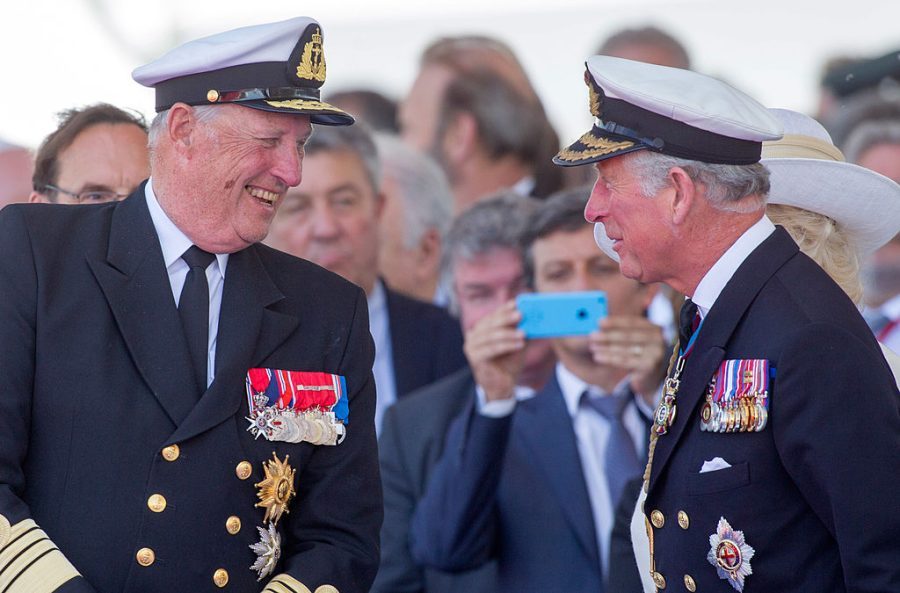
The death of the Norwegian monarch, King Harald, at the age of 89 might, initially, seem like a sad but ultimately inconsequential event as far as the British royal family are concerned. Still, at a time when there are only a few monarchies left in Europe, there is an informal fraternity of sorts between the kings and queens who still – some would say anachronistically – cling onto their thrones. And in the case of the Oxford-educated King Harald, there were many parallels, for good and bad, that King Charles, Prince William and the rest of the Windsors would do well to learn from.
Given Norway’s rather smaller size than Britain, it is unsurprising that its monarchy has always been a more informal and less rulebound institution than ours. Yet Harald excelled at an accessibility and apparent universality that saw him approvingly called ‘the people’s king’ and ‘grandfather to the nation’. This was shown at its best in 2011 when, addressing his grieving people after the Anders Breivik massacre at a national memorial service, he rallied them by saying, ‘I can only imagine the depth of your pain…I feel for each and every one of you.’ He went on to announce that ‘I firmly believe that we will uphold our ability to live freely and securely in our country’ and stated that they should not ‘let fear take over’ their lives.
Norway will be mourning its consequential, much-loved king
It was a sincere and moving speech that spoke to Norway with real feeling and ensured that Harald’s people knew that the monarch sincerely understood their shared pain. Should anything similar happen in this country, King Charles would be well advised to take note. Like Charles, Harald evolved during his reign, which began in 1991, from a cerebral, rather withdrawn figure into someone who was capable of empathising with the ordinary Norwegian. He was also unafraid to modernise, too.
Perhaps the apogee of this came in 2016 when he made a speech in praise of diversity in all its forms, saying that Norwegians came from ‘Afghanistan, Pakistan and Poland, from Sweden, Somalia, and Syria’, they ‘believe in God, Allah, the Universe and nothing’, and they ‘are girls who love girls, boys who love boys, and girls and boys who love each other’. It is not impossible – for good or ill – to imagine Charles making such an address.
And there are other similarities, too. As with William marrying the one-time Kate Middleton, and eyebrows being raised in stuffier corners because she was (gasp!) a commoner, so Harald’s marriage to a businessman’s daughter, Sonja Haraldsen, was initially fraught with controversy. Eventually it was, however, not only accepted but set a precedent for his children to marry non-aristocrats, too. This has, admittedly, been a mixed blessing.
The new king, Haakon, inherits the throne trailing some dynastic controversy that was largely overlooked during his father’s reign but will now come under renewed scrutiny. His wife Mette-Marit was a frequent feature in the Jeffrey Epstein files, showing the paedophile financier’s ability to touch everyone from all walks of life. Meanwhile, Haakon’s stepson Marius Borg Høiby was convicted of rape earlier this year, shortly after which his mother underwent a lung transplant.
Compromising Epstein connections, unpopular members of the royal family whose right to rule is being openly questioned by a sceptical media, the popular late monarch being replaced by their more controversial son: all of these are familiar to any British royal-watcher over the past few years. It remains to be seen whether Haakon will be able to maintain his father’s modernising outlook or indeed to steer the monarchy away from any nascent republican sympathies. The approval rating of the institution has fallen nearly 20 points, from 72 per cent to 54 per cent, since 2024. It is widely, if not universally, believed that Mette-Marit’s Epstein associations – as well as the actions of her son – make her unsuitable to be queen.
Yet there will be time to see how this plays out. In the meantime, Norway will be mourning its consequential, much-loved king, and Charles, for one, may be wondering if he will merit such a send-off when his time comes.






Comments