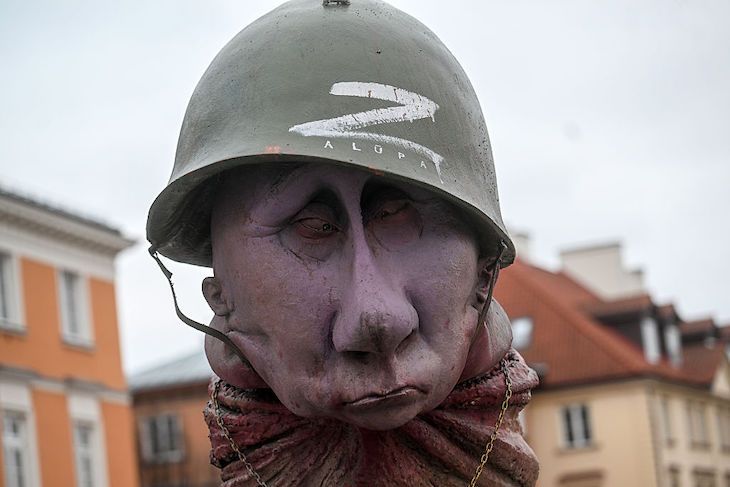
When Vladimir Putin invaded Ukraine, Russia’s president launched what was supposed to be a textbook twentieth-century invasion. Military commentators believed the Russian military possessed overwhelming advantages in tanks, artillery and aircraft. The war, political and military leaders from Washington to Nato assumed, would be over within days.
Putin believed he was fighting a twentieth-century war of mass, armour and centralised command. Ukraine demonstrated something different
Instead – with casualties at over 1.3 million after almost five years of fighting – Russia remains bogged down in the conflict. One of the world’s largest military powers has found itself being tracked by commercial satellites, exposed across social media and harried by small teams armed with drones and precision weapons. The invading army had arrived prepared for one kind of war and found itself fighting another. So what happened?
Putin’s great mistake, as I detail in my new book, was not simply underestimating Ukraine. Dictators and military commanders have been making that mistake throughout history. The Russian president’s deeper failure was to misunderstand the changing nature of warfare itself. He believed he was fighting a twentieth-century war of mass, armour and centralised command. Ukraine demonstrated something different: a form of warfare that fused drones, satellite communications, civilian technology and dispersed networks into a single fighting system.
Historians like me remember certain battles, not because they were the largest, but because they revealed a new way of war. Marathon in 490 BCE, Agincourt 1415 or The Battle of Britain in the summer of 1940. Each marked a moment when established military assumptions collided with a new reality. Kyiv in 2022 may eventually be remembered in the same way: not simply as the battle that shattered Russia’s aura of military invincibility, but as the first great battle of a new military age.
Most battles confirm existing trends and a select few change warfare forever – what we label ‘hinge moments’. They expose the sudden gap between military assumptions and military reality. At Marathon, Persian numbers were overcome by Greek discipline. At Agincourt, mounted French knights discovered that technology and tactics had made them vulnerable. During the Battle of Britain, radar and integrated command multiplied the power of how the Royal Air Force could defend Britain.

The pattern in these key moments is always the same. The decisive advantage belonged not to the side with the most men or weapons, but to the side that first understood how warfare was changing. The loser was usually fighting the last war; the winner had grasped the next one. In 2022, Russia repeated that historic mistake.
To understand why the battle for Kyiv matters, we first need to understand what Russia thought it was doing. Putin’s invasion plan was not irrational. On paper, it reflected decades of military orthodoxy. Russia would achieve strategic surprise, seize the crucial cargo airport at Hostomel with elite airborne troops, drive armoured columns south from their jump off points on the northern border and penetrate quickly to the capital and remove Ukraine’s president Zelensky.
The operation was designed not as a war of attrition but as a rapid decapitation strike, delivering Putin a compliant government, as organised Ukrainian resistance collapsed.
It was, in essence, a campaign that Napoleon Bonaparte would have understood in 1812, and that current Soviet planners would have recognised instantly. Yet almost from the opening hours the invasion began to unravel.
The assault on Hostomel failed as the Russian airborne units were stopped in their tracks, surrounded and cut off. Russian armoured columns became trapped on congested roads. Units struggled with logistics, communications and command. Instead of collapsing, the Ukrainian state adapted and fought back fiercely with a level of coordination between the regular army, police forces and militia units not seen before.
The problem was not simply poor Russian execution, important though that was. The deeper flaw lay in the assumptions underpinning the entire operation. Russia had planned for a battlefield in which information could be controlled, forces could be concealed and military power flowed from the top down. Ukraine was fighting on a battlefield where information moved instantly, where every mobile phone was a sensor and where small, dispersed units could often react faster than large headquarters. Russia arrived in Ukraine with the military logic of the twentieth century. Ukraine was beginning to demonstrate the military logic of the twenty-first. What emerged in Ukraine was not a single revolutionary technology, but a revolutionary way of connecting technologies that already existed.
Drones were and still are the most visible example – such as the Bayraktar TB2 from Turkey which carried laser-guided bombs to lethal effect. Cheap commercial systems allowed Ukrainian forces to find and strike targets at a fraction of the cost of traditional military platforms. But drones alone do not explain what happened. Ukraine also harnessed commercial satellites, Starlink communications (when switched on!), digital networks and real-time intelligence from civilians armed with smartphones.
The result was what strategists now describe as a ‘mosaic’ approach to warfare: thousands of separate components, military and civilian, linked into a common operational picture. Information flowed rapidly between soldiers, commanders and intelligence analysts. Small units could react faster than large headquarters. None of these technologies was entirely new. What was new was their fusion under battlefield conditions. Ukraine did not invent the components of twenty-first-century warfare. It became the first nation to integrate them successfully during a full-scale conventional invasion.
Russia arrived in Ukraine with the military logic of the twentieth century. Ukraine was beginning to demonstrate the military logic of the twenty-first
That may ultimately be Kyiv’s greatest significance. Ukraine was not merely resisting Russia; it was revealing the architectural template of future warfare. This is why Kyiv belongs alongside historical turning points like Agincourt and the Battle of Britain. In each conflict, an adversary entered the contest confident that overwhelming structural and numerical superiority would prove decisive.
At Agincourt, the longbow exposed the vulnerabilities of a military system built around heavily armoured cavalry. During the Battle of Britain, victory relied on a sophisticated, multi-layered network that fused early radar technology with civilian ground observers, physical barriers, and decentralised command rooms to deploy a smaller fighter force with extraordinary, localised efficiency.
In every case, victory was not delivered by raw technology alone, but by the ability to seamlessly synthesize disparate tools into a revolutionary way of fighting.
The same lesson can be found in Ukraine. Drones, satellites and digital communications were not individually revolutionary. Their significance lay in how they were combined. Like radar in 1940, they multiplied the effectiveness of every soldier who used them. They allowed a weaker force to see further, react faster and strike more accurately than its opponent.
History rarely announces that a military age has ended. The French knights who struggled through the mud at Agincourt did not realise they represented a fading model of warfare. Few Luftwaffe commanders understood that radar had fundamentally altered the balance of power in the skies above Britain. Nor, perhaps, did the Russian generals whose armoured columns rolled towards Kyiv in February 2022.
Putin believed he was launching a familiar campaign of mass, armour and shock. Instead, he stumbled into a battlefield shaped by networks, information and dispersed firepower. His great mistake was not simply to underestimate Ukraine. It was to misunderstand the nature of war itself. Future historians may conclude that Kyiv was more than a failed invasion or a remarkable defensive victory. They may see it as the moment a new military age first revealed itself to the world.
Iain MacGregor, is a Fellow of the Royal Historical Society, and author of Battle: The Moments that Transformed Warfare from Ancient Greece to Ukraine (Bloomsbury)





Comments