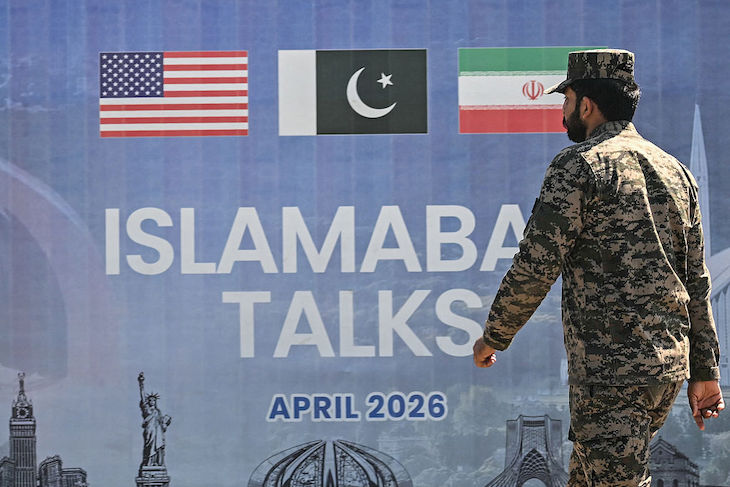
Pakistan was always an unlikely mediator for peace negotiations between the United States, Iran and sotto voce, China. It would not be an exaggeration to describe Pakistan as a failed state. Having outperformed India economically in the aftermath of partition, Pakistan went into steep decline after the arrival on the political scene of a corrupt chancer, socialist and demagogue, Zulfikar Ali Bhutto. Today, bankrupt Pakistan is kept afloat by loans from the IMF, China, and the Gulf States.
Trump can be in no doubt that, with regards to political power in Pakistan, it is Munir who wears the pants
Bhutto’s political dynasty continued under the aegis of his daughter Benazir and later his grandson. Power alternated with Nawaz Sharif, whose brother Shehbaz Sharif is Pakistan’s current incumbent as prime minister. Nominally, Pakistan is a democracy, though arguably it is a military dictatorship every bit as totalitarian as Russia. Pakistan’s political parties are given license to govern by an army which has its grubby paws in every nook and cranny of the economy.
Woe betide anyone who tries to interrupt this cozy arrangement. Former prime minister Imran Khan learned this to his cost. Despite surviving several assassination attempts by his political opponents, and winning most seats in the 2024 election, Khan was inveigled out of power. He remains incarcerated in prison. Despite attempts to erase him from the public consciousness, Khan, lauded for his integrity and charitable works, is still by far the most popular politician in Pakistan and is arguably the world’s most famous political prisoner.
Given Pakistan’s rinky-dink reputation what is it about the country that makes it such a desirable moderator in the US-Iran conflict? Being a nuclear power of course gives Pakistan a head start in terms of credibility. It has the nuclear aura that Iran would love to possess. However dysfunctional, as a nuclear power Pakistan has to be taken seriously. Geographically Pakistan is situated at one of the cruxes of global power. It shares a border with Iran and possesses the second largest Shiite population – 30 million – after Iran. Pakistan’s politicians and its army leaders are well known to the IRGC (Islamic Revolutionary Guard Corps). To the north lies Afghanistan and Russia which makes it an important bulwark to the Taliban and indeed to Russia; since Pakistan won independence in 1947, the United States has been a consistent funder of its military.

Curiously the relationship between the US and Pakistan prospered in the first year of Donald Trump’s second presidency because of his unlikely bromance with Field Marshal Asim Munir. This, despite Munir being notable as a Hafiz, a title given to those who can recite the whole Qur’an. Trump has constantly praised Munir, Imran Khan’s nemesis, describing him as “my favorite Field Marshal” at last year’s Sharm el-Sheikh Peace Summit which concluded the Israel-Hamas ceasefire agreement. On previous occasions he has called Munir “a very important guy” and an “exceptional human being.”
Trump can be in no doubt that, with regards to political power in Pakistan, it is Munir who wears the pants. He was originally chosen as Pakistan’s army chief because of his hatred of Imran Khan who had previously fired him for accusing his wife of corruption. Thereafter Munir earned his spurs for the Nawaz government by the brutal suppression of Khan’s supporters.
But, according to Pakistan’s former foreign affairs and defense minister, Khurram Dastgir Khan, it was Pakistan’s four-day war with India in May 2025 that “was the decisive factor that raised [the] army chief’s profile internationally.” Munir earned brownie points with the White House when he not only credited Trump with the peace brokered with India but also nominated him for the Nobel Peace Prize. Last year, Munir was a frequent visitor to the White House. Despite the budding relationship with Trump, uniquely Pakistan maintains friendly relations with the US, China, Iran, Saudi Arabia and Russia.
Munir’s position as the de facto power in Pakistan was underlined by the passing of the 27th Amendment to the constitution in November. Munir was appointed to the newly created post of Chief of Defense Forces that gave him control of all three services. Legislation was also passed giving Munir and other military leaders lifetime immunity from criminal prosecution.
China, which is playing a background but crucial role in the push for peace talks, has a longstanding close relationship with Pakistan. Long-term geopolitical thinking in China sees India as its major competitor and “forever enemy”; based on “my enemy’s enemy is my friend,” China and Pakistan enjoy common cause against India.
That China sought out Pakistan to try to bring about peace is therefore no surprise. China’s need to open the Strait of Hormuz is pressing. Iran may account for just 13 percent of Chinese oil imports but over 38 percent comes from the Middle East, most of it through the Strait of Hormuz. China suffers from the war in two ways. Having already lost its discounted oil from Venezuela, the closure of the Strait of Hormuz will be a further hurt to a Chinese economy that, in 2026, is already expected to record its slowest growth rate in a generation. Equally important, the consumer markets of Europe and the US, on which Chinese manufacturers depend, will be adversely impacted by a prolonged rise in the price of energy. Pakistan enables China to make common cause with the US to prize open the Strait of Hormuz.
As a conduit between the United States and China, Pakistan has form. It was from Pakistan in 1972 that Henry Kissinger, President Nixon’s national security advisor made his secret flight to Beijing to meet Mao Zedong and Zhou Enlai in what turned out to be the most dramatic diplomatic coup of the 20th century – the rapprochement of the United States and China. As sinologist John King Fairbank jokingly noted, in the quarter century after the Chinese revolution “more Americans went to the Moon than to China.”
Subsequently, Kissinger was much criticized for using Pakistan as a middleman at a time when the Pakistan Army was engaging in a brutal genocide in East Pakistan (today Bangladesh) known as the ‘Martyrdom of the Intellectuals.” Indeed, realpolitik can sometimes be a cruel master. Just as Nixon chose to ignore the domestic depravities of the Pakistan government for the higher goal of peace with China, so the Trump administration has turned its back on the brutal suppression of democracy in Pakistan to achieve the higher goal of de-nuking Iran.
While the initial talks between the US and Iran in Islamabad have failed, it seems likely that Islamabad will remain the destination of future peace talks. The two major global powers, the US and China, in what is increasingly a bipolar world, have a common need to sort out Iran. China, more dependent on Middle Eastern oil than America, needs to open the Strait of Hormuz; while the US needs to defang Iran of its nuclear capabilities. Both superpowers are likely to continue to use Munir as their key interlocutor with Iran.





Comments