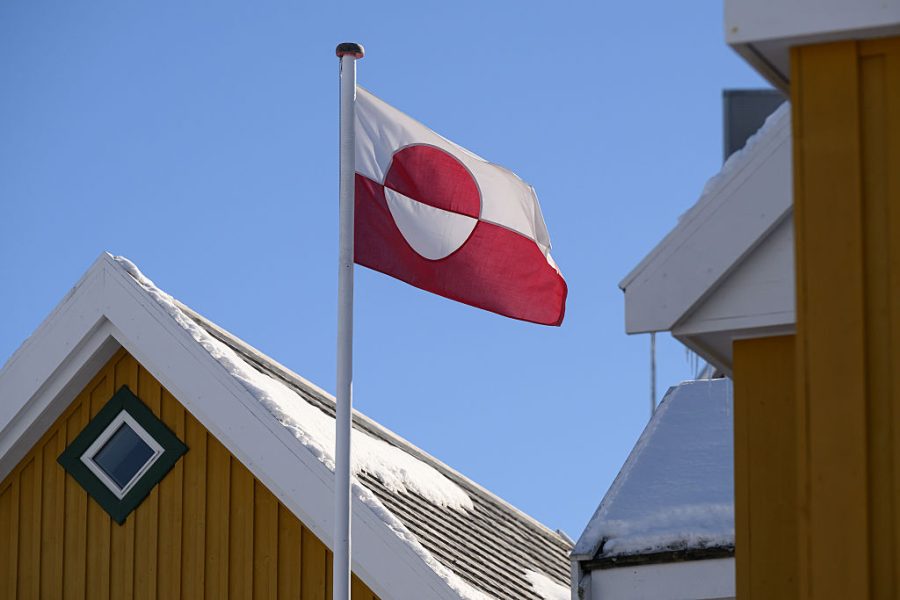
Every time Donald Trump repeats his threats towards Greenland, a familiar claim does the rounds that the UK has ‘first dibs’ should Denmark ever choose to sell the territory. Most versions of this story trace back to comments by Tom Hoyem, who served as Denmark’s last minister for Greenland in the 1980s.
The claim gained traction again after Trump’s recent threats about acquiring the island, saying ‘one way or the other, we’re going to have Greenland’. These threats – which have now been accompanied by additional tariffs on countries including the UK – are being taken so seriously that the Danish and Greenlandic foreign ministers met US vice president J.D. Vance in Washington this week.
It is an entertaining idea to think that Britain has a claim to Greenland, but it is false. Nevertheless, Britain’s historical relationship with the island is more complicated than many assume.
Britain has another concrete interest in Greenland: critical minerals
The origins of the claim lie more than a century ago. Britain was involved in negotiations over Denmark’s sale of several Caribbean islands to the United States. In return, Washington formally recognised Danish sovereignty over Greenland in 1916. The treaty was concluded, the Caribbean islands were renamed the US Virgin Islands, and Danish control over Greenland appeared secure.
Some later suggested that British involvement came with a condition: that Britain would enjoy a right of first refusal should Denmark ever sell Greenland. Adding colour to the story are maps from the late Victorian and early Edwardian period which appear to show slivers of north-western Greenland under the British flag. However, documents in the National Archives show that while Britain did make such a demand in 1920, Denmark never agreed to it.
In reality, Britain’s connection to Greenland has never been a legal one. Instead, it has been shaped by history, geography and strategic importance. In the aftermath of the Napoleonic wars, Greenland ended up part of the Danish kingdom. This was a consequence of the Denmark-Norway union being on the losing side to Britain and Sweden in the conflict. France’s adversaries forced Copenhagen and Oslo to dissolve their union and Denmark was permitted to retain their overseas territories: Iceland, the Faroe Islands – and Greenland.
Norway, by contrast, was handed to Sweden, resulting in a century-long union with the kingdom. This settlement matters today because it explains why Greenland remains part of the Danish kingdom and didn’t end up attached to a different Arctic power.
British interest in Greenland was also influenced by the proximity of Canada, which at the time was self-governing but not yet independent. This Arctic geography continues to matter. Canada and Denmark were even involved in a long-running dispute over the tiny Hans Island, which sits between their lands. The territory triggered a largely symbolic ‘whisky war’, only resolved in 2022 when the island was divided in two – creating a new international land border.
Given Britain’s location, Arctic security has long been a concern. Conservative peer Ross Kempsell has argued that ‘Greenland is in UK’s sphere of maritime influence’ and that Britain should be playing a leading role in the current dispute. Central to this argument is the stretch of ocean between Greenland, Iceland and the UK – known as the ‘GIUK gap’, a critical naval choke point connecting the Atlantic to the North Sea which became a flashpoint in the Cold War. Its relevance has not diminished. Only last week, British forces assisted the United States in intercepting a Russian-flagged oil tanker, the Marinera, as it crossed the gap. This formed part of efforts to crack down on Venezuelan sanctions evasion.
British support for the Danish claim to Greenland comes primarily through Nato, where Copenhagen remains one of London’s closest European allies. Prime Minister Keir Starmer was with his Danish counterpart, Mette Frederiksen, at a summit on Ukraine last week when President Trump repeated his threats to seize Greenland. Since then, both Defence Secretary John Healey and Foreign Secretary Yvette Cooper have been in contact with their Danish counterparts to provide support. The government has also confirmed that ‘the UK is committed to working with Nato allies to strengthen Nato’s arctic deterrence and defence’.
It is difficult to imagine a scenario in which Britain would not support Denmark in the event of an attack as part of a Nato response – though it is equally difficult to envisage British and American troops facing off against one another over Greenland. The recent announcement that Britain and France would be willing to lead a peacekeeping force in Ukraine, which was met with relatively little public opposition, may suggest that the British public has grown more accepting of a muscular foreign policy in this new era of great power politics. That said, support for Ukraine is unusually strong, and much of this remains theoretical.
Trump’s renewed threats have seen European nations put the gears in motion for a Nato mission focused on Greenland. While details remain limited, such a move would be designed to demonstrate European resolve and capability in the Arctic. Indeed, senior politicians, including former defence secretary Ben Wallace, have called for Britain to take more of a leading role through the Joint Expeditionary Force (JEF) that it founded a decade ago with the Netherlands and the so-called ‘Nordic-Baltic Eight’.
This week, a European contingent – including one British military officer – headed to Greenland on a ‘reconnaissance mission’ led by France. It is this mission which Trump cited in his tariff announcement, saying the countries involved were playing a ‘very dangerous game’ and ‘have put a level of risk in play that is not tenable or sustainable’. Whatever happens, for some within Trump’s orbit, any increased attention on the Arctic by the Europeans might be framed as a partial victory, given long-standing US complaints that their transatlantic allies have underinvested in Greenland’s defence. Trump himself recently mocked Greenland’s defences, claiming they amounted to ‘two dog sleds’.
Beyond managing the difficult balance between Washington and Copenhagen, Britain has another concrete interest in Greenland: critical minerals. British mining firms hold a third of mining licences in Greenland; trade talks were reopened last year on pursuing a new free trade agreement with the territory. While Greenland is part of the Danish kingdom, it lies outside the European Union, giving the UK some room to manoeuvre. Britain may not have first refusal over buying Greenland, but it should be keen to ensure its companies can remain competitive against American and European peers.
It may have flattered some British minds to think of the country’s role in Greenland as a latent owner-in-waiting, but the truth is that there is a strategic role for Britain: as a Nato ally, as a stakeholder in Arctic security and as an economic partner.




Comments