

The Times, the newspaper of record, has been invited to witness proceedings in No. 10 North – which is Andy Burnham’s Mancunian analogue, I suppose, of Donald Trump’s ‘Winter White House’. They witnessed, as you’d expect, some blethering on about planning permission and mayoral powers, a joke by Angela Rayner and a humorous cardboard cut-out of Larry the cat. And at the centre of it all: the man of the hour:
Sitting in his trendy new office in Manchester, open-collared shirt, cup of tea on a table in front – milk in first – Burnham is keen to talk about this new policy that he hopes will help him deliver the biggest council house building programme since the war.
Three words. ‘Milk in first.’ This is, isn’t it, an odd thing to notice. And it’s a tricky one to parse. The immediate conclusion must be that it’s intended to make a statement about Andy Burnham’s class position. But what statement? That is not so clear.
Is it that the Prime Minister is an honest, salt-of-the-earth Northerner with a non-nonsense attitude – that he is, in the phrase of my colleague Julie Burchill, of the ‘working-class blood royal’? Or is it that he’s an effete member of the woke metropolitan liberal elite cosplaying a prole?
The tea/milk order is these days a redundant signifier of class
The problem – and maybe that’s what’s gone wrong with this country – is that you can no longer tell. The tea/milk order is these days as redundant a signifier of class as whether you wear brown shoes in town, call it a mirror or a looking-glass, or pronounce that game with the ball and clubs ‘goff’.
Milk in second used to be considered a bit declasse – but that was during the era in which serving tea would in every case involve a teapot. Whether you put the milk in the cup first or second was a matter of free choice. There exist some highly tenuous theories as to why posh people would put the milk in second (they wanted to show off that their expensive porcelain wouldn’t crack if exposed directly to boiling water; or that their milk was less likely to be on the turn so didn’t need scalding) but essentially, it was a social shibboleth.

You know what’s happened since then, though, right? The invention of the teabag. And that throws everything into disarray. I put the milk in second most of the time, as I expect do most of us, not because I live with a duchess but because I usually make tea with a teabag and a mug and everybody except outright actual barbarians knows that the water has to be boiling when it hits the teabag. Ergo, milk goes in second.
But when you’re making tea with a teapot – whether with bags or with fancy-pants proper tea leaves and a silver strainer from Harrod’s – milk now tends to go in first for two reasons. One is that you can get the milk out of the door of the fridge, put a splash in the cup and replace the milk in the door of the fridge while your kettle is still boiling, thus saving you a valuable thirty seconds. This is the benign Taylorism of the teacup.
The other reason is also to do with time and motion. George Orwell was a milk-seconder, and in his 1946 essay ‘A Nice Cup of Tea’ he makes what is on the face of it a robust case:
This is one of the most controversial points of all; indeed in every family in Britain there are probably two schools of thought on the subject. The milk-first school can bring forward some fairly strong arguments, but I maintain that my own argument is unanswerable. This is that, by putting the tea in first and stirring as one pours, one can exactly regulate the amount of milk whereas one is liable to put in too much milk if one does it the other way round.
Orwell, I’m afraid, is wrong here, though. We milk-firsters have an almost supernatural ability, after years of practice, to know by eye exactly how much milk a given size of cup will require. We are like Manhattan barmen free-pouring shots with uncanny precision. Also, using Orwell’s method avowedly requires a certain amount of fannying about with a teaspoon. When you pour the tea in second, it mixes the fluids uniformly. But milk-second vanishes into the depths of the mug and leaves a glassy translucency at the surface, which requires stirring. You then have to rinse the teaspoon and/or later wipe up the blob of tea on the table where you’ve left the teaspoon, which is so much boring effort that I need a lie-down even contemplating it.
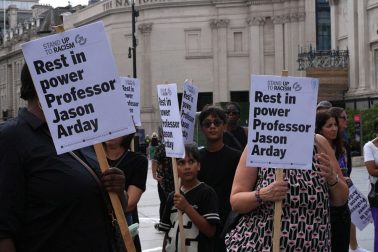
Some of us have scalding hot takes on the Jason Arday affair to be dispensing, and others – Andy Burnham, for instance – have countries to run. None of us, unlike the inhabitants of Orwell’s sleepy age of innocence, have time to be messing about with teaspoons. Nor, unlike the aforementioned imaginary duchess, do we have staff to deal with the teaspoons. If that puts our tea at risk of being microscopically too milky, so be it. There are more important things to worry about. So what we learn from all this, I think, is that Andy Burnham owns a teapot.
The method where you put the milk in while the teabag is still in the cup, incidentally, and then stir the teabag round in the milky solution with your finger, is the only one that really makes you look vulgar. On the other hand, weirdly, in my experience, it makes a very nice cup of tea.





Comments