
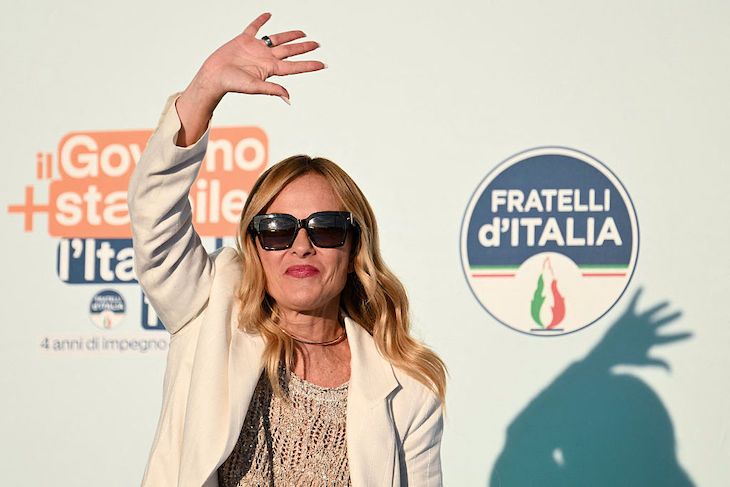
Giorgia Meloni’s right-wing government this weekend became the longest surviving Italian government since the fall of fascism in 1945. It is a remarkable achievement for a woman who identifies as a conservative, but who has been relentlessly branded as “the heir to Mussolini” and a far-right threat to democracy because she was once a post-fascist.
Regardless, Italy’s first female prime minister has become the standard bearer of the European right as the people of Europe continue to pivot right. Elections next year look likely to bring the right to power in both France and Spain.
The Latino will replace the Teutonic in the engine room of the EU
In Italy – where a general election must be held by 22 December 2027, although the talk is of April or May – Meloni remains the favorite to win and thus to break another record: an unprecedented back-to-back second term.
The consequences for the EU will be dramatic as a triple alliance of right-wing France, Italy and Spain will compel the shaky center-right coalition government of Friedrich Merz in Germany to pivot right as well. It will mean that Germany for once no longer calls the shots. The Latino will replace the Teutonic in the engine room of the EU.
At least, that is, until the ever more popular right-wing Alternativ für Deutschland wins at national level in 2029. The AfD has become this year the most popular party in Germany by a country mile in the polls, and on Sunday won its first ever state election in Saxony-Anhalt in former communist East Germany. Herr Merz is going to have to move one heck of a lot more right if he wants to avoid catastrophe.
There have been 68 governments in Italy since 1946 when Italians voted to replace the monarchy that had collaborated with Benito Mussolini’s 23-year fascist dictatorship with a republic. Most have lasted little more than a year. But Giorgia Meloni’s government has now overtaken the late Silvio Berlusconi’s second government that survived 1,412 days between 2001-2005. To celebrate the occasion, Meloni’s party, Fratelli d’Italia, staged a big rally in the port city of Bari in Puglia on Friday where those present were offered local specialties such as Spaghetti all’Assassina. The slogan chosen for the occasion was “Il Governo + stabile, l’Italia + forte” (roughly , “The more stable the government, The stronger Italy”).
Traditionally Italy has been a by-word for political chaos, and so the creation of stability is Meloni’s most important achievement
Traditionally, Italy has been a by-word for political chaos, and so the creation of stability is Meloni’s most important achievement. She is from working-class Rome, never went to university and learned the gift of the gab and the way of the world as a market stall owner. Meloni is the Italian equivalent of a Cockney but she adores Puglia. It is where she always takes her summer holiday and where she hosted the G7 summit in 2024.
Striding with immense intent up to the podium on Friday evening in the shadow of a moored up cruise liner, to the sound of a favorite left-wing song “Ma Il Cielo E’ Sempre Più Blu” (But The Sky Is Always More Blue), no doubt chosen as a taunt to her opponents, this pint-sized political colossus told her party’s activists and politicians:
Stability is the first great reform that we have given this country. Thanks to this stability Italy is no longer Europe’s special surveillance case.
Such stability means, among other things, that Italy’s borrowing costs are for the first time lower than those in both France and Britain. The current yield (interest) on Italian ten-year government bonds is 4.1 percent, compared to those in France of 4.2 percent and in Britain of 5.1 percent.

Critics say Meloni – though she has been one of Europe’s most devoted advocates of military and other aid to Ukraine against Russia – has done nothing much apart from talk tough and loud. This is untrue. Above all, she has brought stability to a country which is a by-word for instability.
Global markets now regard the Italian economy as more stable than those of France and Britain. This is a revolutionary turn-around, when you think that, in 2011, at the height of the Euro Crisis the interest rate on Italian bonds shot through the roof and threatened the survival of the Euro itself.
Despite this, the Financial Times, as ever, mouthpiece of Davos Man, was swift to scorn Meloni’s achievement in an editorial headlined “Giorgia Meloni’s Enviable Stability – And Missed Opportunity”. She has done “almost nothing,” claims the FT, to increase growth.
True, Italy’s GDP growth has been sluggish in the nearly four years she has been in power at less than 1 percent a year. But it has not been much better in France or Britain, and worse in Germany. It’s all very well for the bien pensant bores at the FT to pontificate – as they do in this editorial – that Meloni should have made “deep structural economic reforms.”
But if she had tried, there would have been pandemonium, and her government would not have survived. Trying to kickstart economic growth in ancien régime Europe these days – come sanno anche i sassi (as even the stones know) – has become well nigh impossible for all the obvious reasons.
That said, what Meloni has done is help create 1.3 million full-time jobs – she reliably claims – and reduce the unemployment rate from about 8 percent in 2022 to around 6 percent. Just as significantly, she has got the budget deficit down from about 8 percent in 2022 to 2.8 percent this year – and so under the EU’s permitted 3 percent limit. The budget deficit in France meanwhile remains well above the EU limit at 5.1 percent.
Yes, it is true that real wages have gone down in Italy since it joined the Euro in 1999. And that Italy is the only EU country where this has happened. However, despite this, GDP per capita in Italy, adjusted for Purchasing Power Parity (PPP), overtook that of France and Britain in 2024. Italy’s has slipped back since but remains more or less in line with those of France and Britain.
As for migrants, Meloni reduced migrant sea arrivals to Italy from north Africa by 60 percent in 2024 and in 2025 compared to 2023. So far this year the number – about 19,000 – is even lower, and not much more than the figure for migrant small boat arrivals this year to Britain from totally safe France (15,897). So migrant sea arrivals to Italy in 2026 are set to be up to 80 percent lower than in 2023 at the start of her premiership. This impressive reduction is largely thanks to a €1 billion ($ 1.2 billion) EU investment and loan deal with Tunisia from 2023, which Meloni orchestrated, part of which obliged Tunisia to stop migrant departures. She has also reinforced similar EU and unilateral deals with Libya.
It does not end there.
The EU has now officially approved the creation of migrant hubs outside the EU – such as the ones Italy has built in Albania but has so far been unable to use – for the swift processing of migrants from safe countries who have no right to claim asylum. In the case of Italy, by far the most migrants come from Bangladesh.
Though accused of being a threat to democracy, Meloni is the first Italian prime minister since 2011 to have come to power as head of a coalition that won a majority of seats at a general election
Until now, the Italian courts have stopped Meloni sending safe country migrants to her purpose-built detention centers in Albania, on the grounds that in their opinion countries like Bangladesh are not safe countries. However, the EU has now drawn up a list of safe countries which includes Bangladesh. This will weaken judicial attempts to say that such countries are unsafe.
In addition, the new EU Migration Pact that came into force in June expressly authorizes EU countries to set up third country safe country return hubs like the one built by Meloni in Albania. When Meloni suspended free movement with Spain under Schengen as a result of the recent invasion of Ceuta by up to 80,000 migrants from Morocco, 22 EU countries supported her.
Her party, Fratelli d’Italia, remains well ahead of other parties in the polls with more support than it got votes at the 2022 general election at which it triumphed at the head of a right-wing coalition – something virtually unheard of in a western democracy for a party in power. Meanwhile, the opposition parties of the left lack charismatic leaders or a compelling narrative and are divided.
The main threat to Meloni comes from the right, in the shape of a new party founded in February by a former paratroop regiment general (and author of a self-published anti-woke cri de coeur that became a runaway bestseller) as a breakaway right-wing party from Meloni’s coalition ally, the Lega.
Called Futuro Nazionale, its leader Roberto Vannacci accuses Meloni, just like the FT, of being all mouth and no trousers. It has already gained 7.5 percent support in the polls, which is more than the Lega and her other coalition partner Forza Italia.
Clearly, Vannacci would never form a coalition with the parties of the left, but the danger is if he does a deal with Meloni, then her other coalition party – Forza Italia – which is center-right rather than right – might quit the coalition and deprive her of the necessary seats to form a government.
Worse, Forza Italia might ally with the left-wing coalition parties, thus potentially giving them enough seats to form a government.
Or, just as bad, Futuro Nazionale refuses to do a deal with anyone and Italy returns to its time-honored anti-democratic back room horse-trading way of doing things to appoint a compromise prime minister.
One final point: despite being relentlessly accused of being a threat to democracy, Meloni is the first Italian prime minister since Berlusconi resigned in 2011 to have actually come to power as head of a coalition that won a majority of seats at a general election. Four of the six previous prime ministers in the eleven years in between – virtually all left-wing or shades of left – were not even members of parliament when appointed prime minister.
Meloni told the party faithful in Bari: “It is not easy. It requires a mountain of courage, There have been days in which I have felt as if I am swimming in glue but I have never given up and I don’t intend to do so now.”
Che donna!


Comments