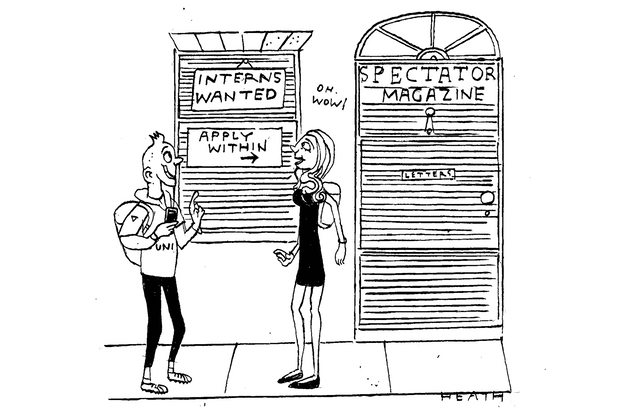
The Spectator runs the UK’s only double-blind internship scheme. We don’t ask for a CV, we don’t use your name. We don’t care where (or whether) you went to university, we anonymise your application. We give each applicant a city name, mark out of 100 and give offers to the best ones. You’ll come in for a week of your choosing in the summer. It’s a useful window into journalism and gives us the chance to meet new talent. When jobs come up, as they do in various fields, we look to hire past interns.
About a third of our editorial staff came through this way — full list below. No other publication goes to such lengths to find interns, which is perhaps why those who make it on our staff list are often snapped up by other publications.
We don’t use CVs because we regard that means of recruitment as stale and unfair, reflecting not much more than whether you were good at exams aged 18. Many brilliant journalists did excel at school and university, but others – like Frank Johnson, a former Spectator editor – took different routes. Looking at The Spectator’s senior editors now, one left school aged 16 and another is an alumnus of Eton and Oxford. None of that stuff matters here. Only talent does.
We typically get 200 applications for about 12 places. So why apply against such odds? It’s fun, fair and genuinely open. If you have applied before, then please do so again: James Heale, now our deputy political editor, applied three times (unsuccessfully).
Please put the text of your application both in the email body and as an attachment. Email entries to internship@spectator.co.uk, deadline 29 March.
Choose a category (or more than one if you like) and for each one do the following:
Editorial
Do three or more of these tasks…
- Suggest three articles that could run on Spectator Life. Write one of them (600 words).
- Produce the news in brief bullet points (the section at the top) of today’s Lunchtime Espresso email, making sure to match our style. Send your application in before midday, before the email is sent out.
- Find three articles from foreign media (published within a fortnight of your application) that have not been picked up by the UK press and say how The Spectator could expand on them.
- Suggest three alternative website headlines for a Spectator magazine article of your choice
- Write a ‘Notes on’ (500 words).
Steerpike Political Mischief
Do all of these…
- You’re on the political mischief internship and are told you need to find a Steerpike story. How do you spend the next 60 minutes?
- What was the best political interview of 2025 – and why?
- Suggest three FOI requests that could lead to a story.
- In the forthcoming local, Welsh and Scottish elections which five areas would you choose to cover – and why?
- Write a 300-word Steerpike article on a subject of your choice.
Broadcast
Do one of the following…
- Produce a short video (no more than 3 minutes) summarising or giving your analysis on a recent article you read in The Spectator
- Produce a short podcast on the events of a recent Prime Minister’s Questions
- Produce three clips to promote a recent episode of The Spectator.
Do three of the following…
- Write a brief for a Quite Right episode recording. See previous example here. You must suggest three different topics.
- Pitch three guests and topics for one of our Spectator TV shows: Reality Check, Americano, Spectator Originals, Quite Right
- Point out two things we are doing wrong with our broadcast output
- How can we make our broadcasts more discoverable?
- Suggest two ways in which we can improve our social media outreach for both podcasts and TV.
Social media
Do all of these…
- List ideas for how The Spectator can present its social media content to make it more attractive to readers under the age of 24.
- Choose a carousel on our Instagram page that really grabbed your attention and made you want to read the full article and tell us why. Then choose a carousel on our Instagram page that you think people will swipe past and tell us why.
- Develop a video concept for The Spectator that maintains our intellectual rigour while adapting to the platform’s format and audience.
- Propose a strategy for using our archive (we are the oldest continuously published magazine in the English language) in an innovative way on social media.
Data journalism and research
Do all of these…
- Find two factual errors in the magazine from the last year (please do not report them to Ipso).
- How many people move off universal credit into work every quarter?
- Suggest and build in datawrapper two graphs that could fit in this magazine cover article or another Spectator article of your choice (if you can, make them auto update using python).
- Make an interactive dashboard for a new part of The Spectator Datahub (‘vibe coding’ encouraged and you don’t have to host it).
And for all applications…
Send a covering letter, saying why you’d like to apply. No coded references to where you went to uni please (i.e. ‘I edited my student newspaper, Cherwell’). If you have been accepted on a journalism postgrad (like City) or vocational course (such as the News Associates course), then do mention this. It shows commitment and any journalist will need plenty of that.
There is an advantage to sending your application in early as we start processing and even making offers quite early. The internship pays (although not very much). We do ask that you only apply if you’re available for employment in the next two years.
And some previous interns:
- John Connolly (news editor) 2018
- Gus Carter (deputy features editor) 2019
- Lukas Degutis (editorial manager) 2021
- Oscar Edmondson (head of podcasts) 2021
- Max Jeffery (writer-at-large) 2020
- Margaret Mitchell (US assistant editor) 2023
- Svitlana Morenets (Ukraine reporter) 2022
- Michael Simmons (economics editor) 2021
- William Atkinson (assistant content editor) 2021
- John Power (assistant content editor) 2022
Out, and into the world…
- Sam Holmes (comedy producer, BBC) 2021
- Tali Fraser (Daily Mail, House magazine, ConHome) 2019
- Adam Cherry (GB News, Guido Fawkes) 2019
- Poppy Greenwood (Spectator video editor, who then went to the Times) 2019
- Sophie Jarvis (former political secretary to the Prime Minister) 2019
- Katherine Forster (the Sunday Times, GB News) 2018
- Madeleine Kearns (The Free Press) 2018
- Eleni Courea (the Times, Politico, the Guardian) 2015
- Seb Payne (WashPo, FT, ‘Onward’, The Times) 2014
- Cindy Yu (Head of broadcast, who then went onto The Sunday Times) 2015
- Fabian Carstairs (FT) 2023
- Kara Kennedy (The Free Press) 2021
- Mimi Yates (Daily Mail) 2024
- Waseem Mohamed (reporter, The Times) 2024





Comments