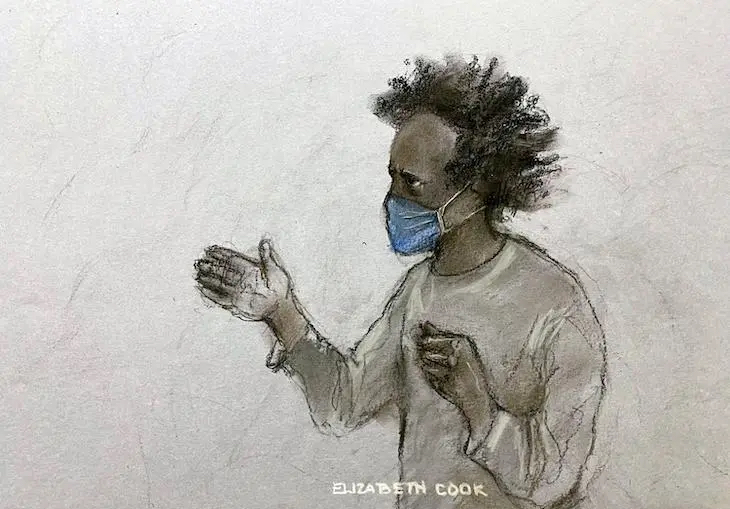
The Southport murders and maimings did not need to happen. Three little girls, Elsie, Alice and Bebe, should still be alive. That is the conclusion of the first phase of the Southport Inquiry, which was published today. Who then, is to blame? Axel Rudakubana himself, of course, but reading through the report it is clear that there were countless opportunities to prevent this horror, and many people who failed in their duties.
His family are clearly to blame, although the inquiry warns against ‘demonising’ them. They ‘had some knowledge of his possession of weapons and knew of the aborted attack’ which Axel planned the week before Southport. The killer’s father, Alphonse, seems particularly difficult. Despite Axel’s violence in schools, his father believed he should return to mainstream schooling. When Axel was becoming increasingly violent at school, his father ‘took his son’s side’ on every occasion, especially when the boy claimed he was being bullied. Even the horrific killings of July 2024 do not seem to have changed Alphonse’s opinion very much – during his evidence at the inquiry he also ‘resorted to his earlier criticisms of various of the agencies which had been involved’ with his son. He also claimed in his evidence that ‘the entirety’ of Rudakubana’s ‘deteriorating behaviour’ was the fault of his school.
So the family environment was very much part of the problem. But Rudakubana also had a great deal of contact with many education, mental health, social work and justice professionals who became aware of the boy and the risk he posed. Again and again they failed.
In October 2019 the killer contacted Childline, telling them that he wanted to kill another pupil at the Range High School, where he was a pupil at the time. Rudakubana told Childline that when he saw a particularly boy ‘I want to kill him and I just get more angry when he pushes and just touches me.’ Childline referred the matter to the National Crime Agency, who in turn informed Lancashire police, who visited Rudakubana at home that evening. When the police questioned him Rudakubana admitted to taking a knife with him to school on ‘about ten occasions’. At the time one of the police officers considered that Rudakubana had ‘both the means and the intention of committing a murder’. When the officers explained to him the consequences of being arrested, Rudakubana ‘recanted somewhat’, and the officers decided not to arrest him and no criminal investigation took place. The inquiry tells us that this response is ‘in line with their training and the prevalent culture in policing’. So the school was informed, although his potential victim and family were not, and Rudakubana was permanently excluded.
Rudakubana was then enrolled at the Acorns School, a special school for pupils who had been excluded from mainstream education. Here the deputy headteacher, Joanne Hodson, immediately had grave concerns, saying that from his first day should could tell that he was ‘very high risk’. Indeed, on 11 December 2019, Rudakubana took a pre-booked taxi back to his old school. He was armed with a ‘adapted’ hockey stick and had a knife in his back. Once there Rudakubana was not able to locate his intended target, so he ‘attacked another pupil seemingly at random’. On this occasion he was taken in to custody and interviewed under caution before being released on bail. For reasons unknown the events of 11 December ‘were not recorded in any real way’ on Lancashire police’s systems.
Given her experiences, when Joanne Hodson found herself drafting an official document on the boy in 2021, she described Rudakubana as ‘sinister’, ‘cold and calculating’. On sharing this draft, Hodson found herself ‘met with hostility’ by both the boy’s father and a mental health worker, Samantha Steed. Indeed, Steed went so face as to accuse Hodson of ‘racially stereotyping’ Rudakubana as ‘a black boy with a knife’, in her response to him looking her dead in the eye and stating he had intended ‘to use’ the knife he took to his previous school. Cowed with the threat that she was ‘racially profiling’ him, Hodson deleted the phrases. Steed told the inquiry that she was worried about the effect on Rudakubana’s ‘psychological wellbeing’ if and when he were to read such words in the future. A clearly dangerous boy’s future mood was thus held to be more important than the safety of pupils and teachers at the Acorns, or the little girls Rudakubana would murder.
Another astonishing failure was by Dr Ramasubramanian, ‘an experienced consultant psychiatrist’ who had Rudakubana ‘allocated to her caseload’. Despite claiming in her evidence to the inquiry that ‘she had reviewed the whole of’ Rudakubana’s mental health record, the psychiatrist was unaware of thirteen key events, despite nine of them being detailed in his mental health records, including that he had taken a knife into school on ten occasions, his habit of searching school shootings, his desire to look at images of a severed head, his stated desire to hurt another boy with a knife and his description of the Manchester Arena terrorist attack as a ‘good battle’ from the perspective of the bomber. Ramasubramanian now accepts that ‘those incidents…were highly relevant to her understanding…and that any assessment of risk would be flawed without knowledge of them’.
Rudakubana was still on Ramasubramanian’s case load when, on 17 March 2022 he went missing from home. His father, clearly fearing another attack, contacted both Range High School and the police. An officer completed a form ‘focusing solely on the risk’ to Rudakubana, rather than the risk he might pose to others. Police officers found Rudakubana that afternoon thanks to a report from a bus driver. He was in possession of a knife. The police took the decision to ‘treat this as a safeguarding issue’ rather than considering arresting him or detaining him under the Mental Health Act.
As the police drove Rudakubana home, he ‘smiled and told them that he wanted to stab someone’, explaining that he believed committing ‘a serious offence’ would cause the police to seize his phone and delete ‘embarrassing videos’ on his social media accounts. During the car journey Rudakubana also made references to poisoning people. Despite this they still did not arrest him. Had they done so his family home ‘would have been searched’ and the police ‘would have discovered the equipment and seeds’ he had bought in an attempt to produce ricin. They also would have seized his devices and discovered his ‘downloads of the Al-Qaeda manual’. The inquiry is clear. If Rudakuaban ‘had been arrested’ on that day, ‘the attack on 29 July 2024 would probably not have occurred’.
Again and again the system decided to treat a dangerous young man as ‘a child’ and focus its concerns on his ‘wellbeing’, rather than ‘stereotyping’ or ‘stigmatising’ him. Just as with Valdo Calocane, every part of the state was concerned with fairness to the killer, rather than his potential or actual victims. In both cases it is clear that anti-racism itself has caused the deaths of innocents. We have to get real. When we know that young men are ‘sinister’ and dangerous then we must remove them from society. If only we had sooner, then Elsie, Alice and Bebe would still be alive, their parents would not be bereaved, and two dozen other children would not carry the horrors and scars of that day with them.


Comments