The devoutly Christian world of Hubert Van Eyck, and his more famous brother Jan, was full of relics. A piece of skull here, a finger bone there, the odd foreskin in a box. It has been said that there were enough pieces of the True Cross to have built the Ark. Many have vanished, including at least one but maybe two much-venerated body parts belonging to the Van Eycks themselves. After Hubert’s death his arm was placed in a reliquary over the west door of the Cathedral of St Bavo in Ghent, which the brothers had adorned with their giant polyptych of the ‘Adoration of the Mystic Lamb’ in 1432. Jan’s hand is also said to have been preserved and then lost. True, the Van Eycks were not canonised, but their contemporaries realised that they had performed miracles of naturalistic painting.
What happened to these famous remains is a mystery: to lose one artist’s hand may be regarded as a misfortune, but to lose two… Mind you, the ‘Mystic Lamb’ altarpiece could itself have been lost when the beeldenstorm – the Calvinist iconoclasm of 1566 – hit Ghent. The cathedral authorities took it apart and hid it in the bell tower. The frame’s inscription had recorded Hubert as ‘greater than anyone’ and Jan as ‘arte secundus’: runner up. If that was true, then Hubert must have been some painter (although nothing of certainty by him survives). Or was Jan just being modest?

We know more about Jan than Hubert because Jan took care to inscribe his name on a number of his paintings, often with a date. There are inscriptions on five of the portraits that are the subject of an astonishing exhibition at the National Gallery that opens on 21 November. They take the form of variations on a personal, punning motto, ‘Als ich [Eyck] kan’ (‘As [only?] I can’). There are ten stand-alone portraits by Van Eyck, made up of nine paintings and one drawing, and they have never before been brought together in one place.
Remarkably, the old chestnut is still repeated that Van Eyck was the first artist to recognise his own worth as the practitioner of a liberal art – rather than being a craftsman fated to remain anonymous. The National Gallery wall text even claims that what is considered his ‘Self-portrait’ (1433) ‘may be the earliest self-portrait in the history of European painting’. This is simply not true, and nor is the further assertion by the National Gallery in its exhibition publicity that ‘the rising status of painters from anonymous craftsmen to celebrated figures [took place] during the Renaissance’ (the excellent catalogue is much more nuanced about all this).
Artists had been celebrated individuals long before Van Eyck. In 1110 the name of a sculptor was carved on Modena Cathedral’s west front in giant letters: ‘Your name among sculptors, Wiligelmo, blazes forth.’ In Pisa, the elaborate signatures of Nicola Pisano and his son Giovanni are cut in stone on their respective pulpits. Giovanni boasted in 1311: ‘Giovanni carved [this pulpit] … the son of Nicola, blessed with higher skill, and endowed with mastery greater than any seen before.’ As for self-portraits, Giotto painted himself in the ‘Last Judgment’ (c.1305) in the Arena Chapel, Padua, while in the same city Altichiero’s self-portrait stood over his own name, as he gazed back over his incomparable 1384 fresco sequence in the Oratory of St George.
What is undoubtedly true about Van Eyck is that he was valued so highly by Philip, Duke of Burgundy, his patron in Bruges, that he was given a salary, and so released from the need always to work to commissions. Van Eyck was free to paint, to an unprecedented degree, secular individuals of a similar social status to himself, including his wife Margaret, in a portrait that I recently examined behind the scenes at the Groeninge Museum in Bruges.
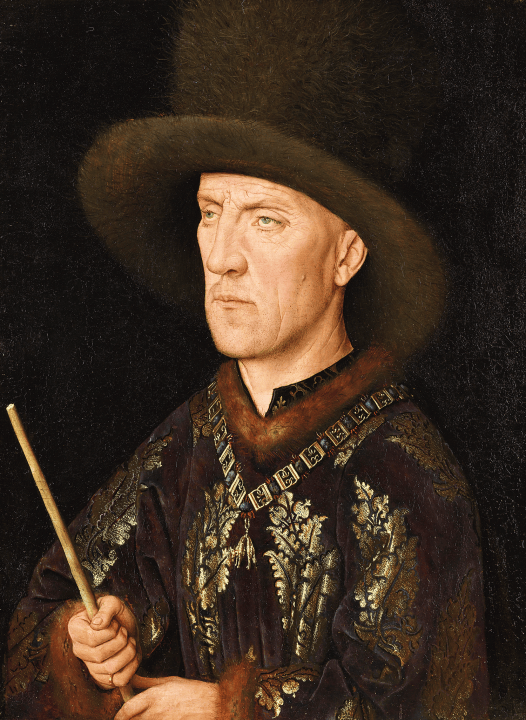
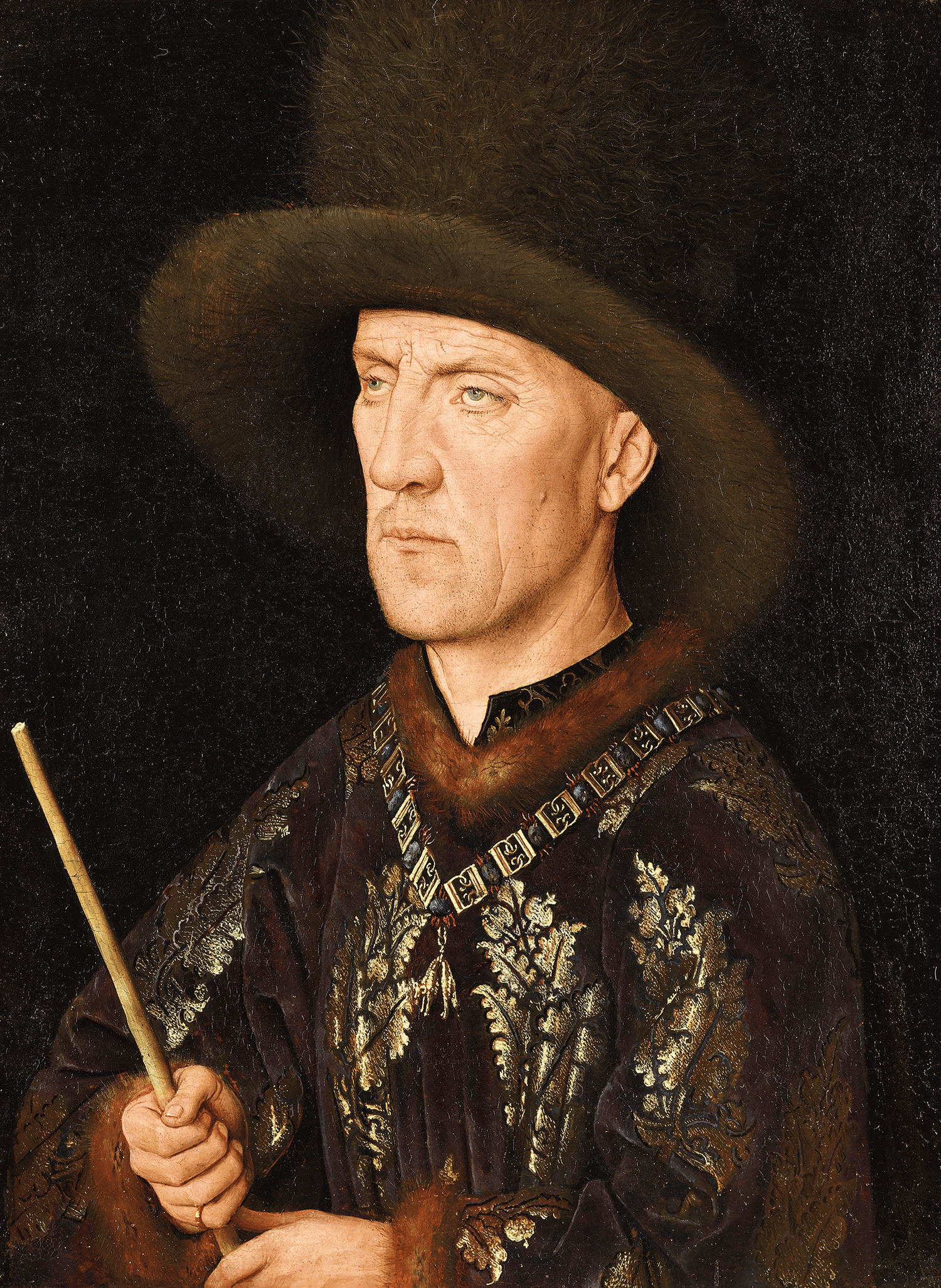
So remarkably naturalistic is the painting of Margaret’s head that, as with every other Van Eyck painting, one is amazed at his complete mastery of oil painting, the full potential of which he was the first to exploit. Initially, the picture appears to be flawless, but it struck me, as it has in the past, that Margaret’s body is remarkably small for her head. The same phenomenon, to a lesser degree, can be seen in his ‘Self-portrait’ and is more evident when hands are shown, as in his ‘Léal Souvenir’ (1432) and ‘Baudouin de Lannoy’ (c.1435-40), which is almost as extreme a case as in ‘Margaret van Eyck’ (1439). Apropos, the famous little figures in the background of the Louvre ‘Virgin and Child with Chancellor Rolin’ (c.1435) are strangely stunted, with heads and bodies far too large for their tiny legs.
But Van Eyck possessed uncanny powers of direct observation, and I am prepared to bet, for example, that his painting room had a double window because you can see it minutely reflected on the right-hand of Margaret’s eyeballs. The same reflection can be seen in the ‘Self-portrait’, in ‘Cardinal Albergati’ (c.1438), and in the patron in the ‘Virgin and Child with Canon van der Paele’ (1434-36). As it happens, Van Eyck shows a double window at the left of the ‘Arnolfini Portrait’, and it is duly reflected in the convex mirror behind the couple. In ‘Léal Souvenir’ (1434), the window reflection is on the left-hand side of the eyeballs, and so if the sitter was in the same room he was facing the other way.
There is plenty of controversy about the subject of the ‘Arnolfini Portrait’ and the couple’s identity. A convincing argument suggests that it shows Giovanni Arnolfini with a posthumous image of his wife, who had died by February 1433, probably in childbirth, a year before Van Eyck dated the portrait. It would thus record Giovanni’s loss in the form of a poignant reaffirmation of his marriage vow. His features are highly individualised, as is the case with all Van Eyck’s portraits from life and, in a dramatic coup, this exhibition will show for the first time the double portrait alongside Van Eyck’s separate record of Giovanni. That equally marked characterisation serves only to emphasise the contrast with Van Eyck’s depiction of Giovanni’s lost wife. She is merely a generically beautiful woman, idealised in death because she was no longer around to sit for the artist.
The Van Eycks’ contemporaries realised that they had performed miracles of naturalistic painting
Reflections, in every kind of surface, from brass and armour to the human eye, are an integral part of Van Eyck’s art, most famously in that convex mirror beneath the inscription ‘Johannes de eyck fuit hic’ (‘Jan Van Eyck was here’). In the ‘Virgin and Child with Canon van der Paele’, in addition to the dazzling reflective effects and the uncanny representation of different materials, we see a pair of spectacles prominently held in the patron’s hand. It seems to draw attention to Van Eyck’s mastery of ‘ways of seeing’. Was he using optical devices? If, so, which?
David Hockney noticed that in Ingres’s 19th-century drawing of ‘Mme Godinot’ she has a disproportionately small body. It makes a striking comparison with ‘Margaret Van Eyck’. Hockney suggested that Ingres was using a camera lucida to trace his sitters and so perhaps Van Eyck was doing the same. Optical devices of this kind, Hockney argued, offered the only plausible explanation for the sudden leap in naturalism that took place in painting at the time of Van Eyck. It is clear from his pictures that Van Eyck had a deep knowledge of how light passes through gemstones and glass, and he was celebrated as a polymath: painter, scientist, courtier and international diplomat. It seems perfectly possible that this Leonardo of the North had developed a form of camera lucida, which uses a prism to project an image downwards on to a flat surface, where it can then be traced.
As it happens, an unwanted variation in the relative size of the parts of a subject is a built-in snag with the camera lucida. The problem arises if the subject is sitting down and you later change the distance between device, flat surface and subject, because the scale of the image produced then varies proportionately. Ingres always produced sketches of his sitters’ bodies independently from the heads and evidently became aware of this particular problem. I have just been looking (in the spectacular exhibition Ingres et la Mode at Montauban) at his drawing for a never-completed standing portrait of Monsieur Bertin (the seated image is legendary). It shows a separate head pasted on to a separately studied body, and the head is squared up, precisely in order to ensure a unified scale for the whole figure.
The odd effect seen in ‘Margaret van Eyck’ could easily occur if, similarly, the head was first drawn and then the body traced at a second session when Van Eyck had altered his position. In the instance of only one individual portrait is this effect wholly absent, that of the man identified in the past as Cardinal Albergati. Uniquely, Van Eyck’s preparatory drawing for ‘Albergati’ survives and in it, indeed, the body is proportionately too small. On that occasion, as Ingres was to do, Van Eyck adjusted the error in his finished painting – which he failed to do in his portrait of Margaret a year later. Evidently, a revolution as radical as Van Eyck’s was as hard to control as any other.
Van Eyck: The Portraits is at the National Gallery from 21 November until 11 April 2027.




Comments