
Everything is bigger in Texas. And that now includes the epic repudiation of Donald Trump by the American voters in the midterm elections. Yes, Republicans got pummeled in several conservative redoubts, including the loss of Senate seats in Kansas and South Carolina. But the biggest, most expensive and most stunning losses happened in the Lone Star State.
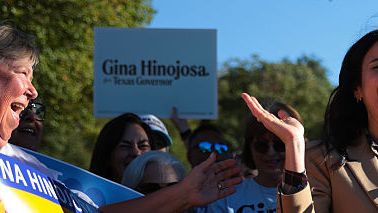
After 32 years in the wilderness, Texas Democrats won eight statewide races in a single day, including the thumping of incumbent governor and Trump ally, Greg Abbott, by Gina Hinojosa. They also won the lieutenant governor, attorney general, comptroller and three other offices, and flipped control of the Texas House of Representatives.
If a Democratic candidate can count on Texas’s 40 electoral votes, the path to the White House suddenly becomes far easier
Republicans weren’t the only ones who got pummeled. The other big losers include Texas resident Elon Musk and his friends in Big Tech, who are now wondering about the future of their data center projects. Furthermore, by losing Texas, which will now have a Latina governor, it’s easy to see how Texas could rally Latino voters in future presidential elections and become reliably Democratic in 2028 and beyond.
Before we get to that, it’s essential to understand what happened in the US Senate race. James Talarico defeated Ken Paxton, one of the most corrupt politicians in Texas history, in a landslide victory. Despite Paxton’s awful record, Trump endorsed him anyway, because he said the incumbent, Senator John Cornyn, a moderate Republican, “wasn’t particularly loyal to me.”
Trump’s endorsement was the kiss of death. Why? Exit polls show that 90% of voters named corruption as a crucial or major issue.
Talarico’s vote totals are gobsmacking. He got more votes (5.4 million) than any other candidate on the Texas ballot. He also won his race by a larger margin, in both absolute and percentage terms, than any other Democrat. He collected 1.2 million more votes than Paxton and beat him by 12.3 percent. By comparison, Hinojosa beat Abbott by about 700,000 votes, with a margin of 7.4 percent. The numbers tell the story: Texans turned out in droves to vote for Talarico, or perhaps to vote against Paxton, or maybe both.

By beating Paxton, Talarico, a soft-spoken 37-year-old bachelor who is pursuing a Master of Divinity at the Austin Presbyterian Theological Seminary, rocketed out of obscurity to win the most expensive non-presidential political contest in US history. ($573 million).
This week, I spoke to a lobbyist who has worked the halls of the Texas Capitol for decades. Like nearly every other political observer in Austin, he expected a tight race between Talarico and Paxton. In fact, he expected Paxton to win. On Wednesday, he told me that Talarico “ran one of the best campaigns I’ve ever seen. Maybe the best since George W. Bush beat Ann Richards in 1994.” Indeed, Talarico campaigned hard, stayed consistent in his messaging, and ran ads attacking Paxton for corruption that were devastating and often riotously funny. (Do yourself a favor: watch this Talarico ad, which shows Paxton stealing a $1,000 Mont Blanc pen at the Collin County Courthouse in 2012.)
Talarico’s victory is a stinging rebuke to Musk, who contributed $168 million in August and September to political action committees backing Paxton. In all, Musk spent $445 million on Republicans in the midterms, with at least $225 million going to campaigns in Texas. But even Musk’s mountain of money couldn’t stop what US Senator Ted Cruz – who is now the only remaining statewide Republican in Texas – has dubbed the “blue tsunami.”
Musk, who moved Tesla’s corporate headquarters from California to Texas in 2021 to get away from Democrats, now must grapple with an entirely new political environment at both the state and federal levels. Earlier this year, the New York Times found that Musk has “quietly built an empire of more than 90 companies and other legal entities in Texas,” including his EV company, SpaceX, his personal security business, X and others. And the state has lavished incentives on his companies, including a $1.7 billion tax break for his Terafab project.
Top of mind for Musk will be his ability to build data centers in Texas and other states. During her campaign, Hinojosa called for “an immediate moratorium on data centers to last until the legislature can meet to put in place real protections” for local citizens. She reiterated her stance on Thursday, saying that she wants “laws to protect Texans” from the projects. She also said she doesn’t “hate data centers. I hate the way they are taking advantage of Texas, and that stops when I’m governor.”
Musk understands the risk. At 12:12 a.m. on Wednesday, after the midterm results were clear, he posted on X, “data centers in space looking pretty appealing right now.”
Regardless of what happens with Musk, it’s clear that Democrats are riding the biggest wave of political support since the Watergate era. They control the House, the Senate and they are perfectly positioned to win the White House in 2028. That goes back, once again, to Texas. The last time Texas voters backed a Democratic presidential candidate was Jimmy Carter in 1976. Ever since then, Republican presidential candidates have largely been able to ignore Texas in their campaigns because they could count on the state’s 40 Electoral College votes in their pursuit of the 270 needed to win the White House.
That’s not true anymore.
Texas has turned blue, and a key reason is the surge in the state’s Latino population, which turned its back on Republicans in the midterms and voted overwhelmingly for Democrats. Since 2000, the number of Latinos who are eligible to vote in Texas has doubled, to 6.3 million. The Latino share of the state’s electorate now stands at almost 32 percent. Latinos also account for more than 45 percent of the state’s young voters. And here’s a key point: About two-thirds of eligible Texas Latinos speak Spanish at home, and half are bilingual in English and Spanish.
Now consider the significance – and symbolism – of Hinojosa, who speaks perfect Spanish. She’s the first Latina elected as governor of Texas. She’s of Mexican descent. (Her mother was born in San Luis Potosí.) She grew up in Brownsville, attended public schools, graduated from the University of Texas and earned a law degree. She’s married and has two children. In other words, for many Latinos, Hinojosa embodies the American dream.
Given those facts, Hinojosa will be enormously influential in turning out the Latino vote in Texas and other states for the Democratic presidential nominee in 2028. If a Democratic presidential hopeful can count on California’s 54 electoral votes, as well as Texas’s 40, the path to the White House suddenly becomes far easier for Democrats than for Republicans. And remember, Hinojosa is relatively young, at 52. That means she could be a force in US politics for decades to come.
On Thursday, in an analysis of the Republicans’ drubbing in the midterms, longtime GOP strategist and commentator Karl Rove placed the blame squarely on Trump. Rove, who played a key role in turning Texas into a Republican stronghold, said Trump’s “wild accusations, sloppy insults and over-the-top bragging” distracted from the messaging the Republicans needed. Rove concluded by saying that Trump’s “policies and candidate choices burned the Republican party to the ground.”
Nowhere was Trump’s arson more obvious than in Texas.




Comments