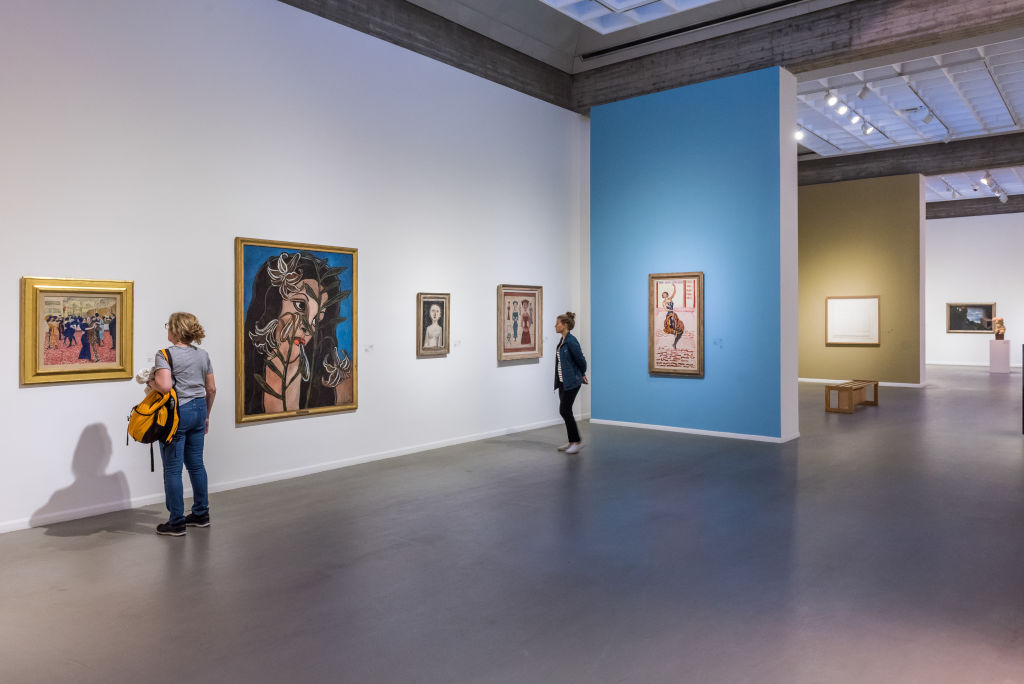
The Israel Museum in Jerusalem (IMJ) – home to impressive collections of ancient and modern art and some of the world’s rarest antiquities, such as the Dead Sea Scrolls – celebrated its 60th anniversary last year by launching eight new exhibitions. All focused exclusively on showing Israeli artists or works within the museum’s collection. The centrepiece exhibition, Israeli Art: Swing of the Pendulum, featured Reuven Rubin’s triptych from 1923, ‘First Fruits’, a work that embodies the harmony of Jewish immigrants and local Arabs in the early days of the British Mandate of Palestine. On the opposite wall hung Zoya Cherkassky’s diptych ‘Friday in the Projects / 1991 in Ukraine’, painted in 2015, depicting scenes of brutal street violence and war. Rubin’s idyllic harmony and Cherkassky’s horror conveys how life in Israel is like a swinging pendulum, constantly shifting between war and peace.
Artists and museum workers have had to adjust to the trauma and challenges of continuous multi-front wars, a depleted tourist industry, and the adversity of being shunned by a hostile, anti-Semitic international art community
The pendulum took a major swing last month, when sirens rang out across Israel, alerting the nation that the air force had carried out the opening salvos of Operation Roaring Lion against Iran. It was Shabbat morning, the day of rest, but museum workers and curators were called in to begin taking down valuable artworks from gallery walls, packing up rare artefacts, and storing them underground. It was a familiar task, one rehearsed last June at the start of Operation Rising Lion, on the afternoon of 7 October 2023, and many times in between.
Since 7 October, the Israeli art scene should perhaps be described not as a pendulum, but a raging storm on the high seas. Artists and museum workers alike have had to adjust to the trauma and challenges of continuous multi-front wars, a depleted tourist industry, and the adversity of being shunned by a hostile, anti-Semitic international art community. But how you ride out a storm is what matters. Rather than being swallowed alive by the waves, the Israeli art world turned inward and had innovative responses to keep the beacon of culture alive.
Immediately after 7 October, ‘some [artists] stopped creating entirely – the reality led them to retreat inward and lose a sense of meaning,’ noted Raz Shapira, curator and head of art at Freshpaint Group in Tel Aviv. But after periods of mourning and reflection, creativity rebounded. When interviewing artists for Freshpaint’s 2025 Art & Design Fair – Israel’s premier annual art event – Shapira recalled how the opportunity to participate in the event inspired many Israeli artists to start working again.
Tal Mazliach, who survived Hamas’s October 7 attack on Kibbutz Kfar Aza, could not pick up a paintbrush for months. When she did start painting again, the 22 acrylic-on-canvas paintings in her War Decorations series, exhibited at the Tel Aviv Museum of Art (TAMA), retold the fuzzy memories and haunting recollections of being holed up for 20 hours in the safe room of her home while Hamas terrorists committed atrocities outside.
For Cherkassky, work became a necessity. The Kyiv-born, Tel Aviv-based artist immediately began sketching the 12 graphic and gruesome drawings in her 7 October 2023 Series as a rapid response to sudden shock and grief. ‘When everything has changed and you don’t understand what’s going on, being able to draw – it’s something that gives me a feeling that I’m still who I used to be,’ Cherkassky said in an interview for the debut of her series at the Jewish Museum in Manhattan.
While war themes became an emotional outlet for some, others feel that current events are still too close to touch. The photographer Tomer Ganihar – whose exhibition on the work of Philip Johnson opened last year at the IMJ – candidly told me, ‘I need more time and contemplation before I can address October 7 and the current war in my art.’
TAMA and the IMJ have been riding out the storm incessantly over the past two and a half years with intermittent periods of closure. ‘We have a protocol for emergency situations; each department knew exactly which work had to be taken down [for safe storage],’ IMJ director Suzanne Landau told me. Within 24 hours of the initial October 7 attack, and during both Operations Rising and Roaring Lion against Iran, specialists relocated the Dead Sea Scrolls and select antiquities and artworks to designated safe places.
In late October 2023, the international art magazine Artforum published its infamous and controversial ‘An Open Letter from the Art Community to Cultural Organizations,’ calling for the boycott of Israeli art and art institutions over the IDF’s military campaign in Gaza. Major international exhibitions were immediately cancelled, and foreign artists refused to show in Israel out of both security concerns and to virtue-signal their rejection of Israel. As a result, Landau, like her counterparts at TAMA, instructed her team of curators to look inward and think innovatively about the museum’s in-house collections for future exhibitions. ‘We are completely isolated from the outside art world,’ Landau said. The collective inward turn became a point of strength and resilience in the face of an increasingly hostile, anti-Israel, and anti-Semitic art world.
TAMA, for example, pulled from its impressive collection of Barbizon and Impressionist masterworks and launched a timely exhibition in 2025 to join major museums around the world in commemorating 150 years since the birth of Impressionism in France. Earlier this year, just before the current war with Iran, the museum wrapped up a major exhibition of German New Objectivity from the collection of a private lender. The New Objectivity artists in the 1920s and 30s interpreted European society through a sobering and often brutal lens following the horrific experiences of the first world war. The TAMA exhibition prompted the curator Noam Gal to ask, ‘What do we have in common with this work?’ especially as Israeli artists continue to face destruction and death from Iranian cluster bombs and Hezbollah rockets.
Curator Tamar Margalit at the Center for Contemporary Art (CCA) in Tel Aviv also had an innovative approach after international artists cancelled their shows. The CCA’s 2025 group exhibition, Spectacular Failure, showcased contemporary Israeli art that undermined the inherent competitiveness of conflicts. Perhaps the smallest and most overlooked installation in the CCA’s show left the deepest impression on me and others who attended the opening. Uri Weinstein’s ‘Incoming Call From Dad’ – an iPhone on the floor (which I almost stepped on) with a perpetual incoming call from ‘Abba’ – was a sobering reminder of sons and daughters who, for a multitude of reasons, cannot answer their parents’ incoming calls.
To open IMJ’s 60th anniversary exhibitions last year, the museum held a major open house event in June. Musicians played in various galleries, performances were staged in the atriums and hallways, a DJ played to cocktail drinkers in the Isamu Noguchi-designed art garden, and the galleries were packed as if all of Jerusalem showed up to celebrate.
Eight hours later that night, the Israeli Air Force carried out Operation Rising Lion against Iran, igniting the so-called 12-day war, or the first Iranian war. The country shifted back into a state of high alert, and museum specialists set to work removing priceless artworks. The second Iran war would erupt less than a year later. But the resilience remained.
‘It doesn’t matter what happens, artists are going to continue working, and, in a way, really interesting art is being made,’ Margalit from the CCA told me. ‘They’re doing it out of conviction and passion. In a way, the art is kind of freeing because it’s kind of against all odds.’

Comments