
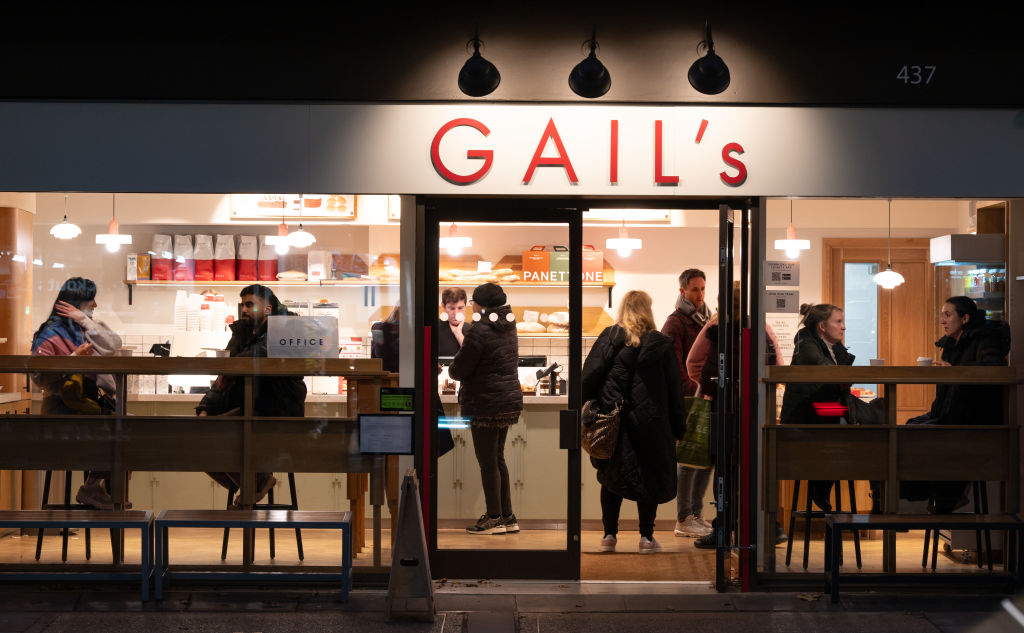
Nothing good has ever followed the words ‘we need to talk’, ‘terms of service update’, or ‘by Jonathan Liew’, and the evidence is really piling up on the third one. The Guardian columnist has written a piece about Gail’s, the bougie coffee shop and bakery chain, and it vents hostility from every sentence like steam from an espresso machine. If you’re wondering how anyone – even a Guardian columnist – could get worked up over pricey lattes, Liew makes sure to tell us Gail’s was ‘founded by an Israeli baker in the 1990s’.
Had Gail’s been a Pakistani-owned business targeted by white Britons aggrieved by the grooming gangs, the Guardian would not soft-pedal it as a symbolic act in a disenfranchised age
Yeah, it’s exactly what you think. Actually, it’s worse.
Gail’s has become a target for people The Spectator’s lawyers would probably prefer me to call ‘anti-Zionists’. People who have called for boycotts of the bakery over Palestine and what its opponents (because bakeries have opponents now) claim is its role in ‘gentrification’. The rationale for the Palestine-related boycott is that Bain Capital, Gail’s parent company, invests in cybersecurity firms based in Israel. As for the gentrification business, the vilification of Gail’s as a symbol of affluent outsiders who don’t belong here certainly seems to dovetail with the anti…Zionism.
But back to Liew. His concern with Gail’s is about Cafe Metro, a nearby Palestinian business in north London. Liew describes eating there: a sumptuous feast of traditional Levantine cuisine, with tabbouleh, falafel and maqluba. It all sounds delicious, even if Liew writes about Cafe Metro’s owners in a patronising tone that borders on exoticism.
Co-owner Faten Sehwail ‘stands at her stove cooking the recipes her mother taught her’ and ‘feels a little closer to the land she left behind’, a land where her family lives ‘a precarious and hunted existence’ but which evokes memories of ‘the big, loud family meals rich with aroma and gossip, where everyone seems to be talking at once.’ There is no such purple prose for Yael Mejia, the British-born, Israeli-raised founder of Gail’s. Her family must have eaten dinner in silence.
As if all these culinary emotions weren’t enough for the owners of Cafe Metro to be dealing with, ‘a number of predators have appeared on its doorstep’. These predators include the usual (Starbucks, Costa) and now, just a few weeks ago, a new branch of Gail’s. Economists would call Gail’s a competitor, but Liew sees it in darker terms: ‘its very presence 20 metres away from a small independent Palestinian cafe feels quietly symbolic, an act of heavy-handed high-street aggression.’
After acknowledging that Gail’s has had all its windows smashed and its walls graffitied with slogans including ‘reject corporate Zionism’, Liew tells us that stickers reading ‘Stop killing people’ have been stuck on Cafe Metro and the local council tried to get them to take down all their Palestinian flags. In this Liew sees a ‘deeply asymmetric war, defined by gross imbalances in power and resources and platforms, but a war nonetheless, and one that simultaneously feels more distant and more local than ever’. If Gail’s-versus-Cafe Metro is a war, Liew is surely our Kate Adie. He adds that, in ‘the current oppressive climate, even to exist as a Palestinian in western society is to be the target of aggression and suspicion, to be tainted as a murderer and an antisemite’. I stand corrected. He’s our Jeremy Bowen.
Liew muses that ‘perhaps this is simply the nature of an increasingly disenfranchised age’, contending that Palestinian activism has ‘never been less capable of exerting a meaningful influence on global events.’ Oh, I don’t know. October 7 was a nifty bit of Palestinian activism: invade your neighbour, murder 1,200 people, rape women, burn children and get rewarded with a state while your neighbour gets accused of genocide for fighting back. Sounds like meaningful influence to me.
But in Liew’s alternative reality ‘small acts of petty symbolism’ – including ‘a smashed window’ – now define the Palestinian cause. You can’t stop the US or Israeli militaries, or make the council boycott Israel, or support Palestine Action, and so ‘some people then direct their ire at the bakery with distant links to Israeli security funding’. If you can’t take on an army, prevent others from buying medjool dates, or support a banned organisation, isn’t smashing up a bakery vaguely connected to the Zionist entity to be expected?
Liew never recommends this course of action; he just sighs wisely about the humanity of it all. It’s a one-sided humanity, though. Smashing the windows of a Palestinian cafe would not be a small act of petty symbolism; it would be a traumatising hate crime. This is why discourse is impossible with a progressive. They simply do not believe in common standards or rules. They believe in Good People (them and theirs) and Bad People (you and yours). Had Gail’s been a Pakistani-owned business targeted by white Britons aggrieved by the grooming gangs, the state collusion and cover-up, and the absence of a full public inquiry, the Guardian would not soft-pedal it as a symbolic act in a disenfranchised age.
There’s a good reason for that: the Guardian regards every ethnic minority as a victim group, to be treated with respect; shielded from hatred; and permitted to define their own victimisation without question or quibble. Every minority except one, and there’s a good reason for that, too. The Guardian regards Jews as white, wealthy, influential, and oppressors of the saintliest people ever to walk the earth. It might be a devoutly disbelieving newspaper but in its political theology the Palestinians appear to hold an almost Christ-like status. The progressive worldview is a meeting place for the worst of post-Christian piety, Soviet anti-Zionism and critical race theory.
Jonathan Liew writes like someone who wants to be liked, keen to hit all the right notes so that people he regards as high-status regard him as one of them. It’s hardly the gravest sin. Most people want to be liked. The error of judgement here is on the part of the Guardian. A good editor would have read this and refused to let Liew embarrass himself or the paper.


Comments