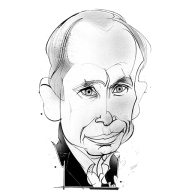

How Chancellors love jacking up the minimum wage, as John Healey has just done in his Budget, by 3.9 per cent. Look, here’s a pay rise on me, he is saying, and it doesn’t even require a penny on tax to pay for it.
Left-wing economists have a word for it: ‘predistribution’, which means trying to achieve economic equality without having to tax and spend (not that there aren’t also numerous benefits on offer the poor as well).
Look, here’s a pay rise on me, Healey is saying, and it doesn’t even require a penny on tax to pay for it
It isn’t just Labour Chancellors who have fallen for the lure of increasing the minimum wage, but Tory ones, too. That is why, following Healey’s latest move, we will have a National Living Wage (for the over 21s) of £13.20 per hour and a National Minimum Wage (for 18-20 year olds) of £11.27 per hour. This is nearly twice the level the minimum wage would have been had it simply increased with inflation since it was introduced in 1999. Initially, the over 22s received £3.60 per hour (which would be £7.20 at today’s prices) and 18-21 year olds £3.00 per hour (now £6.00). Over 21s on the Living Wage will now earn more than £27,000 a year.
How lovely the world would be if you could make everyone richer simply by announcing an increase in their wages. Being Chancellor would be the best job in the world, and Healey would be everyone’s favourite uncle.
Sadly, however, the real world doesn’t quite work like that. Someone, of course, will have to pay for an increased minimum wage. The direct victims, needless to say, will be employers, who will suffer a hit to their wage bill. That may mean less profit, less investment in the business – or staff being laid off. That brings us to the next round of victims: the employees who are handed not a pay rise but a redundancy cheque.

But a minimum wage has a more subtle effect than simply costing jobs. Repeated increases in wages at the bottom lead to a phenomenon known as ‘wage compression’, where the differential between the earnings of the lowest-paid staff and those in high brackets is eroded.
Workers at the lowest end may be receiving a 3.9 per cent pay rise thanks to the Chancellor but you can bet that those higher up the pay scale will be receiving a lot less than that. The 3.9 per cent rise in the minimum wage is, after all, higher than inflation (3.5 per cent according to the Consumer Prices Index) and the average increase in earnings in the private sector (3.0 per cent according to the Office of National Statistics).
When the Institute for Fiscal Studies looked into the issue of wage compression in 2024 it found a significant reduction in the ratio between earnings at the 50th percentile and those at the 10th percentile. It also found a fall in the ratio between pay at the 90th percentile and 10th percentile.
Wages, in other words, are being compressed all the way up a company’s pay structure. The only exception was among firms where there were very large numbers of employees on the minimum wage.
This will please socialists who believe in equality of outcome, but it matters because it is removing some of the incentive for low-paid workers to seek promotions with extra responsibilities.
Why take on the extra stress if you are only going to receive a few extra pounds per week? That makes it harder for firms to find the staff they need, and eventually works against the interests of employees. If you fail to take one step up the career ladder you are never going to advance up it at all.
When Tony Blair’s government first proposed the minimum wage, William Hague’s Tories were dead against it, warning that it would lead to mass job losses. It didn’t. Nor, by the way, did it seem to do anything to reduce the benefits bill, which has risen relentlessly since.
But it is always was crucial at what level the wage was set. Initially, it was at a realistic level. Since then, however, it has galloped upwards to reach a level which is highly distorting to the employment market and, in the longer term, against the interests of employees.





Comments