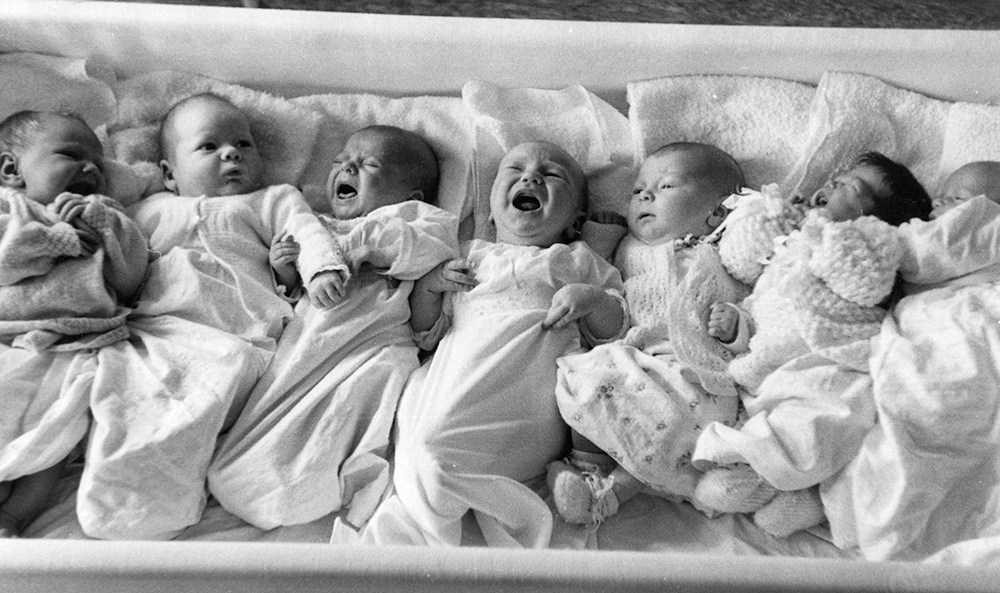


As a Warwickshire girl, born and bred, I am rarely one to take issue with Shakespeare. However, when the intensely drippy Juliet mused ‘What’s in a name? That which we call a rose, by any other name would smell as sweet,’ he may have committed a cardinal error. Only now, as I prepare to welcome a child into the world, do I realise how important names are. There’s the perennial dilemma: finding the sweet spot between ‘everyone is called this’ and ‘my child will get teased’. After all, you want a name that’s distinct but not an obvious bully-magnet, somewhere between ‘John Doe’ and ‘Moon Unit Zappa’.
It’s important to maintain some secrecy. The question with which I am most bombarded by people who notice my bump is, ‘Have you thought of a name?’ Not ‘Is it healthy’, ‘When will you have it baptised’, etc, but the name question. To the average nosy parker, this is of most interest. Maybe, like Rumpelstiltskin, they feel they gain some sort of power through the knowledge of names.
Names, and their changing popularity, tell us as much about our times as any individual taste
Some, however, are not so much interested in the name as in telling you their opinions on it. My mother has already nuked two options which my husband and I were considering by relating stories about girls she disliked in secondary school who had the same name. The fact that these women are unknown to us is of no relevance. When it comes to names, even the nominally polite feel free to smash the crushing boots of their opinions into ordinary conversation.
Names, and their changing popularity, tell us as much about our times as any individual taste. There’s the explosion of nicknames being used as standalone names, perhaps reflecting a less formal society. ‘Lottie’, at 31 in 2025’s most popular names list, is closing in on ‘Charlotte’ (25), while ‘Freddie’ (the tenth most popular baby boy name) is miles ahead of ‘Frederick’ (52). The Sussexes managed this with both their children, Archie and Lilibet – an unmistakable sign of royal decline. Speaking of the Sussexes, the list of names in Britain today shows signs of many – ahem – ‘profound societal shifts’. One of the more benign, if annoying, shifts is the prevalence of ‘America-brain’.
This often manifests itself in the US predilection for place names: ‘Hudson’ and ‘Austin’ (as in Texas, not – alas – Austen Chamberlain) feature in the top 100 for boys. I’m of the opinion that if you’re going to name your child after a place, fine, but at least make it a British place. I won’t rest until I see a baby Kettering enter the top 100. Even more worrying is the frequency of names that reflect a brief moment in pop culture. The presence of Game of Thrones names was a particular blight some years ago. It’s the child I feel sorry for, as inevitably a particular television programme fades from cultural resonance: pity the scores of ‘Khaleesis’ born at the high watermark of George R.R. Martin mania. It would be the equivalent of a man in his fifties walking around with the name ‘J.R.’ or ‘Kunta Kinte’.
Then there is the phenomenon of surnames-turned-Christian names. I’m not against this in principle, but baulk when they sound too American (e.g. Cooper or Madison, both now in the top 100 for Wales). Not least because we already have our own repository of deranged examples. Surely an artisan rediscovery of these is better than lifting wholesale from the New World. Think Sacheverell Sitwell, whose name nodded to the High Tory partisan Henry Sacheverell, or the Revd Sir Borradaile Savory, a 19th-century rector of St Bartholomew-the-Great in Smithfield. It is worth remembering that every figure from the past with a strange name, from the Puritan preacher Praise-God Barebone (c. 1598-1679) to the shipping magnate Preserved Fish (1766-1846), was a gurgling infant at some point. And for all the things we might be blamed for, our name is generally not one of them.
To be clear, I’m not advocating for a kind of name-snobbery. It always comes and bites you in the end. Who could forget when the terminally vile Katie Hopkins was brought on to daytime TV to slag off children named after places, only for it to be revealed that her own daughter was called India? Rather, we all have our own likes and dislikes: so if you see a visibly pregnant woman, perhaps stick to less potentially fractious small talk.
Yet no baby name is an island, and as we weigh up possible labels for our child, it is tricky not to notice trends, like the shift towards Edwardian names. Eight years ago in Liverpool, my husband, who is a priest, began noticing that his baptismal lists were starting to resemble the passenger roll call from the Titanic: countless Alfreds, Arthurs, Ivys, Audreys, Elsies and Ediths. This being Liverpool, you’d still get the occasional eccentric choice, like Presley, for Elvis, or Divock, for the Kenyan-Belgian striker.
I can still just about remember meeting elderly ladies in the 1990s who bore beautiful yet then unmistakably granny names like Edith, Daphne, Mabel – even a very ancient ‘Florence’, born in the same month in 1910 that Florence Nightingale died. Since that generation has mostly gone, perhaps that explicitly ‘old lady’ significance has vanished, which explains why names which P.G. Wodehouse felt suitable for Bertie Wooster’s maiden aunts are now being borne by gurgling babies once more. Given the cyclical nature of names, in a few decades’ time many classic Boomer names may yet enjoy a second renaissance. If you really want to get ahead of the game, now’s the time to lock in baby Linda, baby Sharon, maybe even baby Nigel, or baby Ian, like Mark Corrigan’s son in Peep Show.
Perhaps, then, Shakespeare was on to something. People always say, ‘oh I can’t imagine a baby X’, but what people can imagine is mostly a matter of habit and, as we can easily trace, it changes in even half a generation. A baby, by any name, is an incredible gift. Even if it stares up at you while lumbered with the name ‘Preserved Fish’.



Comments