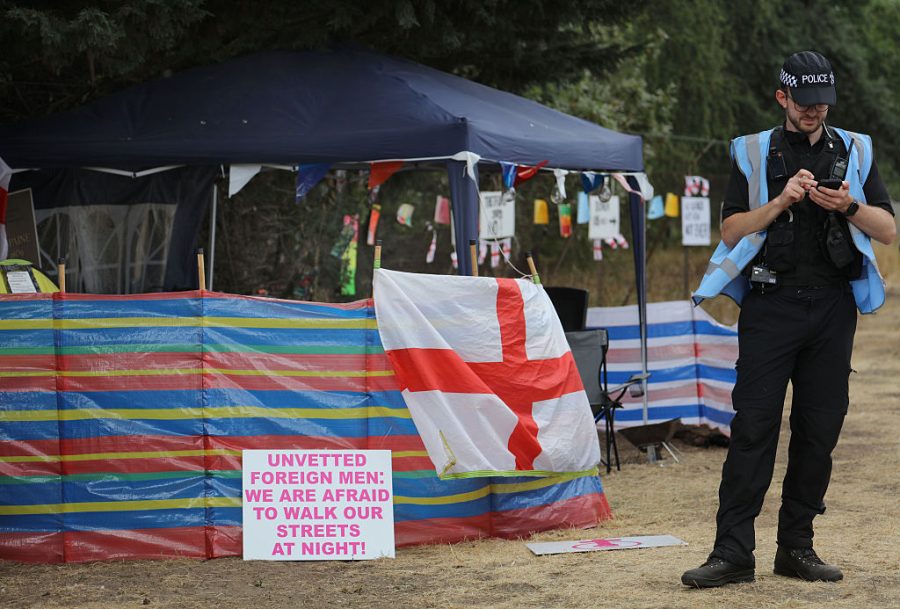
Over the last four nights, unrest has broken out in the small Norfolk town of Thetford over the housing of migrants in HMOs within the local estates. Depending on your choice of media, you will see a range of reactions to the unrest, ranging from the rare ‘mostly peaceful protest’, to the more common ‘thuggery’, ‘violence’, and ‘rioting’. I am hesitant to take either side, and so for the time being will continue to refer to it as precisely that – ‘unrest’.
As a Thetfordian myself, though, having seen the responses of some of those involved and watched local footage, some of the reports about the unrest are exaggerated. Although there were a handful of arrests, and unsavoury words and actions that I certainly would not condone, if we can refer to larger incidents of disorder as ‘mostly peaceful’ (such as the Notting Hill Carnival or BLM), then there is a legitimate question about whether Thetford is being described consistently.
What is missing from a lot of the media coverage, however, is what sparked the unrest. More importantly, too, is what the story of Thetford can tell us about the mood in the UK.
Until British people learn to have empathy for other British people, this is only going to get worse
Thetford is not the idyllic sleepy Norfolk market town one might picture. It perhaps once was, but no longer. In recent years there has been an influx of immigration into the town. Much of this has been relatively positive, and Thetfordians will be the first to tell you so. Thetford has, for example, a thriving Portuguese community, a fairly well integrated Polish community, and many other such immigrant communities.
Most Thetfordians have no problem living alongside these people, and even many of those who attended the unrest do not have a problem either – something I know firsthand. However, there has also been the same gradual change to Thetford that most towns and cities across England have seen: the vape shops, barbers, and takeaways – cash preferred if you please. For those who have lived here a long time, it is not always what they want to see happening to their town centre.

So when it was then announced, after much speculation in the town, that RAF Barnham would be used to house around 1,250 migrants, many locals came together to protest the plans. As I discussed in my article on the first protest, the feeling was that the plans had already been agreed without consultation, and that locals’ voices had not been heard.
More recently, there has been the arrival of what seemed to be very new and unintegrated migrants. In a small town where people recognise each other, this stood out like a sore thumb.
With the feeling that things were again being hidden, some went digging, only to discover that migrant men had been moved into HMOs in the local estates, once again without consultation, and again overlooking the nearby primary school.
What this led to was the events we have seen reported in the media. Four migrant men were escorted by police out of a house on the first night of unrest, with more police escorts as other houses were tracked down and protests ensued outside.
The truth is that the situation has shown a complete lack of empathy – but not in the way you may think. It should go without saying, I do not condone tracking down migrant HMOs and intimidating them. I do not condone the violence against police where it has occurred. But I also do not condone the lack of empathy shown towards the people of Thetford.
Yes, there were ‘thuggish’ types present at this unrest, and there was violence, but too many have forgotten how to have empathy for even these people. Whilst there has been plenty of empathy for the migrants, removed from their government-provided accommodation, I am yet to see much empathy for locals.
Without sounding patronising (and I really don’t mean to) Thetford is not an affluent place. The council estates where these migrants have been housed are not what one might call gilded. The town offers very few prospects, university-level education is often lacking, and in some areas, one might even call it impoverished.
This is not a story unique to Thetford. All across the UK, there are communities in the exact same position – they feel forgotten by society and belittled by the country their ancestors built. Being blunt, let’s call it what it is; the white working class has been let down – and Thetford is the perfect case study.
It is easy for people to say that they should blame the government, the rich, or other favourite targets of liberal activists. It is easier still to sit in a leafy suburb or trendy diverse community and say, ‘it’s not the migrant’s fault’.
But these people do blame the government. People who have struggled for years to access council housing and public services see newly arrived migrants being accommodated by the state more fully than themselves and feel, understandably, upset, isolated, and angry.
In desperation, people don’t always look at the broader problems or may feel helpless to tackle them, and so they focus on protecting their locale, the place they can control. And when you factor in the brushing under the carpet of the rape gangs, the secrecy of the HMOs, RAF Barnham, and the overlooking of the nearby primary schools, you have a powder keg. If you really cannot empathise with that, then I don’t know what else to say.
In Thetford, I am sad to report, that keg seems to have been lit – but Thetford is not alone. Across the UK, as white working-class communities continue to be ignored, shouted down and called bigoted, things are only going to heat up, and more kegs will catch. Until British people learn to have empathy for other British people, this is only going to get worse.
So yes, the unfortunate stereotype of the big man, covered in tattoos, teeth missing, bald head, beer can in hand shouting ‘get them out’, might not be your cup of tea. But he is no less human than you are, and his voice matters no less. He may not have a degree, he may not have a column, he may not speak English perfectly, but neither do the migrants who garner so much sympathy. This is his home, he doesn’t have another, and so empathy, rather than belittling, would be a much better place to start.




Comments