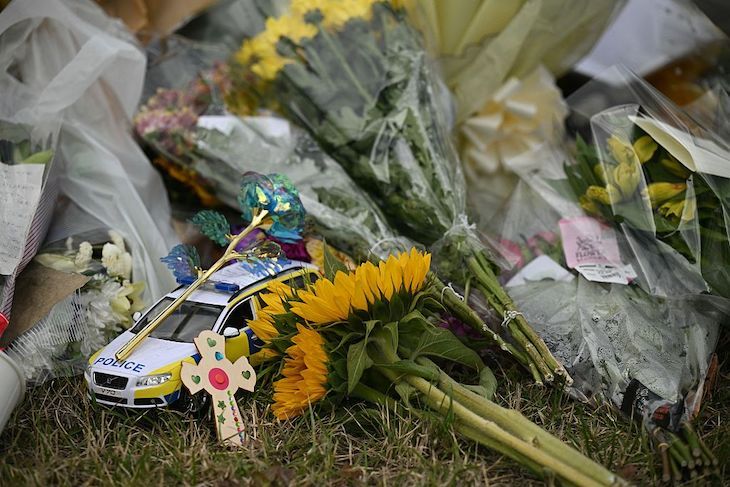
The much-missed Rod Liddle, who knew Middlesbrough so well, would have had exactly the right words to describe the aftermath of last month’s catastrophe on the A66. Five men slammed headfirst into a marked police car carrying Constables Matthew Blades, a former teacher and father of two, and Tom Clough, an Iraq veteran – killing both officers as well as themselves.
PCs Clough and Blades were the very best of Teesside. The five other men who died represent the worst
PCs Clough and Blades were the very best of Teesside. The five other men who died represent the worst. Yet if this incident and its aftermath have shocked the country, for people in the area, it represents a grim escalation in a rising tide of violence.
On hearing the news, my mind went back to my time as a local MP in Middlesbrough, observing a nightshift in Accident & Emergency in James Cook, the town’s major hospital. I watched a stabbed drug addict handcuffed to a bed, trying to bite the young doctor who had her hand inside his collapsed lung. On the Cass House Road in Hemlington, a few hundred yards from Cleveland Police HQ, I heard how gangs threw rocks at passing taxis. Children as young as six were involved. In Middlesbrough, failure has many fathers.
Statistics tell a damning story. Cleveland has the highest crime rate in England and Wales. It has the second highest rate of knife crime per head of population. One in 20 crimes there is categorised as a serious violent offence.
What these bald facts can’t tell you is just how frightening these young men are to their communities. Balaclava-clad teenagers race for sport across the town’s estates on off-road motorbikes and quads. They cluster around shopping precincts, asserting their territory. They know exactly how and where to melt away when the police chase them into their haunts. And they intimidate residents into silence for fear of retribution – a car or a house burned, windows put through, the threat of worse.
But what last month’s event has also exposed is the extent to which this culture of destructive, feckless thuggery has now merged with organised crime. It has been reported that gangland rivals had attacked the homes of family members of two of the A66 crash dead in the immediate run-up to the collision.
A glance back over the past 12 months demonstrates some of what Cleveland Police are dealing with. In July, three young men and a 17-year-old boy were jailed for the brutal murder of Anthony Dickons with machetes and a BB gun, as part of a row over stolen cocaine cash. Last November, 19-year-old Curtis Cremin was jailed for grooming and exploiting young teenage boys to deal drugs. The phoneline he ran to sell cocaine received more than 10,000 calls in a period of just two months. These are not amateur operations.
Sensing opportunity, bigger players have moved in. In particular, Albanian gangs have become a savage new influence on crime in the area. Teesside is a major point of entry for drugs into the UK. For these gangs, the aspiring hard men of Middlesbrough are useful pawns.
It is not so much the nature as the severity of what is happening that currently sets Cleveland apart from other places. If Middlesbrough were a big city, there would have been a national outcry long ago. But it is an unfashionable, far-away town of which most people know little.
What people have now found out, of course, risks worsening the problem. I know just how upset many Teessiders are about the image this has presented of their home, because the reality is more nuanced. I was born and grew up in Middlesbrough and served it for seven years. Most of the town is a very good place to live, full of hardworking, decent, caring people. The serious issues are localised within a handful of postcodes. It’s 15 minutes to both the North Yorkshire Moors and the coast. Massive industrial regeneration is under way, bringing with it a new generation of skilled jobs. But just imagine the impact recent events will have on those trying to attract investment or to recruit talented people to posts on Teesside.
As I write, surge resourcing has seen an extra 200 officers deployed to Cleveland from across the north. But this is a stopgap solution. The Home Office police funding formula needs urgent reform – the extraordinary demands on Cleveland are not reflected adequately by a system that remains too heavily weighted according to population rather than need, and where the precept base is relatively small.
We also need to restore a clear sense that crime is punished: it is soul-destroying for the police to secure arrests only for the guilty to walk out of court with a community-based sanction or a sentence that will see them back out to resume offending in a matter of months. We need to dismantle all the ridiculous constraints that make building the thousands of new prison spaces we need so difficult and expensive. We must end the scandal of early release. Andy Burnham’s announcement over the weekend that the scheme will not apply to manslaughter cases, under pressure to detain the smirking killers of PC Andrew Harper, should only be a beginning.
Recalling the horrific killing of PC Harper in Berkshire in 2019, dragged behind a speeding car, is where Middlesbrough’s story joins back up with our national one. These events are the most damning recent example of what happens when you have a criminal justice system that has ceased to represent either punishment or deterrent. In modern Britain it is too easy to find excuses, and too difficult to enforce the fundamentals of a fair society. Criminals claim victimhood while making other people’s lives a misery.
There were only two victims of the A66 crash, and they wore uniform. We owe it to PCs Blades and Clough to try to bring some good from their sacrifice. The eyes of the country are on Middlesbrough. We must try to keep them there until change is secured and safety restored – for all of our sakes.






Comments