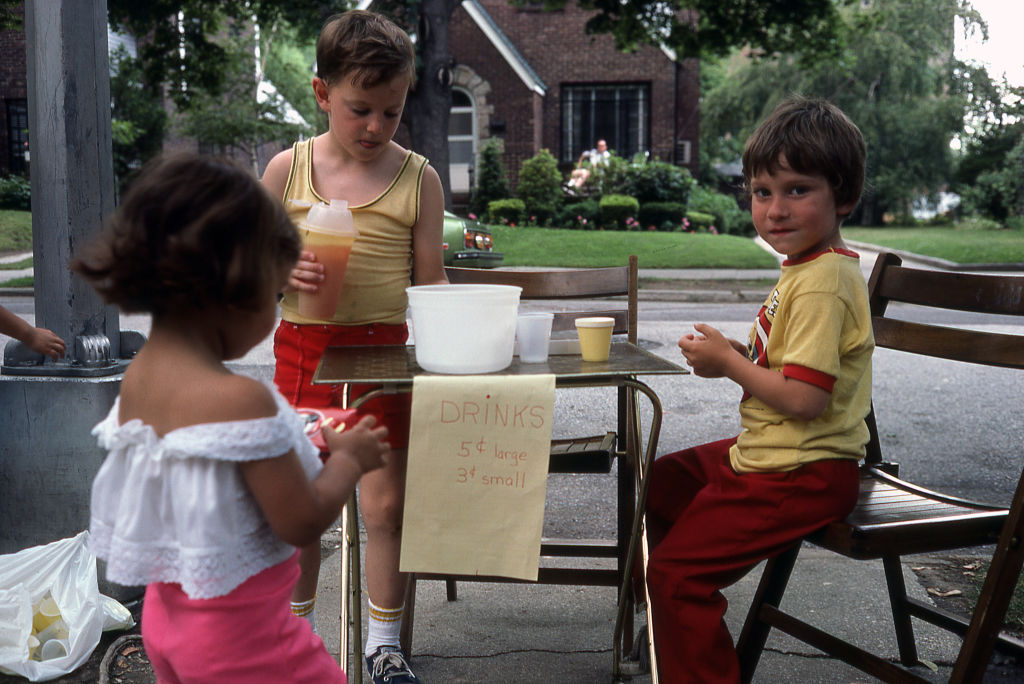

It’s a big week in my household. My London-born, New York City-raised eight-year-old is taking an initial tentative step into the glorious, promise-filled world of American capitalism: she’s setting up her first lemonade stand.
If you’re not American, or you haven’t spent much time here, you may be wondering why I’m announcing this with the fanfare of an Ivy League acceptance letter. And sure, perhaps it’s evidence that I’m slowly morphing into the Type A Manhattan parent I so like to mock. But also: the lemonade stand occupies a somewhat mythical space in American culture. As well as a way for children to earn a few dollars during the summer holidays, it’s a rite of passage. A tiny, sticky-fingered celebration of free markets, of free enterprise – hell, of freedom itself.

The humble lemonade stand has been around for more than a century. It represents all the things Americans like to tell themselves about their country: that initiative should be rewarded, that hard work pays off and that today’s child entrepreneur could well become tomorrow’s Elon Musk – ideally without the erratic personality and indeterminate number of children.
It’s difficult not to admire the boundless belief that all this amounts to a very good idea. Somewhere amid market surges and slumps and bulls and bears and booms and busts, the nation collectively reached a decision. Instead of passively accepting pocket money, kids should experience the joys of inventory management, customer service and pricing strategy before they’ve lost all their baby teeth.
My daughter’s operation – which consists of some repurposed garden furniture, a hand-painted sign and a pitcher of something vaguely lemon juice-adjacent – might be described as charmingly nostalgic. If we’re being honest, it’s a bit budget. The Spirit Airlines of lemonade stands, if you will. But a few of her competitors appear to have launched fully fledged business ventures. Printed marketing materials. Cashless payment options. QR codes. I’ve got a feeling that somewhere at 11 p.m. tonight, a seven-year-old will be workshopping a pitch deck in the glow of a MacBook Air while her parents debate whether Pipsqueak Ventures should lead the seed round.
Which brings me to my real point about all of this. America simply cannot leave anything amateur. The country’s great strength – its relentless belief that practically everything can be improved – also happens to be one of its more exhausting national characteristics. Every pastime becomes a performance. Every hobby acquires a business model. Every childhood milestone morphs into an opportunity for excellence. Youth sports aren’t just about kicking a soccer ball around a park; it’s all private coaching, travel teams and the faint possibility of an Olympic gold. If you don’t believe me, spend half an hour watching the Dallas Cowboys Cheerleaders documentary on Netflix. I rest my case.
So no, of course the lemonade stand was never going to be immune to the tyranny of optimization. The internet is awash with printable business plans, marketing templates and advice columns explaining how to maximize profits. Public television has aired segments featuring preteens talking margins and pricing strategy with all the seriousness of a quarterly earnings call. Selling watery lemonade to sympathetic neighbors isn’t just a quaint summer pastime, it’s about cultivating an entrepreneurial mindset. It’s an exercise in commerce as much as it is a rehearsal for the American Dream. Always be closing.
My daughter’s operation is, if we’re being honest, a bit budget. The Spirit Airlines of lemonade stands
As someone who has only lived in this country for six years, I feel about this stuff the way I feel about many trappings of this nation’s culture: it’s totally absurd and astonishingly wonderful. Britain tends to treat ambition with suspicion until it’s been proven. America assumes you’re onto something simply because you’ve had the audacity to give it a go. Sometimes that optimism produces spectacular excess. Occasionally it produces Steve Jobs. More often it produces a child who’s proud of earning 20 dollars by squeezing lemons and adding way too much sugar. What’s not to love about that?
My daughter will almost certainly make very little money from the stand. But hopefully she’ll learn that making something, even something small, can be satisfying. Hopefully she’ll experience the kindness of strangers. Hopefully she’ll discover that confidence grows when you put yourself out there. Which, of course, is a lesson worth more than whatever ends up in the cash box.
I know that someone, somewhere, is already thinking about franchising. For now, though, I’m going to give her two dollars and enjoy the sugar high. They grow up so fast!



Comments