One of the few benefits of being an anthropologist is the uncanny exhilaration one feels watching novel current events as re-runs from previous episodes in the history of mankind.
Donald Trump’s capture of Nicolás Maduro, President of Venezuela, is no exception. Kidnapping Latin American emperors is a continental tradition. It’s simply the most practical method for breaking the chain of command in the region. It triggers succession chaos, enables the extraction of resources and keeps the rest of the hierarchy more or less intact. In earlier centuries, it was Spain and Portugal. Today, it’s the United States.
In the colonial era, the objective was to secure enough gold to beat European rivals. Now, with an astonishing 90 percent of Venezuela’s oil produce heading to China, it’s about ensuring dominance over East Asia. And there has never been a better way of establishing dominance than by carrying out a good kidnapping.
Stuck in his cell in New York, awaiting trial, Maduro will take little comfort in the knowledge that he’s just the latest Latin American leader to go through this process
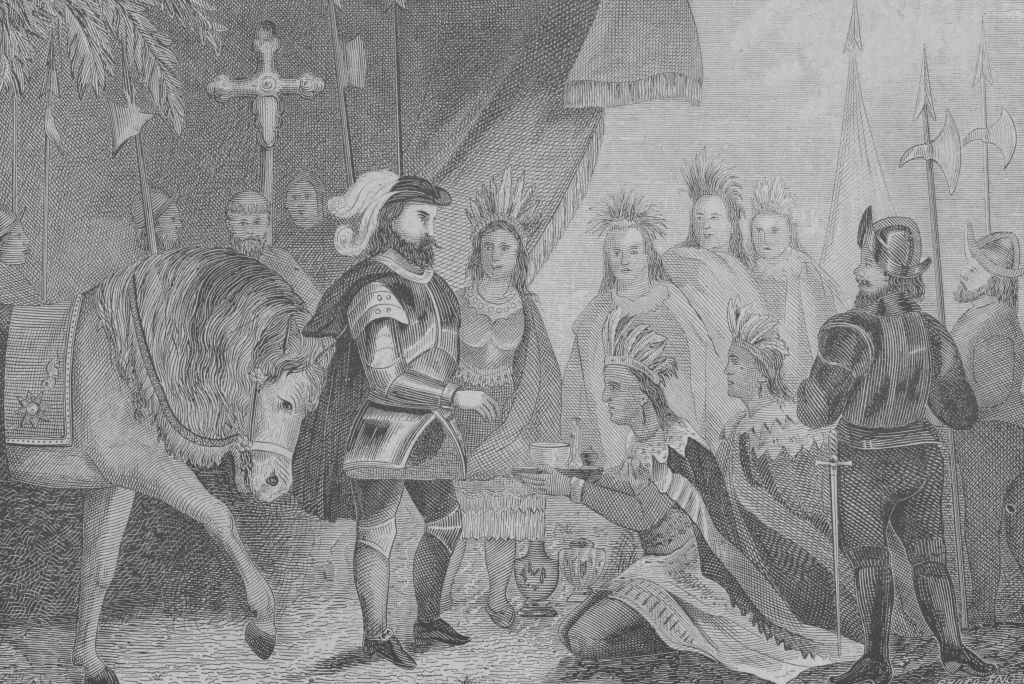
The first to try it in Latin America were the original Spanish conquerors led by Christopher Columbus. When he sunk his leather boots into the warm Caribbean sands in 1492, he discovered a continent of unprecedented size and a near-endless source of human slaves. But military resistance was immediate, and an Indian chieftain called Caonabó was the fiercest of all, directing surprise attacks that killed nearly all the men Columbus left on the islands when he regularly popped back to Spain. When the admiral heard the news, he sent a terrible deputy, Alonso de Ojeda, to sort out Caonabó and eradicate any opposition.
Ojeda, approaching the Indian chieftain peacefully with a mere handful of men, offered the chief some polished brass handcuffs and shackles, saying that they were “royal ornaments” worn by kings in Spain that offered them divine and magical properties. Caonabó believed him. And so he let the Spaniard put them on. Then, Ojeda snapped them shut, kidnapped the chief and galloped back to his settlement – effectively decapitating the native’s leadership. The entire culture crumbled soon after – and slaves poured into Seville. And I imagine the sketching of Caonabó’s face looked just like the shots of Maduro that have been circulating on social media today.

A few decades later, the conquistador Hernán Cortés landed in Tenochtitlan, present-day Mexico City, and discovered yet another ancient civilization. This time, though, the sheer scale and sophistication of the Aztecs surpassed even the greatest cities back in Europe. The Emperor Moctezuma II, feeling untroubled by a couple hundred badly-smelling foreigners, invited him into the city to show Cortés his personal aviary. The conquistador, following the Spanish tradition, immediately kidnapped him and put him under palace arrest.
Much like Trump’s recent announcement that the US would be running Venezuela for the time being, Cortés, too, governed the Aztec empire with Moctezuma as a puppet. The successful kidnap meant gold flowed back to Spain in abundance, but the emperor himself soon died after being taken onto the palace rooftop to try and calm his subjects. One of them, unhappy with the emperor’s performance, ended the whole charade by throwing a rock at his head.
Perhaps the most uncanny example happened a few years later, when another Spanish conquistador, Francisco Pizarro, landed on the shores of Peru to discover an even bigger empire: the Inca. Their emperor, Atahualpa, also looked upon these straggly foreigners with little cause for concern. A gambling man, Pizarro took the biggest risk of his life by getting his priest to read the Inca emperor the Requerimiento; a forced submission to Christianity with cultural roots in the Moorish tradition, recently expunged from Spain, of the summons to accept Islam or be attacked.
Atahualpa refused, as all self-respecting Latin American emperors did in the face of foreign conquest, but misjudged the cunning of the Spanish, who promptly closed the palace gates, locked out his army, butchered his bodyguards and, as per tradition, kidnapped the emperor and held him to ransom. Like Maduro, Atahualpa was handed a set of trumped up legal charges – in this case “idolatry” and adultery (the emperor enjoyed many wives). His kidnapping lasted eight months before the Spanish strangled him with an iron collar, but not before being forcibly baptized as “Don Francisco” after his conqueror and tormentor, Francisco Pizarro.
It did not surprise me to see that Nicolás Maduro, too, has already ended up in today’s cultural equivalent of the ritual humiliation once offered as forced baptism. Maduro and his sovereignty were instantly mocked online, videos of American eagles eyeing up his power, and quickly reposted on Donald Trump’s Truth Social feed. Stuck in his cell in New York, awaiting trial, Maduro will take little comfort in the knowledge that he’s just the latest Latin American leader to go through this process.

Comments