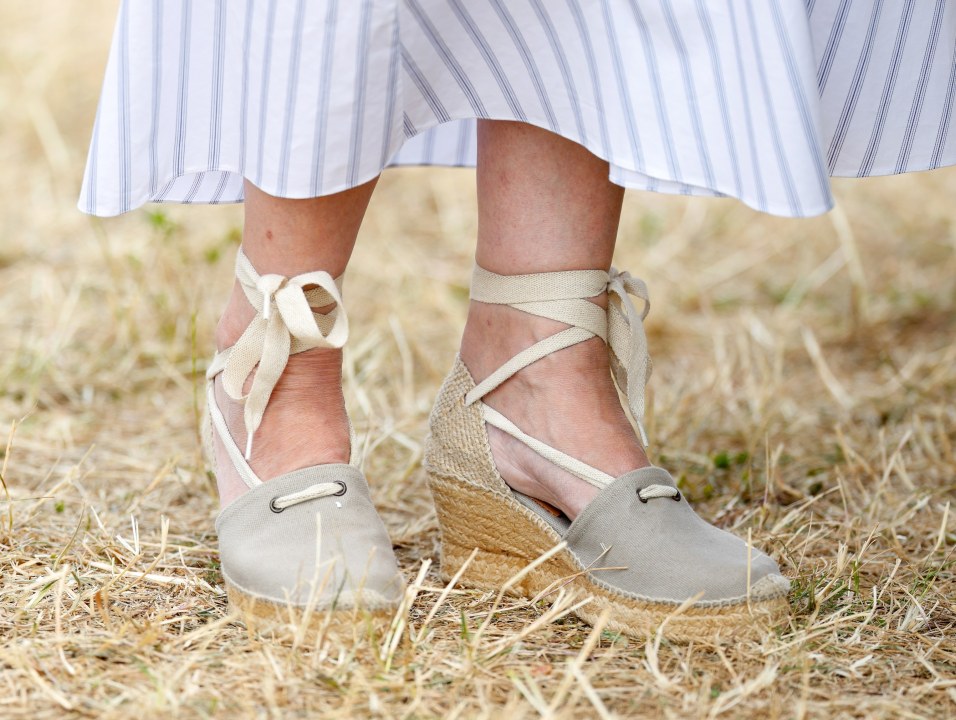
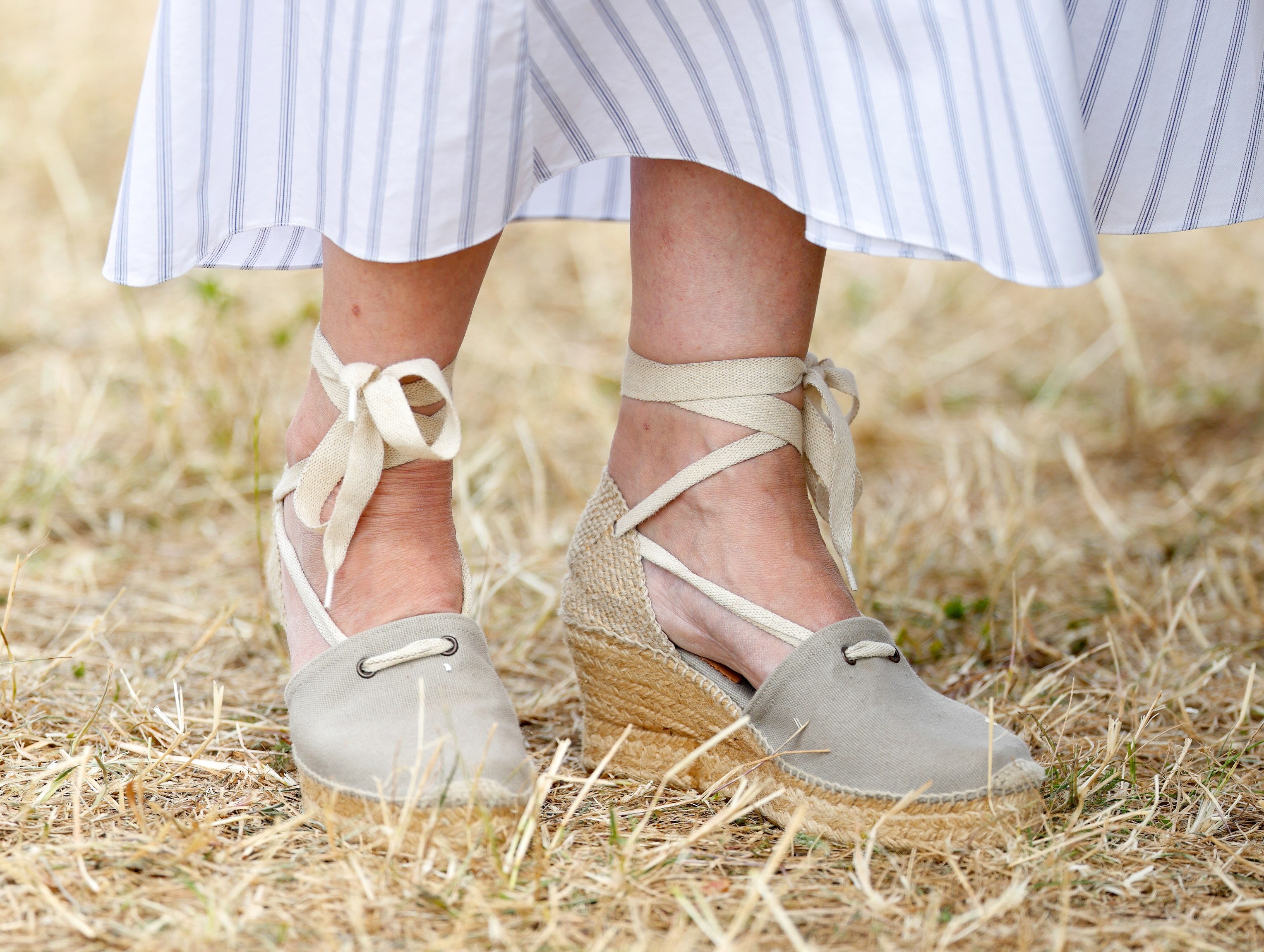
My daughters used to tease me mercilessly about my infatuation with Julio Iglesias. Not because I moved heaven and earth to get a ticket (and an interview) with the absurdly divine dreamboat when he performed in Lausanne in the 1970s. But because I swooned over the crooner’s bare, tanned feet tucked into espadrilles.

It is possible I was the only Swiss housewife who couldn’t resist Iglesias in his bare feet, clothed in cotton and as seductive as his ballads. ‘Señora Corner,’ Mme. Formosa, my Spanish housekeeper told me, ‘You wouldn’t have been happy. Señor Iglesias came on stage in a black suit, black tie and shiny, black shoes. But his singing was still fabuloso.’ Contrary to Mme. Formosa’s belief, I would still have been deliriously happy – espadrilles or no espadrilles.
My daughters’ teasing only stopped when one daughter chose a pair of rather expensive, green silk wedged espadrilles to wear with a white linen sheath for her wedding in our Montecito garden. Both were the perfect choice for the small, lovely ceremony held among palm trees and flowering trellises. More recently, Sophie, the Duchess of Edinburgh, was teased in the British press for wearing espadrilles with an expensive flowery dress as she honoured Gurkhas in Nepal. Some fashion misfits even thought Sophie (who is taking some of the British wardrobe critique away from the Princess of Wales, so the future queen can concentrate as much on her charities as her clothes) should have worn heels on the dusty plains of the Himalayas. I think not! Last month at the RHS Chelsea Flower Show, espadrilles were very much on view.
Over the past seven decades, celebrities like Lauren Bacall, Gary Cooper, Audrey Hepburn, Noel Coward, Ernest Hemingway (who wore white espadrilles as he chased bulls with the locals in Pamplona) and Salvador Dali (who laced his to his knees as Catalonians do) began wearing espadrilles in southern climes.
But espadrilles have been around for at least 1,322 years in Europe. That was when the simple shoe, with a cotton, canvas body and rope sole, was described for the first time using its Catalan name, espardenya, referring to a type of shoe made with esparto: a wiry Mediterranean grass used in rope-making. There is a friendly debate between Catalonia and the Basque Country, who call grass espartna, over which region invented the shoe once worn by farmers, fishermen and soldiers and now favoured by royalty and the bourgeoisie. Spaniards dancing the national Catalan dance, the Sardana, wear espadrilles with ribbons tied around their ankles. By the 19th century, espadrilles gained popularity in the French city of Mauléon, which became a major distribution hub for the shoe.
The shoe’s appeal was exported to the United States, thanks to Hollywood and mid-20th century American tourists visiting the French Riviera
The shoe’s appeal was exported to the United States, thanks to Hollywood and mid-20th century American tourists visiting the French Riviera. Around the same time, espadrilles found their way to South America, where they appealed to the masses and even served as political slogans. Espadrilles were so common among the lower classes in Argentina and Uruguay they were known as alpargatas, replacing botas de potro, part of the traditional gaucho attire made from the leather of a horse’s lower leg. Along with other clothing, espadrilles became essential shoes for both sexes and, especially for gauchos, traditional knickerbockers. In 1943 and 1944, the left-wing student movement opposed to Juan Perón’s regime used the slogan ‘No à la dictature de las alpergatas’ (‘No to the espadrilles dictatorship’). Perónistas responded ‘Alpergatas sì, libres no’ (‘Espadrilles yes, books no’).
High-end fashion houses came out with their versions of espadrilles in linen, silk and leather from the 1970s when Yves St. Laurent introduced them to the catwalk. Chanel’s can set one back a whopping £770. But espadrilles similar to the Duchess of Edinburgh’s can be bought on Amazon for £30. At Mediterranean resort boutiques as well as supermarkets, espadrilles can be picked up for less than €10 – I’ve never paid more. Just make sure the soles are the authentic braided jute and not Chinese plastic. Although many styles of espadrilles are still manufactured in Spain, some production has moved to Bangladesh, the largest jute producer.
Now, when I’m in my Mini Cooper and Julio comes on my playlist crooning ‘Crazy’ or ‘To All the Girls I’ve Loved Before’, I slide back the roof, turn up the volume and put my foot on the accelerator while silently telling the dreamy grandfather, who happens to be my age, that he still has ‘it’. Maybe so do I – espadrilles or no espadrilles.




Comments