
Jonathan Meades has narrated this article for you to listen to.
Van’s genius, without Thought or Lecture,
Is hugely turn’d to Architecture.
Jonathan Swift’s dismissive jest has never been forgotten. It may not be as vituperative as ‘A Beautiful Young Nymph Going to Bed’ but it is there ready for duty whenever the skirmish between the principals’ proxies is resumed in all its petty self-importance.

It’s England, so social class looms. While Vanbrugh strode with ease among kings and bitchy duchesses, heavily made-up Foppingtons and grand cru horizontales, the resentful Hawksmoor – his collaborator – lurked in the shadows meekly giving great forelock and not receiving the commissions he deserved. Some suggest Vanbrugh stole the credit from Hawksmoor, a batman of genius who rose to subaltern despite his uncouth ways and a hilarious Midlands accent that might have been Tunbelly Clumsy’s in Vanbrugh’s play The Relapse.
Hawksmoor had worked as an apprentice to Christopher Wren. According to Harry Goodhart-Rendel, ‘practically all Englishmen and practically no foreigners’ believe that Wren was a great architect. As if to prove it, English architects and their epigones would, amazingly, still be at it, all red brick and stone quoins, in the years after the first world war. Wren’s alleged greatness supposedly rubbed off on Hawksmoor.
Vanbrugh had, despite his unremarkable mercantile background, enjoyed a rather more colourful life. He had been a soldier, a herald, a courtier. He had spent four years mistaken for a spy in French jails including the Bastille. Those sojourns, like his most unusual voyage to India, appear to have made little impression on him at the time. He became a playwright, an actor manager, a theatrical impresario and property developer. Like, among others, Kingsley Amis and Joe Orton, he seems to have believed that a writer who doesn’t cause offence is not doing his job. He connected very well indeed, notably with members of the Kit-Cat Club. However, until he met Charles Howard, Earl of Carlisle, he was an amateur, an absolute beginner. What can the earl have been thinking of?
The Saumarez Smiths are England’s first family of ‘Heritage’. There is no chair they have not occupied, no ruinous curiosity on whose behalf they have not pleaded, no diocletian window they have not dated, no obelisk to the fallen of a forgotten war they have not limned, no topographical subject they have not addressed with a scholarly brio.
All of which may cause us to wonder what sort of communicative embuggerance can have prompted this otherwise alert book on Vanbrugh to illustrate its towering subject with a mean figure from the Albert Memorial’s Frieze of Parnassus whose only relevance is that it stands lifeless and artless close beneath the inscribed name ‘Vanbrugh’ in an unconnected, nominal frieze. The face, cruel and disdainful, bears no resemblance to John Vanbrugh’s. It is presumably the best that the untutored, or ill-briefed, designer could come up with in a fit of enthusiasm touched by anachronistic ignorance – an ignorance shared by some wisenheimer at the Soane Museum who has deemed Vanbrugh ‘the rock star of English baroque’, an epithet which might have been marginally less crass had rock’n’roll not died a death a generation ago. (Perhaps no one noticed.)
Vanbrugh was unbelievably brilliant in two arts and unburdened by deep feeling or an excess of conviction
And as for his being a baroque artist – this is the standard-issue pigeon hole that goes indolently unquestioned. The baroque was polyvalent; like art nouveau, which it presaged by a couple of centuries, it varied from one country to the next, one generation to the next. Vanbrugh at his most Vanbrughian – after he had ceased to work with Hawksmoor – defies taxonomy. His tastes for the martial and the threateningly defended are sui generis. He talked of putting on ‘a masculine show’. Masculinity was to be found in the ruggedness of north Britain, seldom in the south. He had an impressive knack for blankness and for changes of scale: San Giovanni in Laterano, largely by Alessandro Galilei – who had worked at Kimbolton – just about outdoes Vanbrugh in this regard. That is an exception. More usually Vanbrugh is as stylistically apart from his contemporaries across Britain and Europe as they were from each other. It is perhaps rash to squeeze him into alien schmutter.
He looked as honest as he indeed was. In the portrait by Godfrey Kneller he appears plumply suppered, getting fubsy, smug, alert, companionable, amused, well togged – a relaxed worldling, not perhaps the early 21st-century idea of a supreme artist of long ago: no intimation of the lamp, no starving to death of syphilis with a beautiful young nymph in a garret for the sake of a cornice. But so what: this is the man, haut bourgeois avant la lettre, living on his wits, connecting very well indeed, a virtuoso Rastignac. But also lovable, unbelievably brilliant in two arts and unburdened by deep feeling or an excess of conviction. He was not afflicted by religious belief, which he regarded as hypocritical and silly.
He regarded puritanical moralisers as even sillier, which may have been a miscalculation: his detractors were ipso facto humourless, and held his levity in contempt. He was certainly anti-clerical but not with the exhilarating hostility that the French bring to that cause. Indeed he seems to have possessed no appetite for extremism save, of course, in his buildings where there is little else. Excess is taken to excess. They are startlingly brutal and might have been conceived to deliver a cold shock to the virgin spine. His tectonic lexicon does not include sweetness. That omission may be the cause of the distaste, even abhorrence, felt by many of his contemporaries, forebears of the little Englander, whose ideals were ‘good taste’, knowing understatement, whimsy, Alexander-Popery and Georgianism’s frail bromides. And whose characterisation of Blenheim as ‘a quarry’ is as brainlessly philistine as Ruskin’s deprecation of Beethoven’s oeuvre as ‘the upsetting of a bag of nails’.
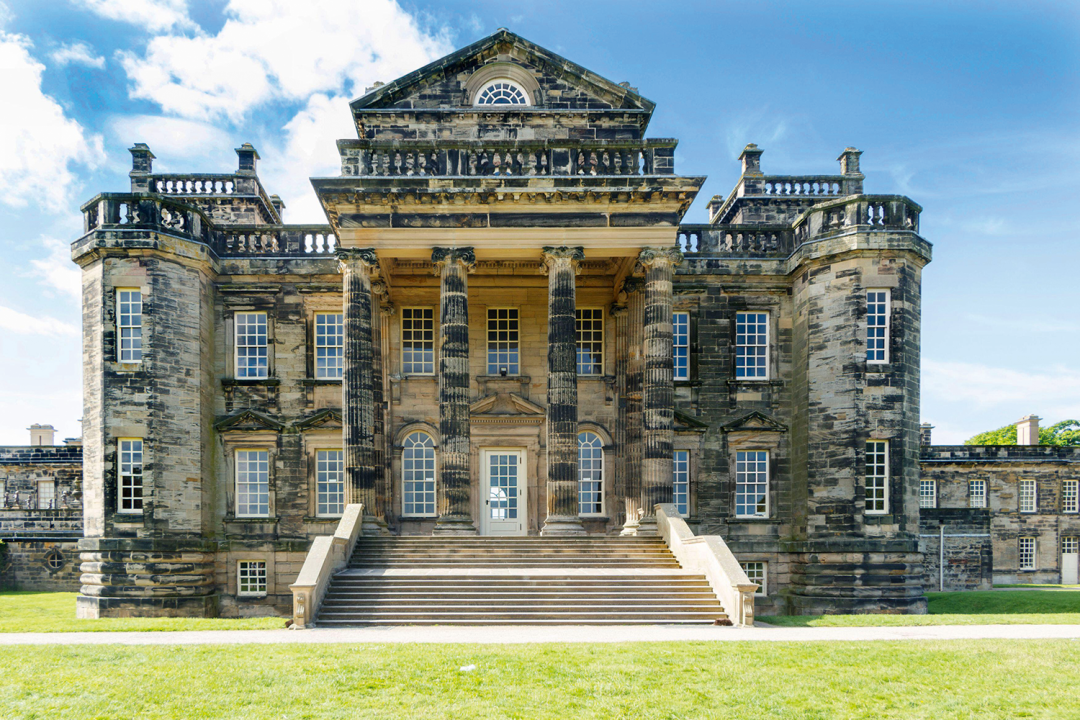
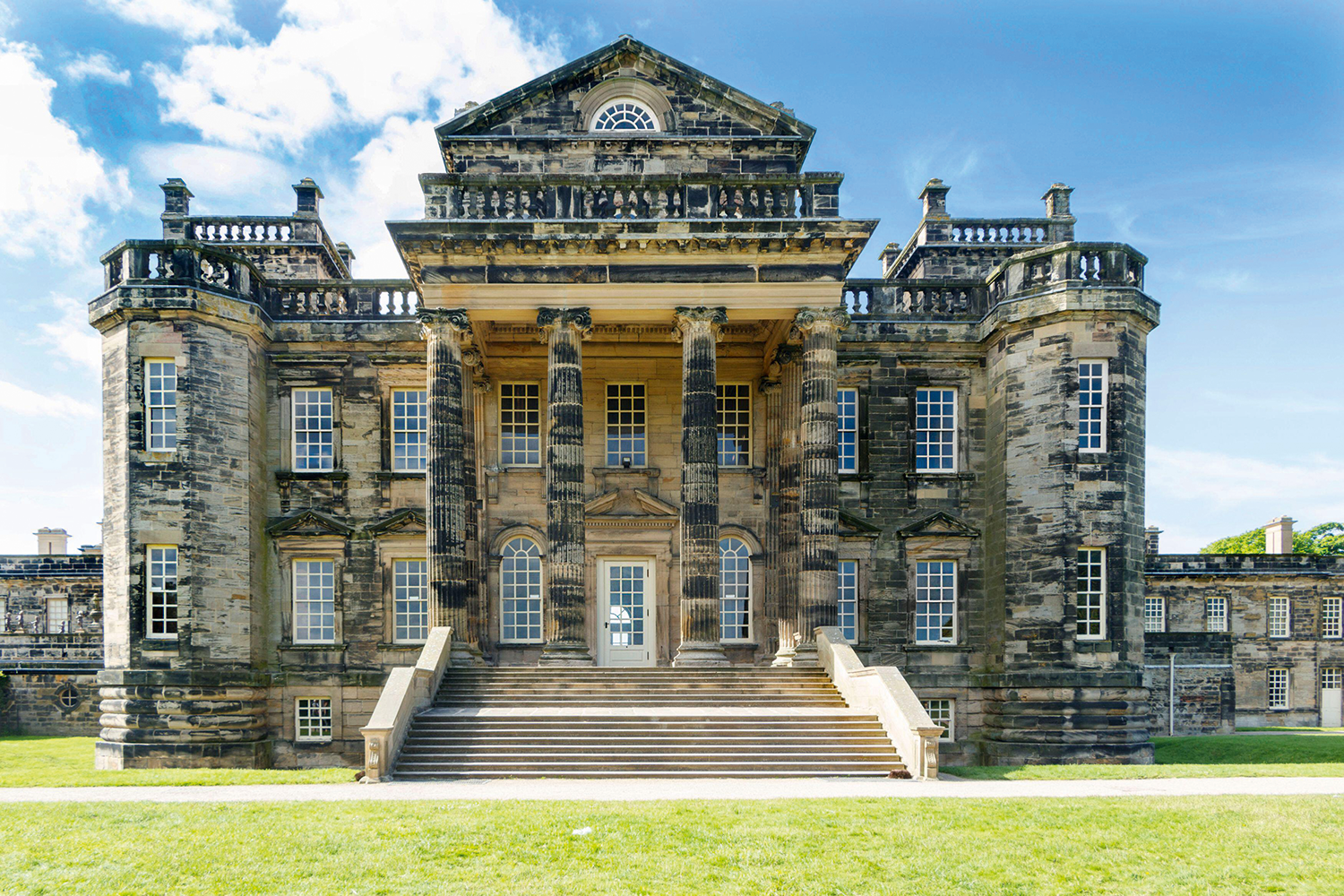
The first sight of Seaton Delaval, the most affecting building in England, imprints itself in one’s head whether bidden or not. On a November dusk, when rooks fill the lowering sky, the entire decor spells both sulphurous malevolence and aesthetic bliss. This is a stage where skeletal revenants smeared with seacoal from Seaton Sluice might kidnap the living to add to their numbers. It is a harsh and unholy place: John Martin without exaggeration; Vaux-le-Vicomte without the dome supplied by a surgical goods emporium; a dais for Goya’s monsters. It was the last great work that bore Vanbrugh’s signature. Such was the speed off the mark of fashion’s dictates that it was stylistically old hat by the time construction was complete (and its author dead).
His buildings are startlingly brutal and might have been conceived to deliver a cold shock to the virgin spine
Palladianism is dullard’s architecture by numbers: witness Quinlan and Francis Terry’s tiresome timidity, which is formulaically reproduced many times over. Vanbrugh’s great works, on the other hand, had few copyists. The same might be said of Cuthbert Brodrick, Ricardo Bofill, Gino Coppede or Terry Farrell: no group, no movement, no school. These giants came and went, and left little trace, apparently. That anyway is what the rare persons who know Vanbrugh’s splendour only from Charles Saumarez Smith will glean. This is a ‘responsible’ account not given to speculation. Bernard Levin rightly warned against ‘responsible’ writing.
Provenance is all. So numerous works – whose appearance shouts their authorship – are disqualified from the canon for lack of proof in the shape of letters or memoranda. And what of his four years as a young man banged up in French prisons? Surely this requires a biographer’s deductions. How could such an experience not leave scars of some sort? In his massive biography of half a century ago Kerry Downes does not ignore this matter even though his bias towards Hawksmoor over Vanbrugh doesn’t steady the vessel. Is the kinship of numerous mid-Victorian English houses of correction with Vanbrugh’s designs of the 1720s coincidental? Much remains unanswered. Why did he not find the right girl until late middle-age? Gay? Straight? Or did he shop on both sides of the street?
Perhaps another elegant but more revelatory volume is required, one in which the author declines to rely on, for instance, the questionable opinions of Robert Venturi, author of the National Gallery’s hideous extension whose presence in these pages demeans its sublime subject.
John Vanbrugh: The Drama of Architecture by Charles Saumarez Smith is published by Lund Humphries. Vanbrugh: The Drama of Architecture is at the Soane Museum from 4 March until 28 June. Details of all the Vanbrugh 300 events that are taking place across six of the architect’s most significant creations – Castle Howard, Blenheim Palace, Seaton Delaval Hall, Grimsthorpe Castle, Kimbolton Castle and Stowe House – can be found at Vanbrugh300.co.uk




Comments