My discovery of Marsala was a happy mistake. After a grim day at work, as I slaved over the stove making saltimbocca, I felt like a drink. I usually try to resist such temptation until we sit down, but the flesh can be weak. I went to the fridge to find that, disgracefully, we were out of sherry. Returning to the task in hand, my eyes fell upon the Marsala which I was about to slosh into the pan. What a delicious treat it was.
There are so many different ways to drink it
I’ve since learnt that this view of Marsala has been part of the problem for this noble and unfashionable drink. ‘Things went wrong for Marsala,’ explains Filippo Bartolotta, wine educator and expert on Sicilian wines, ‘when it started to become just an ingredient’. As Patrick Schmitt, Master of Wine, observes, ‘Saltimbocca and tiramisu are great dishes, but neither should be the sole use of Marsala’.
Marsala was once held in the same esteem as port, sherry and Madeira. It was regarded by Italians as part of their national heritage: Garibaldi launched his unification campaign after landing at Marsala. Apparently the otherwise teetotal revolutionary republican developed a real fondness for the local sweet iteration, and Garibaldi Dolce is still available today.
What went wrong? Legal protection for Marsala was introduced in 1931, but commercial exploitation and rip-offs had already let the rot set in. Post-World War II mass production cheapened the brand further and allowed pale imitations and experimental flavours to emerge. It became a sort of Italian Baileys – ‘every Italian family had a bottle of Marsala liqueur on the shelf’, notes Bartolotta.
Baileys was invented by an Englishman fewer than 50 years ago. While Marsala has a richer history that stretches back hundreds of years, its heyday can similarly be attributed to British creativity.
The Phoenicians brought viticulture to Sicily nearly 3,000 years ago. But in 1773, a storm forced an English merchant from Liverpool, John Woodhouse, into port at Marsala. While there, Woodhouse delighted in the local vino perpetua – aged in a 100-gallon barrel and topped up with younger wines. Realising its similarity to the port, sherry and Madeira that were so popular, Woodhouse abandoned his original mission and bought 50 barrels. While it was probably more than sufficiently robust for the voyage back to Blighty, Woodhouse gilded the lily by sweetening and fortifying it with the addition of a hearty slug of brandy.
It was a hit, helped in no small measure by certain celebrity endorsements. Admiral Nelson was the hero of the day, and was in the early stages of his affair with Emma Hamilton in Naples when he met Woodhouse’s son. Nelson was so taken with Marsala that he decided it would ‘be of real use for our seaman’ in keeping body and soul together. It travelled well, would keep for ages thanks to the oxidative ageing and fortification process. It offered an alternative to rum and Madeira, which faced wartime trading disruptions.
Others realised Marsala’s potential too, such as Benjamin Ingham from Leeds, who came to work for Woodhouse in 1803, before establishing his own company with his Whitaker nephews. But the most exciting innovators to become involved with Marsala weren’t British but Calabrian.
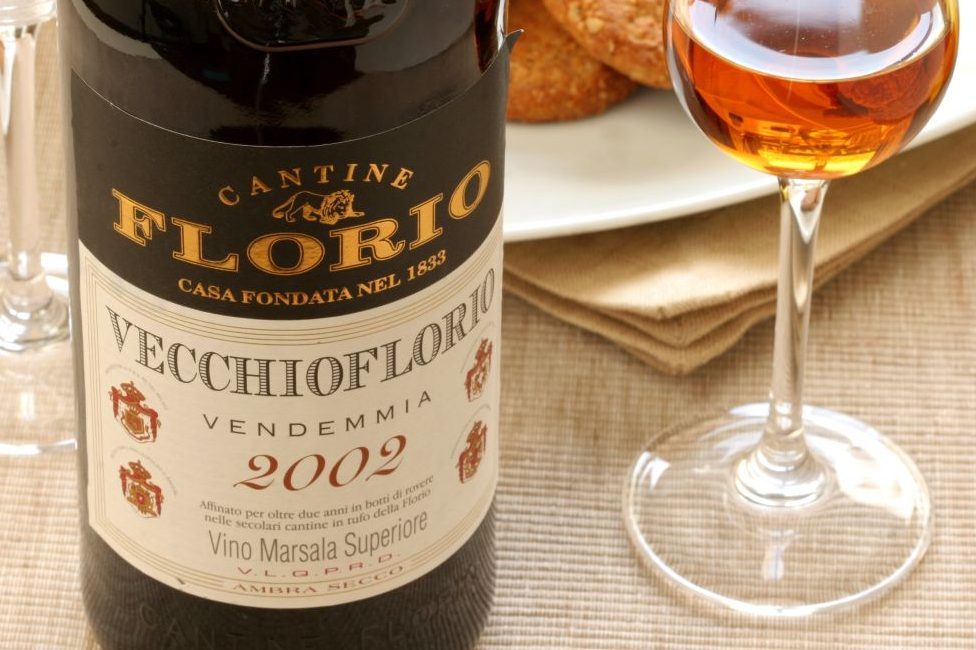
The Florios made the trip from the toe of Italy across Sicily to get some skin in the game. They were into spices, mining, fishing, ceramics and shipping, and duly added Marsala production to their empire, establishing their winery, the Cantine Florio, between Woodhouse’s and Whitaker’s own properties. Serious investment and innovation soon made Florio the biggest name, and in time they acquired Woodhouse. While the expanded business was sold to Cinzano in 1920, Florio’s influence endures, and the name remains synonymous with some of the finest on the market. Schmitt MW chairs the Global Wine Masters, which this year named Florio Marsala Dolce Superiore Reserve 1994 its Wine of the Year. Bartolotta describes their cellars as ‘psychedelic’, with barrels dating back almost 100 years.
Herein lies part of the joy of Marsala. Bartolotta encourages drinkers to move away from thinking of it as something to open and drink, and towards thinking of it as something to sip and keep. While it’s not immune to spoilage, he recently tried some from the late 1800s. While some were certainly not good, others were amazing.
Challenges to the rehabilitation of Marsala persist. Consumers struggle with its complexity and the production regulations are particularly convoluted. But it’s worth persevering because there are so many different ways to drink it – and its versatility means it should be enjoyed year round.
Schmitt notes that ‘there’s immense diversity in terms of styles’, which range from ‘fine’ to ‘superiore’ along with ‘riserva’ to ‘stravecchio’, but ‘the great expressions have a nutty, caramelised character, which is what makes it so good with hard-to-match flavours such as cheese, fish roe and earthy vegetables like artichokes’. A Sicilian friend tells me her family used to have it with hard-boiled eggs (presumably to take the taste away), and Bartolotta recommends pairing it with avocado, salads and roasted nuts, and sweet versions with ice cream – macadamia in particular.
So as the festive season beckons, enjoy some of that Marsala with rather than in your food.






Comments