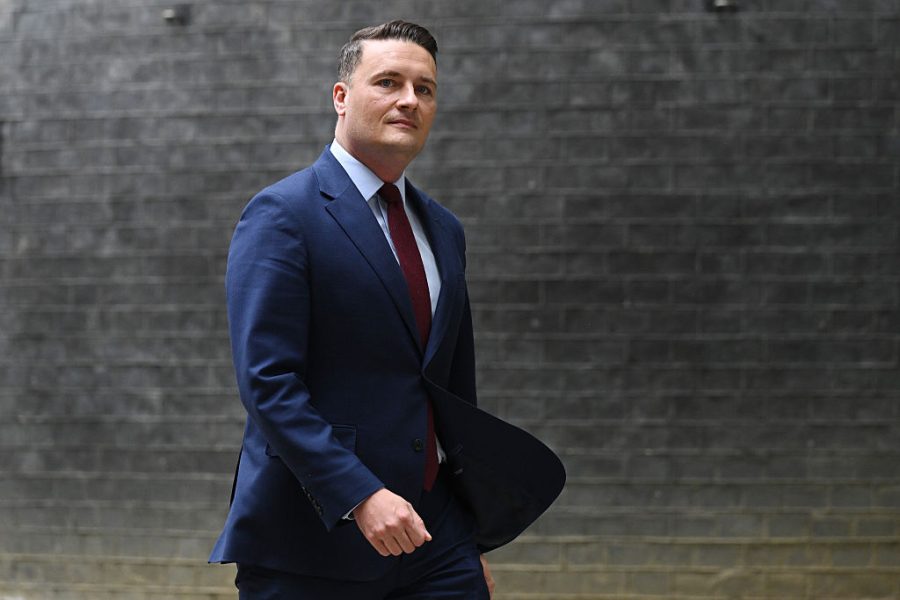
Wes Streeting believes it was a ‘catastrophic mistake’ for Britain to leave the EU. If he becomes prime minister, Streeting will rejoin the bloc, as apparently will Andy Burnham, who also has designs on Keir Starmer’s job.
Lisa Nandy, the Culture Secretary, described Streeting’s desire to rejoin the EU as ‘odd’. It is, but not for the reasons she stated. Nandy was against Brexit from the outset but believes it is pointless ‘reopening the circular arguments that we ended up in as a country’. The question that no Remainer has the honesty to ask is: why rejoin an organisation that is in ‘agony’?
Streeting hasn’t presented any hard evidence for the defence of the EU. Don’t hold your breath
That was the word used in September 2024 by Mario Draghi in a devastating report about the economic decline of the EU. Europe, said Draghi, required additional annual investment of at least €750 billion (£650 billion) – approximately 5 per cent of the EU’s gross domestic product – if it wished to remain competitive against the US and China. That investment was not forthcoming and in August last year Draghi – the former head of the European Central Bank – said that the EU could no longer suffer delusions of grandeur:
For years, the European Union believed that its economic size, with 450 million consumers, brought with it geopolitical power and influence in international trade relations. This year will be remembered as the year in which this illusion evaporated.
It’s hard to contradict Draghi. Just look at the humiliating way in which the EU has been sidelined during negotiations about the conflicts in Ukraine, Gaza and Iran.
The 27 EU member states can’t even agree among themselves. If they’re not bickering about how best to respond to global events, then they’re squabbling over the terms and conditions of the next seven-year budget. Even Euronews – the Pravda of Brussels – admitted in a report last week that the EU’s €2 trillion (£1.7 trillion) budget discussions ‘risk becoming ugly and delayed’.

The EU parliament wants a €200 billion (£174 billion) increase in the bloc’s budget from 2028 to 2034 but this is opposed by northern members. Germany and Holland, who pride themselves on their ‘frugality’, are fed up with the profligacy of southern countries. A recent report predicted that by the end of this year, Italy will have surpassed Greece as the most indebted country in the eurozone; its debt will reach 138.6 per cent of its gross domestic product, superior to Greece’s 137 per cent and France’s 118 per cent.
France, however, may soon be challenging Italy. Last week it was disclosed that unemployment in France has passed the 8 per cent mark for the first time since 2021; add to that figure the 70,000 businesses that went under last year and one understands why fears are growing in Paris that the country is on the cusp of a long and deep recession.
Germany – whose public debt to GDP is 64 per cent – has had enough. ‘We will be setting new priorities,’ declared Germany’s chancellor Friedrich Merz. ‘This means that we will also have to reduce spending in the European budget in other areas. This position was supported by Holland, who said it was ‘unacceptable’ for Dutch tax-payers to contribute more to the EU coffers to bail out the undisciplined south.
The negotiations will continue for the rest of the year, and it will be Ireland – which holds the rotating EU presidency from July to December – who will have to oversee an agreement. ‘There will have to be compromise,’ admitted Prime Minister Micheal Martin. ‘Some think the budget is too high as it is. Others think it’s not high enough.’
The same can be said for the numbers of migrants arriving legally and illegally in Europe. Spain’s Socialist government last month regularised half a million undocumented migrants. ‘It is our duty to become the welcoming and tolerant society that our own relatives would have hoped to find on the other side of our borders.’ declared Prime Minister Pedro Sanchez. He is adamant that the West needs many more migrants.
This is not what the majority of Europeans think, according to regular polls. The French right reacted with fury to Spain’s decision and Jordan Bardella, president of the National Rally, described the country as ‘the gateway to a flood of migrants into Europe’.

Figures released last week by Frontex, the EU’s border agency, appear to bear out Bardella’s claim; while irregular crossings from Africa to Italy and Greece have fallen dramatically this year (by 46 per cent and 32 per cent), they are up 50 per cent on the Western Mediterranean route into Spain. The people smugglers have identified the soft underbelly of Europe.
When Andy Burnham was asked at the weekend about rejoining the EU, he replied that ‘in the long term there is a case for that’. What is that case? Burnham didn’t say. Nor has Streeting presented any hard evidence for the defence of the EU. Don’t hold your breath. It’s hard to defend a bloc that is dysfunctional, disunited and in terminal decline.






Comments