
Among my many unpopular and unpatriotic opinions is that, in most of the ways that matter, the terrorists responsible for the September 11th attacks won. With less than half an hour’s work, and at a cost (to them) of less than twenty lives, Osama bin Laden’s mob of maniacs changed the course of history and cost the economies of the West an unimaginable amount.
As the holiday season kicks off, Europe’s busiest airports are melting down
I’m not just talking about the terrible wars that followed – though the Nobel Prize winning economist Joseph Stiglitz costed the Iraq invasion alone at $3 trillion back when that was considered a lot of money – but the death-of-a-thousand-cuts effects of us all spending the next twenty-five years frightened that jihadi lunatics would try to smuggle box-cutters or explosive underpants onto commercial air flights.
How many minutes did the whole shoes-off, belts-off, laptops-out, full-body-scan routine add to an individual’s journey through an airport? Half an hour seems a very conservative estimate. Multiply that by the five billion or so people who (Google tells me) take a commercial flight every year. Multiply that by 25. The result is a bit north of seven million years of people standing in airport security queues when they could have been doing something productive or fulfilling.
What Osama did to his enemies on purpose, the EU seems determined to do to its friends by accident. Even those of us who tend to take a rosier view than most of the benignity of European co-operation would have to admit that the implementation of Europe’s new Entry/Exit System, or EES, doesn’t show the bloc at its heartwarming, Ode-to-Joy-humming best.
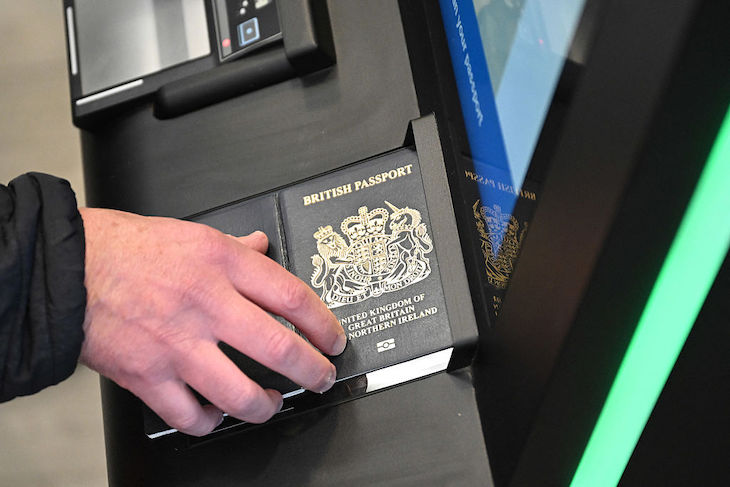
The better to police the movements of people in and out of the Schengen free movement area, the EU has rolled out a new system whereby anyone with a non-EU passport (that’s us, alas) entering via a European airport must now have their fingerprints and photographs taken and logged on a database. It’s agreed to be a good idea in principle – the most Brexity among us will be broadly keen on more rigorous border controls; the least Brexity among us will perhaps see it as sauce for the gander – but a right pig’s ear has been made of it.
Apparently nobody designing the system gave very much thought to the effects on airport queues, and hence throughput and capacity, of adding these extra steps to the passport control process. Or much thought to how nicely this centralised system would play, or fail to play, with dozens of different already-existing software systems all over Europe. The result is that as the holiday season kicks off, Europe’s busiest airports are melting down, flights are departing half-empty, and miserable passengers are sitting on their suitcases in the departure hall rather than sipping pina coladas by the pool.
The chief executive of Aeroporti di Roma, Marco Troncone, told the Times that Rome’s main airport spent the equivalent of £10 million preparing for EES, but that processing times at the border have still doubled since it came in. They’ve tried like billy-oh to make it work – “We managed to optimise the process on our end bringing this to 90 seconds [down from two minutes] but […] this is of course not compatible with 50,000-60,000 passengers every day” – but no amount of efficiency can get round the fact that adding extra steps to the process means adding time.
Airport managers could have told the bureaucrats that for free; but as Troncone puts it delicately, the system was designed with “limited input from airport operators, despite the fact that airports are the ones managing passenger flows every day”. Now Mr Troncone and his colleagues across Europe, not to mention any number of airline operators, are begging to be allowed to suspend the whole thing for at least the next two months. What’s the betting that the European Commission will listen? The signs aren’t great: they failed even to bother providing a comment to the Times’s reporter.
This, it pains me to say, looks like a strong instance of the case against the EU’s set-up. The size of the bloc, the centralised decision-making, and the lack of accountability, means that a half-baked system delivered by bureaucratic fiat can propagate across the whole continent and cause chaos before anyone’s able to say, for instance, “should we maybe ask the airports how this is going to work?” And that when challenged on it, so far, the EC has simply issued the equivalent of a giant shrug in them’s-the-rules mode.
So, on the face of it, it might well make us think: better off out of this nonsense after all. Chalk one up for the Brexiteers. Carrion comfort, though. Being out of it means that if we do want to go to Europe on our holidays, it’s us waiting in those godawful queues. Is it possible, come to think of it, that Ursula von der Leyen could have done it deliberately?





Comments