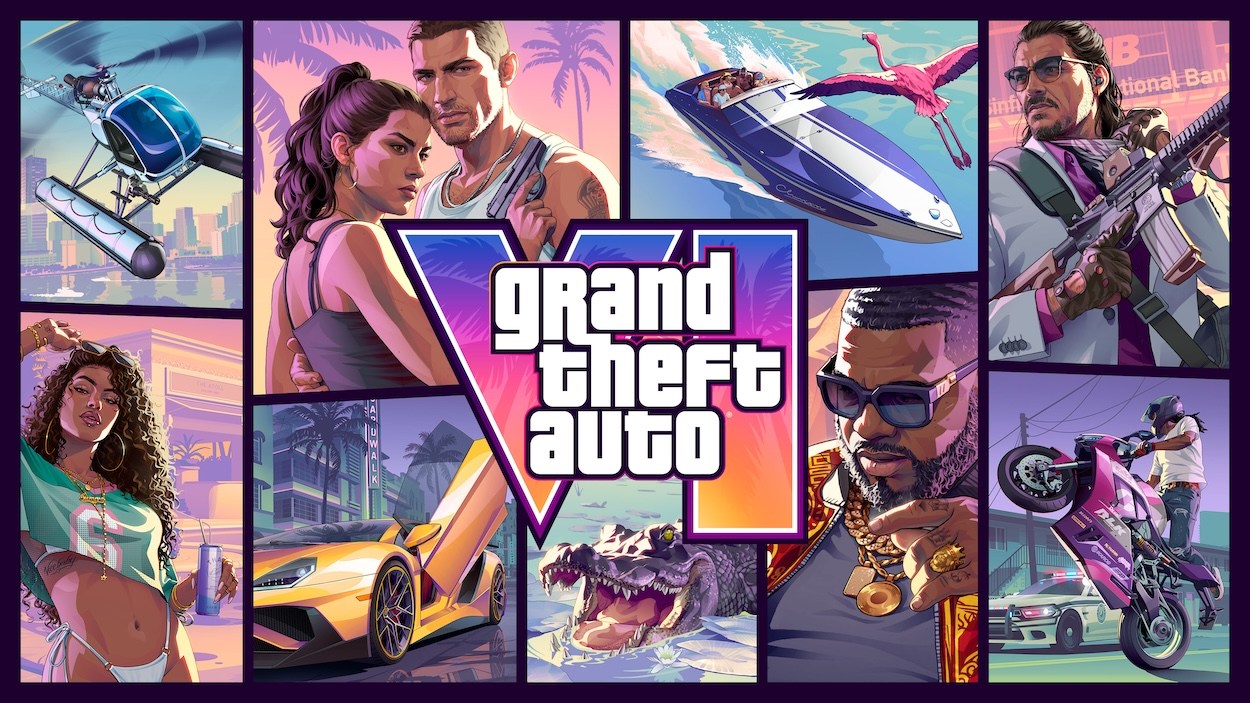
Back in 2001, Grand Theft Auto III let players do something that shocked parents and thrilled teenage boys. You could pick up a prostitute in a stolen car, kill her and take your money back. Critics were outraged. Predictably, sales soared.
The newly released Grand Theft Auto VI, out today, has done away with prostitutes. That is a marked departure from previous editions. This latest iteration of the game has two playable main characters, Jason and Lucia. Intimacy in the game is limited only to them. Players can shape their relationship through activities like going on dates, robbing banks together and, presumably, sex.
The genius of GTA is that it supplies the unavailable. Back when young people were in relationships, or felt that relationships were within reach, the fantasy was the prostitute. Now that hookers and OnlyFans are everywhere, the fantasy is the stable girlfriend.
One of my high school friends got so into World of Warcraft that he kept Gatorade bottles at his desk to pee in
To understand what’s really going on, you have to understand something crucial about what a fantasy reveals about the person having it: a simple request can carry a wish we wouldn’t say out loud. A boy asks for a glass of water after bedtime. His mother brings it. He takes a sip. By the time she’s halfway down the hall, he’s thought of another request for her. He really was thirsty. But he also wanted his mother to stay a little longer. The water was, in a way, a cover story.
A guy buys GTA VI ostensibly to drive fast cars, shoot people and fire rocket launchers into helicopters. He really does want to see the helicopter explode. But he also wants the virtual girlfriend experience the game offers.
In the New York Times review of the game, the author writes, “It’s entirely possible to play separately from your in-game partner… But more often than not, I find myself choosing to spend the day with my partner, whose presence enriches most activities. You can have silly little conversations as you drive around, hug, exchange a quick kiss, go on dates, dance and work out at the gym together.”
Picture a young man today. In 2023, Pew reported that 63 percent of men under 30 said they were single, nearly twice the rate for women the same age.
A big reason people are so frustrated with dating and social life in general today is because almost everything else in life is effortless. You want water? Turn a knob. Hungry? Tap your phone and someone brings food to your door. You’re warm, entertained, safe. Nearly every need is satisfied instantly. Except one. Finding friends and finding a romantic partner still require effort, vulnerability and risk. It’s the last frontier of difficulty.
You see this play out when podcasters discuss sex and relationships, often bringing on evolutionary psychologists to explain mating dynamics. In the comments, there’s always a handful of guys saying things like, “Just wait for the robot girlfriends, boys. They’re coming.” It’s the fantasy of convenience applied to relationships. It’s the mindset of someone who’s grown accustomed to instant access and now wants DoorDash to deliver a girlfriend.
As psychologist William von Hippel writes in The Social Paradox, “the fact many men book the girlfriend experience tells us something important about human nature… we evolved to enjoy sex… But we also evolved to connect… men happily pay $600 an hour for a sex worker to act like a girlfriend and pretend to connect with them.”
There’s a version of this in Anora, the 2024 Academy Award-winning film. Director Sean Baker says the film is meant to show respect to “sex work.” But throughout the film, you see Ani react with fury whenever someone calls her a prostitute. And she latches onto Vanya to escape that way of life. It’s hard to square the nice sentiments of what the director and critics claim with the ugliness of what the film actually depicts.

The whole discourse around sex work is strange, particularly with regard to age gaps. What I’ve learned is if an old man throws money at a young woman in exchange for sex, that’s fine, that’s sex work. But if an old man and young woman form a relationship because they like each other, that’s exploitation. The fashionable view is that intimacy for money is good, intimacy for love is bad. Intimacy in a video game like Grand Theft Auto VI is good. Because this too is intimacy for money.
I liked video games as a kid. One of my best friends had a Nintendo 64, and we spent hours playing Mario Kart and GoldenEye. Then, in 2002, when I was 12, I played Grand Theft Auto for the first time.
The game was Vice City. I’d gotten a PlayStation 2 for my birthday. I got a copy of the game from a classmate who let me borrow it. I played it in my room and hid the illicit disc under my mattress between gaming sessions. While I was in the Air Force, I bought Grand Theft Auto IV, and when V came out in 2013, I spent entire weekends playing.
When I left the Air Force and started college in 2015, I knew what would happen if I bought another console. I don’t think I ever reached a level of addiction; nothing in my life suffered as a result of gaming. Still, sooner or later I knew I’d find a game I loved, and it would be hard to pull myself away from it. I haven’t owned a console since 2015 when I went to college.
I sometimes have this thought that once I reach a certain milestone of success, I’ll finally allow myself to play GTA VI or Fallout 4 or something. I think I like the idea of it more than I’d enjoy the reality.
I think a fair amount of whatever success I’ve had comes down to that one decision. It’s easier to spend a day writing and reading when there’s no console in the room.
I’ve seen friends lose years to online games. One of my high school friends got so into World of Warcraft that he kept Gatorade bottles at his desk to pee in. He didn’t want to leave the game long enough to perform basic bodily functions. He lost about two years of his life to the game. That game was poison for a lot of guys.
At my first duty station there was a young guy who would fall asleep at work all the time. They sent him for a bunch of medical evaluations. Finally, his supervisor discovered that he wasn’t sleeping because of World of Warcraft. The guy was told to stop playing the game on work days and he couldn’t. So he was kicked out. I know people whose marriages fell apart while they were spending most of their free time gaming.
Another friend, who’s now a successful academic, told me that something clicked for him in college. He’d spent much of his teenage years leveling up characters in games. It felt good every time he reached a new level. Then the feeling wore off and he went after the next one. At some point he wondered what would happen if he put that much effort into leveling up in real life. He did just that.
Some studies suggest that violent crime dips when a popular video game comes out. I wouldn’t be surprised if that happens with Grand Theft Auto VI. Young men play a lot of video games, and they also commit a disproportionate share of violent crime. If enough of them spend their nights indoors robbing banks and killing people in GTA, there will be fewer such crimes in real life. The release of GTA also means fewer people will be having sex or forming relationships.
I think about all the weekends in the mid-2010s I spent playing Grand Theft Auto V. I’m glad I got to play it. But I’m also glad to have never played another game since.
When young people believe a steady romantic partner is in the same category as a sports car and a rocket launcher, that tells us something
I’ve seen social media posts about women supposedly telling their husbands and boyfriends they can’t play the new GTA because the game lets players pursue and attain an attractive woman in exquisitely rendered detail. My first instinct was to roll my eyes. Having given this some thought, I now think the women in those stories may be onto something.
Imagine a game that gives you the same sense of progress that World of Warcraft gave my friends, but this time for a romantic relationship. You have to figure out what a woman likes, pay attention to how she responds and risk getting it wrong. By the time you get to the sex scene, you may come to find this strangely satisfying.
Of course, a character in a game is following a prewritten script. But I don’t know how much this will matter, to be honest. People already feel proud of accomplishments in games even though they know the game was designed by someone else. It seems possible to me that some players will feel genuinely romantically desired in a video game even though they know on an intellectual level exactly how the feeling was produced.
So should we celebrate that the wholesome fantasy of having a girlfriend has replaced the fantasy of picking up hookers? Maybe not. The Lucia character doesn’t really exist. There’s no actual effort involved in maintaining a relationship. And the effort is the whole thing.
Economists read prices to find out what is scarce. We can read fantasies the same way. When young people believe a steady romantic partner is in the same category as a sports car and a rocket launcher, that tells us something. It’s not good.
According to the New York Times review of the new release, GTA VI “is a game about love and relationships, their joy and heartache, and the work required to make them successful.”
The more satisfying (remember that satisfaction requires some degree of friction) the romance in the game becomes, the easier it is to spend another night at home. The game, then, gives you a taste of the very thing it is preventing you from attaining. Every day you spend pursuing a woman in the video game is a day you are not meeting someone in real life.
This article first appeared in Rob Henderson’s Substack.
This article first appeared on Rob Henderson’s Substack.





Comments