
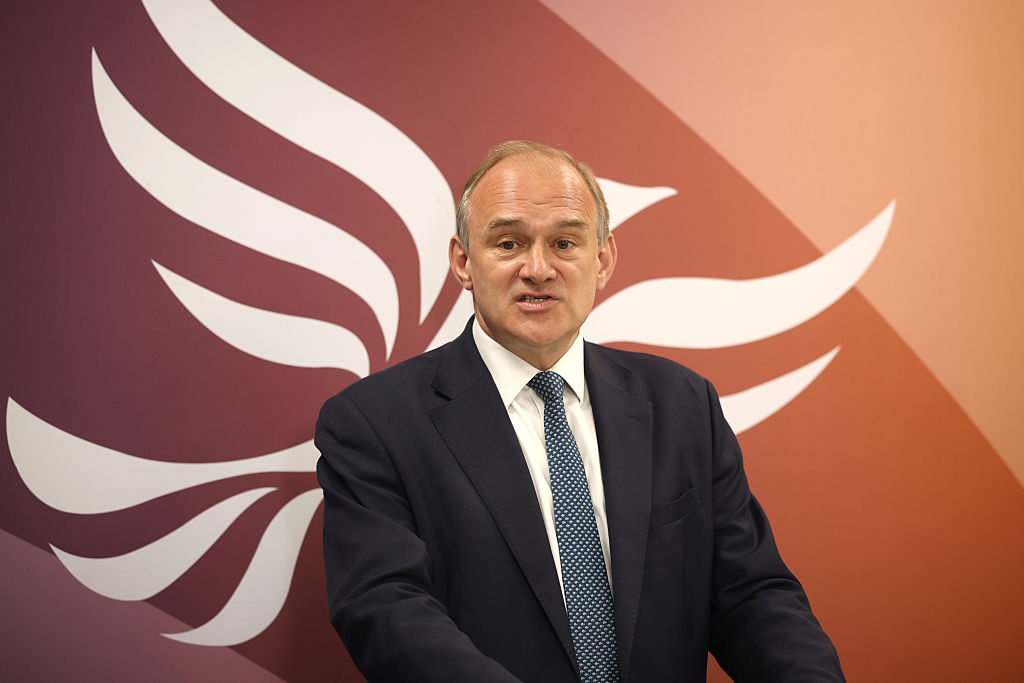
At Prime Minister’s Questions the other week, Ed Davey mildly chided Sir Keir for whipping his MPs on a privileges committee vote, before turning around to accuse other opposition parties of hypocrisy for proposing the measure in the first place. During another debate on the same subject, he gently beseeched the Prime Minister to be the best version of himself. In recent interviews Davey has spoken of Sir Keir as a tragic hero who has betrayed his own high ideals. The Lib Dems’ recent local election campaign was less about opposing the government than guarding against what Davey called the ‘extreme populists’: Reform and the Greens.
Watching these displays I am reminded of another party called the Liberal Democrats – the Russian one, which was led by the colourful figure of Vladimir Zhirinovsky until his death in 2022. The job of Zhirinovsky and his Liberal Democratic party was to provide a fake opposition to Vladimir Putin’s government. He took all of Putin’s ideas for granted, sometimes elaborating on them in a cartoonish way, and only ever criticised the government for not living up to them. Bizarre outfits like these are a plank of what is now termed managed or sovereign democracy in Russia.
The occasional tiff aside, Davey agrees with Starmer on nearly everything and almost always casts his ‘opposition’ in the form of friendly advice
The Liberal Democrats under Davey play an eerily similar role. The occasional tiff aside, Davey agrees with Starmer on nearly everything and almost always casts his ‘opposition’ in the form of friendly advice: to not forget about social care, to go still further in censoring the web. They defer to Starmerites on all the big areas, and are happy to busy themselves in the meantime, very consciously, with quaint minutiae – like cycling paths or the fate of the church roof. Liberalism is meant to be in crisis around the world, and the Lib Dems are scions of the oldest liberal party of all, but we never hear much of anything from them on the subject.
The two Liberal Democrat parties are similar in other ways. Neither has any policies; in fact, both boast of a sort of homespun indifference to national policy, often wondering aloud why politicians can’t simply stop arguing and do what’s right. Both take it for granted that political opponents are the running dogs of foreign governments. Both treat the democratic process as a big joke that only they get. Zhirinovsky used to suggest deliberately outlandish ideas – like dumping toxic waste on the Baltic states or conquering Saudi Arabia – not because he believed in these things, but because it was a way of showing his contempt for the whole parliamentary system. Ed Davey’s stunts with boogie boards and marching bands on the campaign trail should be seen in the same light. After all, this is a party that is noticeably breezy about elections and electoral mandates. From 2016-19 it advocated that the result of a referendum simply be cancelled, something that Zhirinovsky never attempted.
How did we end up with this kind of party in Britain?Because much like the Russian Federation, Britain does not reallyhave the political culture to sustain a liberal democracy anymore. There is no sympathy for pluralism or for liberal ideas. Britain promulgates official codes of values and hates debate, which it only ever sees as harmful ‘division’. The most common refrain about the NHS or even war and peace is that these things should be taken out of politics entirely. Spies and military officers sit in the legislature in ever greater numbers. The British establishment fawns over any stately figure it can find who seems above politics and begs for their leadership – see the recent mooning over Olly Robbins, just as Sir Keir was mooned over years ago. In the 1993 BBC series To Play the King Charles III’s attempts to act politically are presented as faintly contemptible, but in the forthcoming novel What if Reform Wins the monarch simply dismisses Farage as prime minister. The only outcome of the Mandelson affair is likely to be that the security services are given more of a say over who gets to hold public office.
Davey’s Liberal Democrats are another expression of this authoritarian turn. Their showy indifference to anything other than local issues is a sort of protest against the whole idea of politics; the implication always seems to be that some third force should intervene and simply resolve all the nation’s issues. The kind of people who voted Leave and Reform are often accused of a generic anti-politics, but this is much truer when it comes to the Lib Dems and their wealthy voters. Districts won by the Lib Dems are virtually lost to the body politic, taking no further part in the affairs of the nation. That much of the English middle classes have now essentially withdrawn from national life in this way is, one would think, much more alarming for the health of democracy than people criticising judges.
The British people seem to have tired of the current group of ex-spies and generals in office. But the persistence of figures like Davey, and the fake opposition of the Lib Dems, shows that they are more or less happy for their democracy to remain a managed one.


Comments