
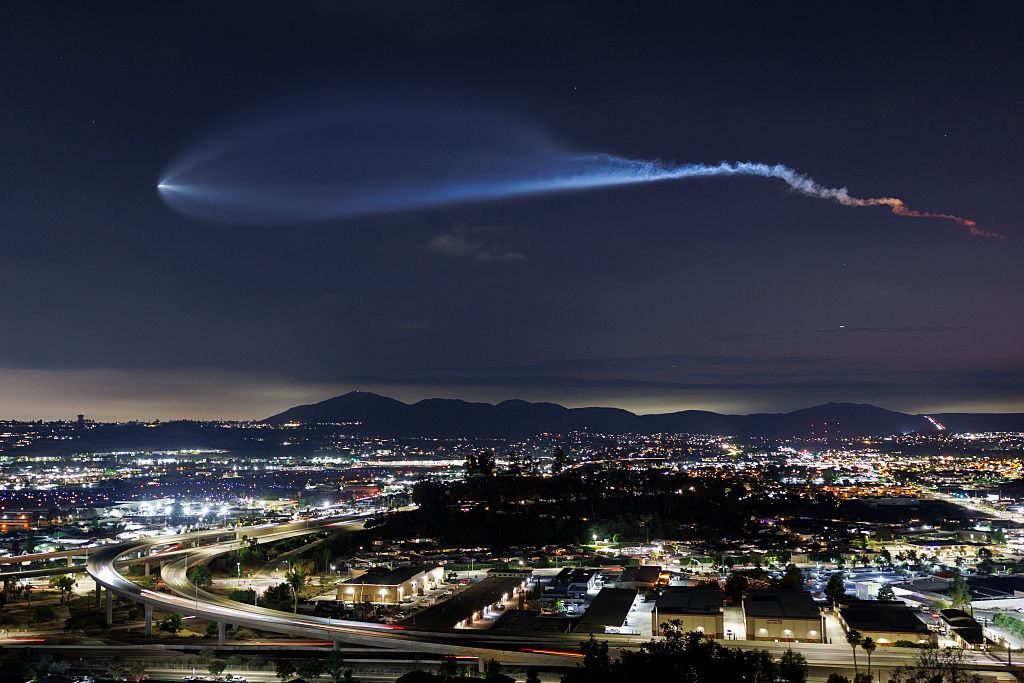
Does China have a plan to destroy Starlink, the low-earth orbit satellite system which provides internet connectivity to tens of millions of people – including Ukraine’s military? That is just one of the extraordinary revelations in a year-long investigation by the Insider, Der Spiegel, and Le Monde. Their report is based on a set of power-point presentations from a secret 2023 Russo-Chinese military conference, as well as a working protocol from negotiations held in Moscow in June 2023, that were leaked last year to the German magazine Der Spiegel. This confidential material appears to provide detailed evidence that military cooperation between Moscow and Beijing is far closer and deeper than previously understood.
The Starlink-killing plan was presented to a delegation of Russian military officers and civilian defence experts in November 2023
Most shockingly of all, the investigation – corroborated by a slew of senior Western military experts – shows that Russia and China have jointly developed next-generations weapons and that China has effectively battle-tested its military technologies in the field in Ukraine.
‘From air- and missile-defense systems to AI-enhanced drone capabilities, cooperation between Moscow and Beijing is allowing Russian forces to keep pace with Ukrainian innovations while China gains the opportunity to test its wares under combat conditions,’ the report says.
Most eye-catching is the allegations that China’s military experts have formulated a detailed plan to jam and ultimately destroy Starlink, the Elon Musk-owned communications system on which Ukraine’s troops rely for their communications and drone operation. ‘Starlink is now actually the blood of our entire communications infrastructure,’ Mykhailo Fedorov, Ukraine’s then-minister of digital transformation and now its defence minister, said back in September 2023. That same month, says the report, engineers from China’s most important space and defence institutions – including China’s principal state space contractor, the China Aerospace Science and Technology Corporation (CASC) – gathered for a secret meeting to discuss ways to annihilate Starlink.
Their plan was a three-stage escalation, starting with Russo-Chinese legal and diplomatic pressure and takeover of essential transmission bandwidths, escalating to joint electromagnetic-jamming to selectively block Starlink in chosen geographic areas, merging the two countries’ separate anti-satellite programmes into a single system. The final phase is physical destruction, beginning with hacking attacks and malware and ending with elimination of the satellites themselves via ‘low-cost’ attacks capable of destroying Starlink satellites in orbit. Though the presentation doesn’t specify what exact weapons could be used, the Insider/Speigel/Le Monde report cites current Nato theories that a ‘single rocket munition that disburses clouds of high-density projectiles such as ball bearings’ could be used, or a ‘vehicle that releases hundreds of low-cost, shoebox-sized CubeSats, which could ram into Starlink satellites or fry their electronics with sprayed chemical agents.’
The Starlink-killing plan was presented to a delegation of Russian military officers and civilian defence experts in November 2023 at the Third China-Russia Military-Technical Cooperation Forum in Guangzhou by two senior CASC engineers. SpaceX – owner of Starlink – is also the Pentagon’s most important space contractor, responsible for building and carrying US spy satellites into orbit, as well as the US government-funded Starshield, the hard variant of Starlink, which ensures resilient military connectivity. At the same time Musk’s other company, Tesla, has deep commercial ties to China, on which it relies for batteries.
Another leaked document was a contract signed by China’s Central Military Commission with Russia’s top air-defence manufacturer Almaz-Antey after nine days of negotiations in Moscow in June 2023. The deal launched a joint project to create ‘an integrated low-altitude terminal-phase air-and-missile-defence system aimed at intercepting American hypersonic missiles.’ According to the investigation team, progress on this project was confirmed at a high-level secret meeting of 80 top Chinese and Russian officers and engineers in Yekaterinburg in December 2024. According to military analyst Pavel Luzin of the Saratoga Foundation, sharing technology on intercepting hypersonic ballistic missiles is ‘the holy of holies — something that neither Russia nor the Soviet Union ever wanted to share.’ But through a combination of expediency and pressure from the ongoing war in Ukraine, ‘now Russia is nevertheless prepared to do so.’
Last but not least of the revelations is an extensive programme of field-testing of Chinese technologies in battlefield conditions. One key area is loitering munitions – drones which hover and seek targets, either guided by human operators or, more recently, autonomous AI. At the Guangzhou conference Li Rong of the PLA Academy of Military Sciences proposed not only testing China’s 160 loitering munition types in combat conditions but also jointly developing next-generation ‘swarm’ munitions – with Russia providing the field testing and China the AI and mass production. According to Ukrainian military-intelligence documents this has since happened, with Russian V2U autonomous drones running on Chinese AI modules, lidar sensors, batteries and solid-state drives.
Is the leaked material reliable? German foreign minister Johann Wadephul believes it is. ‘The findings about the considerable extent of Chinese support for the Russian military are extremely worrying,’ Wadephul told Der Spiegel. ‘China must know that this violates the absolute core of European security interests.’
Many Western countries have long suspected close cooperation between Moscow and Beijing’s militaries, but this report provides key new evidence. Though the threat of Western sanctions places constraints on their ‘no limits’ partnership, we now know that Russia and China are covertly cooperating on a level hitherto unsuspected.





Comments