
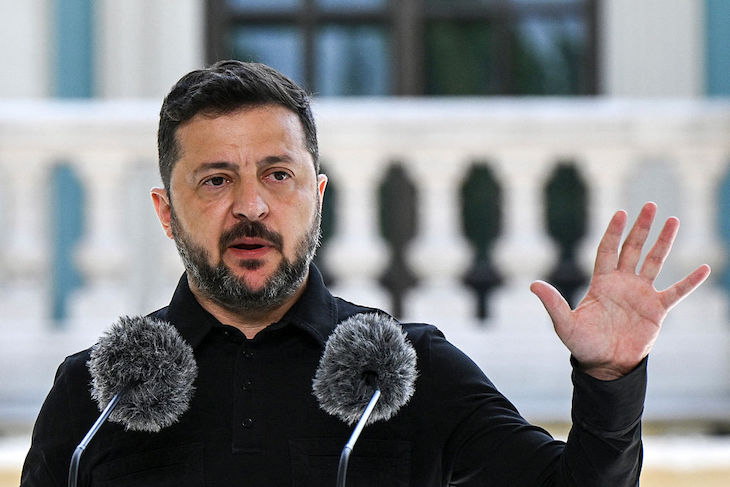
On the face of it, Volodymyr Zelensky’s firing last week of his popular 35-year-old Defense Minister Mykhailo Fedorov was an inexplicable own-goal. As Minister for Digital Transformation, Fedorov led Ukraine’s push toward massive drone production. As Defense Minister since January 2026, he was widely credited with Ukraine turning the tables on Russia with long-range drone strikes and for cutting corruption in the military. Now, after a week of protests that saw thousands of young protesters take to the streets in Kyiv, Zelensky has fired Chief of the General Staff, Oleksandr Syrskyi, too.
The proximate cause of this ruction was a conflict between the Minister and Chief of the General Staff over corrupt military procurement and Syrskyi’s supposedly Soviet-style fighting doctrine that needlessly sacrificed lives. But the much more important story is what the Fedorov affair tells us about how Zelensky runs Ukraine – and the best way to fight the war.
One reading is that the dramas of the last week – which included not just street protests but a parliamentary revolt against Zelensky – prove that “Ukraine remains a democracy despite everything”, says Ukrainian defense analyst and co-founder of the Kyiv Independent, Illia Ponomarenko. “Today, the entire free world has something to celebrate… The ability to unite in a dark hour, take matters into our own hands, go out into the streets, and speak out against those in power has more than once saved our people when they stood on the brink of destruction.”
The hostile interpretation is that firing Fedorov in the first place is just the latest example of Zelensky choosing the interests of the establishment and of his cronies, as well as his own political survival, over the true interests of Ukraine.

Last summer, several close Zelensky loyalists were investigated for massive corruption by Ukraine’s independent, western-backed anti-corruption bodies Sapo and Nabu. Zelensky reacted by attempting to bring the agencies under the control of the Presidential Administration. The first mass protests of the war were the result, and there was an outcry from Ukraine’s western allies. Zelensky was forced to make a U-turn, just as he has this summer over Fedorov, and Zelensky’s all-powerful chief of staff and “green cardinal” Andriy Yermak was sacked, then arrested.
Earlier this year, Zelensky blew up Ukraine’s crucial relationship with Poland after personally attending the reburial, with full military honors, of Andriy Melnyk, a leader of the second world war-era Ukrainian Insurgent Army (UPA). In addition to fighting Soviet troops, the UPA also massacred tens of thousands of Ukrainian, Polish and Jewish civilians. To add insult to injury, Zelensky also named a Ukrainian military unit after the “Heroes of the UPA,” prompting Poland’s President to withdraw the Order of the White Eagle, his country’s highest decoration, from Zelensky. The UPA row collapsed Warsaw’s support in the EU for more funding and eventual membership for Kyiv, and prompted a shutdown of vital Polish military supplies. Zelensky did this because over recent months and years he has also become increasingly reliant on a base of support among ultra-nationalists who dominate Ukraine’s military for whom the UPA are national heroes.
Zelensky’s firing of Fedorov in many ways seems to fit the pattern of backing core supporters over wider strategic considerations. Fedorov was popular with western politicians and donors, the drone warfare successes which he was credited for made him a key part of the “Ukraine is winning” narrative, and last but not least his can-do internet generation attitude was popular among young, tech-savvy voters. Yet ultimately, Zelensky chose to support the military establishment over the boat-rocking firebrand. Worse still, the move came just as Washington is beginning to adopt a more positive attitude toward Ukraine. For Zelensky, when push comes to shove, the support of the military establishment and the big hitters of the military-technology-industrial complex, plus protecting his old friends, mattered more than western partners or Kyiv’s middle classes.
According to former senior members of Zelensky’s administration, the Ukrainian state operates in three concentric rings. The outer ring is performative, designed to “tick the boxes of western socio-political sensibilities”, writes political analyst Aleksandar Djokic, and is populated by characters such as “the feminist girl boss, the modern tech bro, the sweet-talking young minister with UwU stickers on her laptop”. The second ring is for the benefit of Ukrainian voters. “You can call it the dream factory”, says a former senior minister and one-time Zelensky loyalist. This level is where an extensive machinery of loyal politicians, journalists and bloggers “talk bluntly and aggressively about recovering our lost lands, how we’re going to screw Putin and kill the barbarian Russians”. But the innermost ring, where the real decisions are made, is composed of Zelensky loyalists and powerful vested interests. Zelensky “understands and trusts his own team only”, says a former senior member of Zelensky’s administration who has known him for 15 years. “These are the people whose interests he will protect first and foremost.”
According to Iuliia Mendel, Zelensky’s former press secretary: “We were sold a fully manufactured image of Zelensky as an incorruptible wartime leader.” But, she says, “each new minister arrives as a supposed savior and departs as another disappointment… The question is how many more golden calves must be paraded and discarded before the country confronts the person who sits at the center of the system and benefits from its continued opacity.”
The idea that Fedorov is a plucky young upstart challenging the establishment doesn’t really fit with his seven years’ service as an ultra-loyal minister in Zelensky’s cabinet. At the same time, it’s also clear that Fedorov stepped on the toes of many powerful interest groups in his quest to streamline the notoriously corrupt area of defense procurement. Instead of expensive big-ticket items on the army’s shopping list, Fedorov purchased what front-line brigades were actually asking for, such as pickup trucks and drones. Fedorov also attacked Syrskyi’s supposedly initiative-killing approach to the organization of the army, ordered a civilian security service investigation into beatings, abuse and 26 reported murders in Syrskyi’s favored Skelia unit, and finally slammed the army chief for fighting with manpower as opposed to drones and unmanned vehicles. “Drone-assault units are a fundamental change in the way we think about deploying infantry,” said Fedorov in a blistering post-sacking speech. “Technology must be at the forefront of combat. We should lose drones, not people, and only then should infantry move in.”
The narrative of Ukrainian victory leaves out half the scorecard
The most important question is how the sacking of both Fedorov and now Syrskyi will impact the outcome of the war. The narrative that Ukraine is now winning thanks to its long-range strikes is, in part, a carefully constructed PR story put together for the Nato summit in Ankara where crucial funding packages were decided. That’s not to say that Ukrainian deep strikes aren’t doing real damage. Dozens of Russian oil refineries have been set ablaze and last week two giant warehouses belonging to Wildberries, the Russian equivalent of Amazon, were destroyed. Equally real are the massive gasoline lines in almost every Russian province, the effective blockade of the Crimean peninsula and the sunken tankers in the sea of Azov that tried to break it.
But the narrative of Ukrainian victory leaves out half the scorecard. On the ground, Russian troops have reached the center of Konstantinovka, one of the three remaining “fortress cities” of the Donbas. Reports suggest that Kyiv’s strikes have damaged, not destroyed Russia’s refineries – capacity has gone down by only 13.5 percent. That’s undoubtedly painful for the Kremlin, but by no means catastrophic. And in recent weeks a chronic shortage of US-made Patriot interceptors has left Kyiv and other cities wide open to attack by Russian ballistic missiles, which have destroyed an underground metro station and are systematically taking out hundreds of petrol stations. At the Nato summit, the US offered Ukraine (and France) a license to produce their own Patriots – but that won’t become a reality for at least two years. As Ukraine’s military chief Syrskyi said, the long-range strikes are “reciprocal”, with Ukraine being hit every bit as hard as it is able to hit back.
Fedorov understood that modern war runs on tech integration, not Soviet-era hierarchy, yet was fired for pursuing reforms too aggressively. With Vladimir Putin showing no signs of backing down – indeed, many well-sourced recent reports suggest that he instead wants to escalate – Ukraine needs to come up with a comprehensive strategy to make continuing the war too painful for Russia to bear. Thanks in large part to Zelensky’s leadership, Ukraine has achieved a military miracle in fighting its much larger and far more powerful neighbor to a standstill, and even reaching military parity. But in a long war of attrition, it’s Russia with its advantages of size, economic heft and population, that holds the upper hand. Young, smart, tech-minded people like Fedorov hold the secret to tipping that balance. And as Zelensky has belatedly realized, victory depends on backing leaders of the future, not men of the past.


Comments