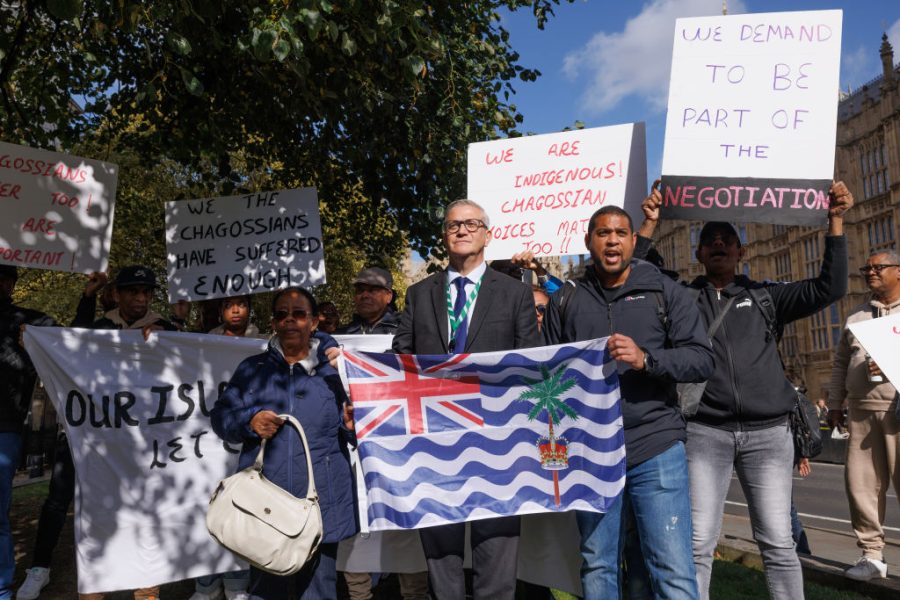
For a moment, it looked as if this tragic inevitability would not happen. But yesterday evening, Donald Trump gave the green light for Sir Keir Starmer’s disastrous Chagos Islands deal following ‘productive discussions’ between the two leaders. As a result, the UK has moved one step closer to realising its greatest strategic blunder in history. The ceding of a vital British sovereign strategic asset to Mauritius, which so many had tirelessly campaigned to avoid, looks set to become a reality.
For the US president, his decision to back the deal was a volte face from a fortnight ago when he rightly derided the deal as an ‘act of GREAT STUPIDITY’. Trump’s approval reportedly came after numerous pleas from Starmer and his National Security Advisor, Jonathan Powell. Thankfully, Washington’s rubber stamp did not come without a caveat. The deal may have been ‘the best [Starmer] could make’, Trump asserted, but should it ‘fall apart’ or should US security be threatened, then the US will ‘militarily secure and reinforce [its] presence in Diego Garcia’. Beggars cannot be choosers.
Trump knows all too well that no deal is better than a bad deal. One need only look back to his aborted Hanoi summit with North Korean leader Kim Jong Un in February 2019. Trump said he cut the meeting short after North Korea reportedly demanded America lift all sanctions against it.
Starmer’s recent visit to East Asia epitomised Britain’s downward slide in the world
But amidst the focus on the United States Starmer cannot escape scot-free. With the Prime Minister preoccupied with the ever more numerous tribulations of the Peter Mandelson scandal, the drastic consequences of the Chagos arrangement cannot be ignored. It is not just the cost to the British taxpayer of a whopping £35 billion on a deal that will lease a vital strategic base to a Chinese ally that is asinine. For Britain’s foreign policy, the deal underscores how we are neither a great nor middle power, but a diminishing one. Its consequences will compromise the US and Nato’s ability to defend the Western world.
Starmer’s recent visit to East Asia epitomised Britain’s downward slide in the world. The sojourn emphasised the Prime Minister’s unwillingness to care for Britain’s global reputation, not least in the eyes of our East Asian partners. Japan and South Korea are all too familiar with the challenges of walking the tightrope between America and China. For Xi Jinping, however, Starmer’s Beijing visit was a victory. Being appeased by the power long chastised for being responsible for the opium wars, whilst simultaneously belittling his British counterpart through carefully crafted gestures, likely proved easier than China’s premier initially thought.
Japan’s own Iron Lady, Prime Minister Sanae Takaichi, who is facing an election this weekend, can wallow in the fact that her levels of popular support far outpace those of her British counterpart.
But whilst London and Tokyo must strengthen their ties, the former seems to be doing all it can to chip away at the latter’s trust. For all Starmer’s words that the two states should respond to global instability with ‘strength and clarity’, the Labour government’s conspicuous lack of clarity with respect to criticising China is unlikely to go unnoticed in the land of the rising sun. The role of Peter Mandelson – whom Starmer himself approved as British ambassador to the United States – in currying favours with Chinese state-owned enterprises should not be swept under the carpet.
Starmer’s decision to give Seoul a miss on his trip last week cannot be overlooked. When he last met his Korean counterpart, Lee Jae-myung, in June last year, Starmer mistook the presidential interpreter for the president himself. First impressions count. Whether South Korea will sign another deal with the UK, akin to that between Rishi Sunak and Yoon Suk Yeol in November 2023, remains to be seen.
President Lee is pursuing a ‘pragmatic’ foreign policy that avoids choosing between the United States and China. Starmer’s foreign policy, meanwhile, reflects the antithesis of pragmatism. The two men may both lean leftwards when it comes to politics, but as the Labour party is demonstrating, being left-wing is hardly enough for unity to prevail.
Thanks to Starmer’s government, Britain has been relegated to the status of a declining power. The Chagos Islands deal has hammered another nail firmly into the coffin. Starmer did not even try particularly hard to make a good deal. Not only will Britain now be seen as a declining power, but it will also be known as an indolent one.
In his 1987 book, The Art of the Deal, Donald Trump wrote that central to his negotiating strategy was aiming high and ‘pushing and pushing’ to achieve his goals. If only the UK government had done the same to stop the Chagos Islands from becoming yet another venue of Sino-Western competition.
Whilst a US-annexed Diego Garcia would be preferable to one under the wing of China, the ideal next step is for Washington to U-turn again and rubbish the deal once and for all. Back on our shores, we must also admit one reality. Starmer’s government is not just a national embarrassment; it is a global embarrassment. The Chagos deal proves it.




Comments