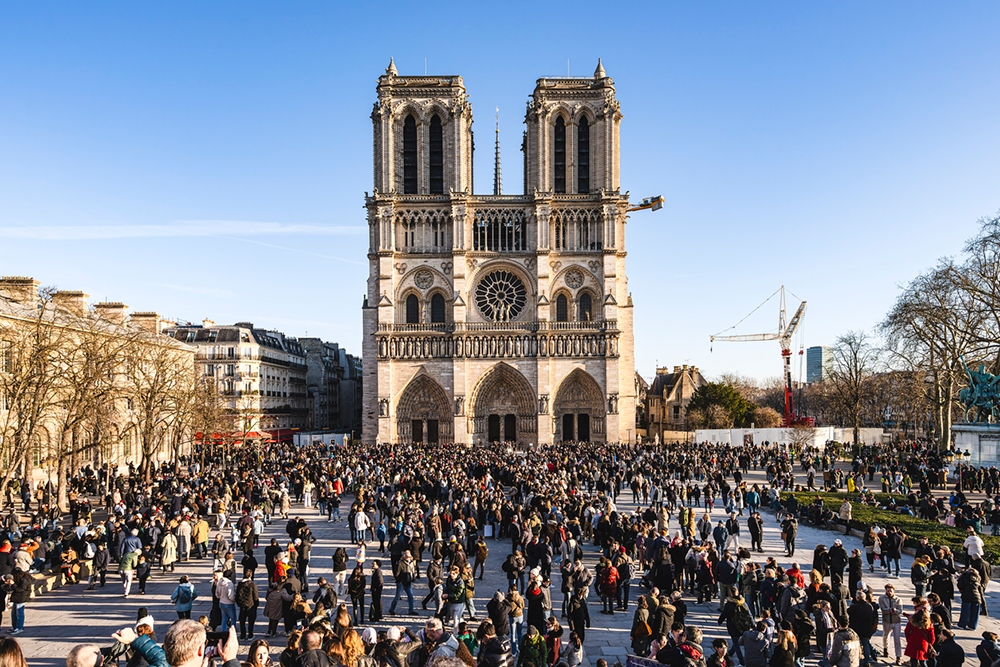
We always try to spend Valentine’s Day weekend in Paris. My wife has held on to a tiny apartment in the Latin quarter since a young age and it is the perfect pied-à-terre from which to venture into the best parts of the city, from St Germain to the Marais.
First stop on the journey is the Eurostar lounge. I like to check on the availability of The Spectator on the shelves. When we acquired the magazine a little over a year ago there was no sign of it despite well-stocked supplies of Guardian Weekly and the New Statesman. Not good. That has now been sorted, and I was pleased to see a generous supply of the world’s oldest magazine.
Our street in Paris traces the path of an old tributary into the Seine and if you stand in the right place you can see both Notre-Dame to the north and the dome of the Pantheon to the south. The best and worst of French civilisation. Notre-Dame is one of the finest and oldest monuments to the Christian faith, which is no doubt why Donald Trump, J.D. Vance and Prince William all hastened there to commemorate its restoration after the fire. The Pantheon on the other hand is a temple to secularism, a monument to the human usurpation of power and home to the tombs of the ghastly Rousseau, and the only slightly less frightful – because Anglophile – Voltaire.
Our custom is to take in a movie or two, to visit an exhibition, and to flâner les bouquinistes, all punctuated with long meals in our favourite restaurants. Or maybe it is the other way round. As you get older the enjoyment of good food and wine seems to rise gently up the priority hierarchy.
We had been really looking forward to the Martin Parr exhibition. The Jeu de Paume was packed. The French are mad about Martin Parr. In fact they are madder about Parr than the English. Which is odd given that his Britishness seeps into every pixel. You could call him the photographer of Brexit. And maybe that is why the Brits are still a bit reticent. He celebrates our working class in all its eccentricity and quirkiness. He does it with compassion but also with a wink and a wry smile. He said ‘people are funny’ and almost every photograph told of his sense of humour. I have never been to an exhibition where so many people were smiling. One of his earliest series, ‘The Last Resort’, shows the dying days of the working class in Thatcherite Britain. In his words, my ‘main aim is to create an archive of the time I have lived in Britain. That will be my legacy.’ That is one reason we decided to decorate the Old Queen Street café (home of the UnHerd club) with Martin Parr photographs. Perfect for a British brasserie.
Martin Parr portrayed us as we are, with all our hopes and fears, in all our messiness. He honoured what was simple. There is a wonderful BBC documentary showing him in action in his later years, walking round seaside towns with his perambulator, with an eye for every angle and every strangeness, snapping people at every opportunity. Whenever he approaches someone, he starts with a kind and engaging word. What a delightful man he was.
Forget Macron or Lecornu, or even Bernard Arnault. The most powerful man in Paris is Luc, the maître d’hôtel at Brasserie Lipp. If you look like a tourist or, most heretical of all, come dressed in shorts, you will be dispatched upstairs. If you are not known to Luc or his team but look respectable, you may qualify for a seat at the back of the restaurant. If you are a regular or a friend, you can hope for one of the prime tables in the front. From there we watch through the mirrors the comings and goings of Parisian intellectual life. I call them ‘bobos’. My wife thinks that’s a cliché. But ‘hipsters’ doesn’t do it – and the term ‘bobo’ was invented in France. So why not? Centre of everyone’s attention is Marisa Berenson, star of Barry Lyndon, Death in Venice and Cabaret. In the 1970s she was known as the ‘Queen of the Scene’. Her sister, a star in her own right, died in one of the planes which were flown into the Twin Towers. She is on a table with three other septuagenarian women who could all have been Hollywood divas. It turns out it is her birthday and when they bring out the cake half the restaurant stands up to join in the chorus.
The menu has stayed faithful to the memory of its Alsatian founder, Leonard Lipp, who established the restaurant here in 1880 to cater to fellow refugees fleeing the Prussian occupation of their homeland. We are drowned in good choices. I went for the veal ‘à la crème de morilles’ with purée. And then profiteroles glacées. Bien sûr.





Comments