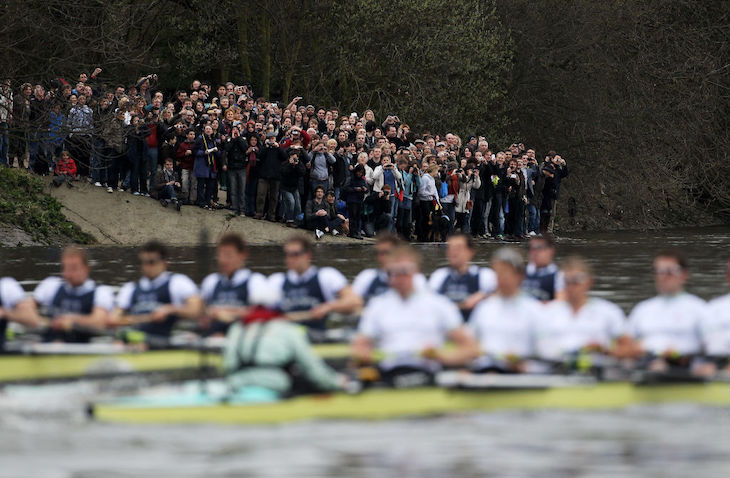
And so, slowly but regularly, the BBC loses touch with British national life. The BBC has just lost the radio broadcast rights to the Oxford vs. Cambridge Boat Race to Times Radio, which will cover the event for three years. It comes after Channel 4 won the deal last year for TV rights for the next five years, meaning it will cover the 200th anniversary of the first boat race in 1829.
What was once the finest broadcaster in the world becomes a navel-gazing, self-obsessed purveyor of frivolous rubbish
Until now, the BBC had broadcast the radio commentary of the race since 1927, except for a brief spell from 2005 to 2010, when LBC had the radio rights. The BBC had televised it (with interruption between 2005 and 2009) since 1938.
The Boat Race may not be quite so embedded in British hearts as it once was but, still, 2.82 million people watched it on the BBC last year, making it the most-watched sporting event that weekend on TV.
It’s true, too, that the Boat Race is a decidedly odd sporting contest. For the rest of the year, the British barely take interest in rowing and then, for 20 minutes in spring (this year, on 4 April), we’re gripped. Up to 200,000 people flock to the Thames just to get a brief glimpse of two boats flashing past them.
But its oddness – and its history and clockwork annual regularity – were what once rooted the Boat Race in British affections, appealing even to non-sports fans. The BBC has gone through its own decline in recent years but, still, the fact the Boat Race was a staple of its sports coverage buttressed the race’s place in our annual calendars.
As Rupert Murdoch realised to his bank balance’s credit, sport is the must-see gold dust of broadcasters. But the BBC has gradually lost most of its gems, once shown live by the Corporation: the Grand National, Cheltenham, Ascot, the Derby, home Test matches, the Ryder Cup, the Rugby World Cup, Formula One, the Lions and the Open.

And what has the BBC replaced these compelling, unique occasions with? Dud game shows, vacuous interviews with forth-rate celebs, bargain basement 24-hour news, crammed with trails of John Simpson showing off about his own brilliance.
Even the BBC’s remaining crown jewels are rapidly going downhill. The Today programme had a five per cent drop in weekly audience last year. Its average weekly audience is now 5.47 million, down from numbers that once hit seven million.
And no wonder! Instead of John Humphrys grilling politicians with intense precision, you get Emma Barnett banging on about herself and asking the listeners to get in contact with the show to give their own opinions. And so what was once the finest broadcaster in the world becomes a navel-gazing, self-obsessed purveyor of frivolous rubbish.
The BBC, to be fair, is in a tricky position. To justify its position as the national broadcaster, supported by a national tax, it must try to be all things to all people: thus the trashy game shows and the dumbed-down news.
If it makes highbrow programmes, the BBC worries it is betraying its obligation to be mainstream. But, in fact, we all like to be talked up to, whatever our background. That’s why Kenneth Clark’s high-minded Civilisation (1969) remains much more admired than its dumbed-down successors, Civilisations (2018) and the moronic Civilisations: Rise and Fall (2025), where that famed Egyptologist Alastair Campbell was brought in to opine on the ancient world.
In fact, for all its oddity – two small, ancient universities rowing against each other – the Boat Race was prized for its oddity and its hallowed history. Take away all those quirky institutions – particularly if they have high-minded, ancient connotations – and the BBC becomes less interesting and no longer unique.
Meanwhile, the commercial channels are eating the BBC’s lunch. Series like The Sopranos, Succession and Curb Your Enthusiasm are on such a high, dramatic, comic level that they are real art. Such brilliance appeals to viewers of all backgrounds – and it is rewarded with the sort of praise and income that mean successive series are commissioned.
No self-respecting commercial broadcaster would ever jettison such gems as the BBC has just jettisoned the Boat Race.



Comments