Ben Delo, the source of one half of Reform’s £72 million mega-donation, wrote in The Spectator last year about being diagnosed with Asperger’s syndrome as a child. The self-confessed geek, now 42, was socially awkward. He did not fit in and he did not care to. His condition would shape the course of his life, making him very good at maths, very rich and hellbent on getting involved in politics.
Christopher Harborne, the crypto millionaire who has matched Delo’s donation, we know much less about. Despite being a billionaire many times over, the 63-year-old has the air of a chemistry teacher and an aversion to interviews. Like Delo, who until recently lived in Hong Kong, he also forged his way in the Far East, living in Thailand. It’s invidious to make conjectures about anyone’s neurodiversity – and I won’t – but Harborne is clearly extremely smart and highly unconventional.
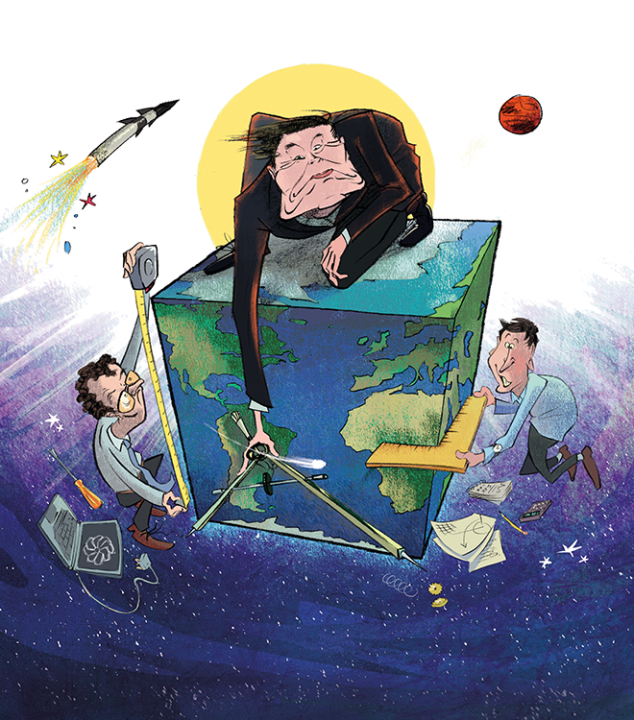
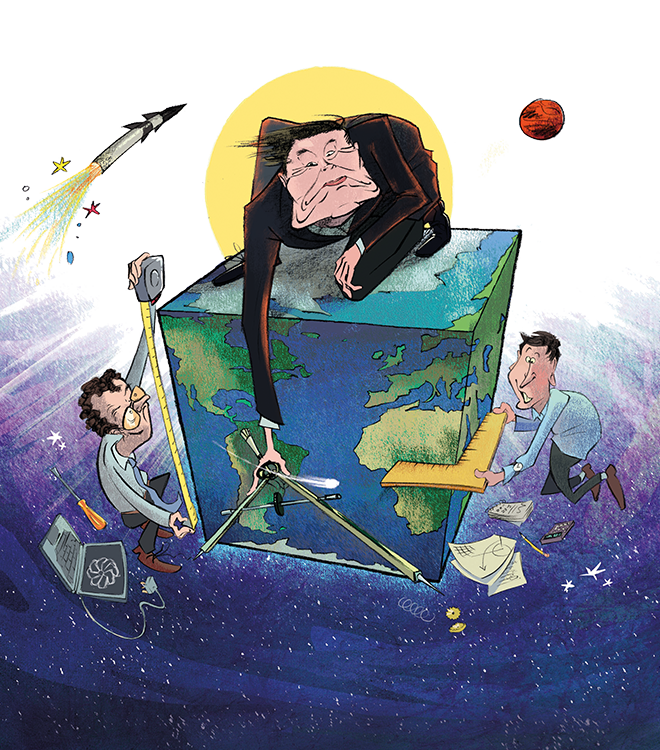
We are on safer ground, however, when it comes to Elon Musk, who considered donating to Reform before ditching Nigel Farage, calling him ‘weak sauce’. Musk had more time to get used to the media and in 2021, at the age of 49, he used the stage of the US TV show Saturday Night Live to tell the world he had Asperger’s. It played no less a role in shaping his life than it did for Delo, even if it does not define him.
Should we be worried when men who think so differently from us wield such financial and political power?
On the same weekend that the £72 million earthquake was changing the financial landscape of Britain’s political parties, another seismic event was happening over in the United States in the world of AI. Musk – who runs SpaceXAI – joined OpenAI boss Sam Altman and Google DeepMind chair Demis Hassabis in supporting a call by Anthropic founder Dario Amodei for a coordinated slowdown in the pace of frontier model development. These four men have a huge role in stewarding the biggest technological revolution in history. Despite their huge power, however, we still know relatively little about them.
I spent four years researching Musk for a book and am convinced that he thinks in a way that is far more different than most of us can imagine. Altman and Amodei have their own particularities but they meet the same description. One of Altman’s mentors, Peter Thiel, for example, told the New Yorker: ‘Sam’s programme for the world is anchored by ideas, not people. And that’s what makes it powerful – because it doesn’t immediately get derailed by questions of popularity.’ Amodei, meanwhile, has earned a reputation for being more vocal on moral questions; he is no friend of Donald Trump and his worldview has been linked to the Effective Altruism movement, which is highly rationalist in nature.
Whether it’s Delo or Musk, should we be worried when men who think so differently from the rest of us wield such financial and political power? Their raw cognitive ability enables them to accrue wealth on a quasi-sovereign level by understanding complex systems rather than people. But communication is not their forte and, with some exceptions (Doge, for example), they avoid public office and, as a consequence, evade the scrutiny that elected politicians are subjected to.
The phrase ‘autistocracy’, once used by Rory Sutherland, comes to mind but not in the sense that he meant it. The Spectator’s Wiki Man was describing ineffective bureaucrats, trained in law and economics, who are detached from reality and take the biggest risk of not taking any risks. They are the reason that Dominic Cummings wanted truly neurodivergent people – ‘weirdos and misfits’ – to join the ranks of government. But might Sutherland’s phrase be better applied to the cadre of deep-pocketed, risk-taking geniuses who operate outside the realms of government, pulling the strings from behind the scenes?
We need to look separately at the crypto donors and the AI titans, but let’s first examine what Delo and Musk mean when they talk about their Asperger’s. This is not simply a term for people who happen to be both very smart and socially awkward. It is a neurological condition, now described more commonly as autism spectrum disorder (ASD). In fact, it used to go undiagnosed, which is probably why we feel more aware of it nowadays (the legendary bond manager Bill Gross, who founded Pimco, only realised he had it in his seventies – his ex-wife quickly agreed).
On the one hand, the brain of someone with ASD is very good at systemising, trying to establish order in a conscientious way. Cambridge professor Simon Baron-Cohen has even challenged the way that we think about creativity, arguing that people with ASD are ‘pattern-seekers’ who are excellent at solving problems and are likely responsible for a great many of humanity’s inventions.
It is called a disorder for a reason, though, because social interaction for people with ASD is very difficult. The brain can be overloaded with sensory stimuli and so is unable to interpret and adjust to what other people are thinking and feeling. Characters like Delo and Musk, therefore, spent a lot of their childhoods in relative solitude, obsessively trying to master different intellectual domains. In the case of Musk, it contributed to appalling bullying as well. They learned to live with ASD, to use social cues (Musk by watching films), but this is not something you would wish on anyone.
This is crucial to understanding how the likes of Delo and Musk function as adults. They have what feels like a very literal view of the world and an obsession with the truth. More than that, they are used to being in a minority and are very resistant to being told what to think.
The systemising brain often jumps, too, from the level of individual humans to society or humanity as a whole. This is where their so-called lack of empathy is often misunderstood. They are less able to understand what others are feeling (cognitive empathy) but they feel for others (affective empathy) in a similar way.
As it turns out, not fussing over what other people think can sometimes be a valuable attribute if you want to succeed in business. That’s the view of Thiel, co-founder of PayPal with Musk. He has made a very successful career investing in people who are ‘Asperger’s-like’, finding them less likely to follow other people and more single-minded in pursuing their goals. They just have to find a way to work with other people.
This is the link between someone with ASD, excelling in a field like mathematics, physics and computing, and becoming very rich. In years past, that profile of person might have whiled away their time doing research at Bell Labs, Xerox PARC or the Ministry of Defence. Since the late 1970s, though, there has been a path to monetise their abilities by starting a company or, more recently, to work at a hedge fund, trading in crypto or building AI.
Their ASD means they are used to being in a minority and are very resistant to being told what to think
It is wrong, however, to think that people like Delo and Musk get involved in right-of-centre politics simply because they are neurodivergent or rich. It is much more complicated than that. Bill Gates, for example, wrote in his memoir, Source Code, that he believes he likely would have been diagnosed with ASD if he were a child growing up today. Greta Thunberg is another example. Her family discuss her ASD diagnosis in their book Our House Is on Fire.
The link between Delo, Gates and Thunberg is that they cannot understand why the world does not see what they see and act on it with the same conviction, be it the decline of the UK, the urgency of improving global health or combating climate change. There is an overlap here, too, with the Effective Altruism movement, which prioritises achieving impact by focusing time and money on areas which are neglected by others, including more recently the potential catastrophic impact of AI.
What Musk and Delo have in common is a visceral dislike of wokeness, which they believe is an affront to the truth. They believe it operates by stifling criticism as most people go along with it for an easier life. Their own willingness not to fit in and care what others think, therefore, becomes a strength. They may be billionaires looking at the UK from afar but they’re convinced the public has more common sense than the Whitehall elites.
So you end up with a strange situation where two individuals with ASD team up with two politicians – Trump and Farage – who are renowned for having the common touch, being plain speaking and wanting to be liked. All four, however, share a temperamental dislike of the Establishment. They are willing to take big risks and bulldoze accepted norms. They talk of moving the Overton Window to the right because they think the centre lacks the ability to reform itself, be it protecting our borders, social media free speech, rape gangs or self-identification of gender. They put it down to political correctness, which they consider themselves immune from.
This has not been the way that Westminster functions. But these men are outsiders and they are not trying to play by gentlemanly rules. Delo sees his neurodivergence as bringing true diversity of thinking to the debates in question. ‘Transformational change,’ he told the Telegraph, ‘starts with heretics and misfits taking on institutions and orthodoxies.’
He and Harborne, therefore, make strange bedfellows with the instinctive, emotional Farage but the alliance is well founded. And £36 million is chump change for them both.
In a way, all of this is reassuring: £72 million buys a lot of advertising and logistics for Reform but the donors are not standing for election themselves. Journalists will play a vital role, providing scrutiny of party finances and the potential links to cryptocurrency regulation. And, in the end, the public will subject Farage to a sniff test and make up their own mind on the merits of the candidates.
Here the view of Tony Blair is instructive. If ever there was a silky communicator who could read the mood of the nation, it was him. In his epistle to Sir Keir Starmer, he identified what Delo and Harborne like about Farage: he is an ‘unconventional leader’ who does not blow with the wind or care about upsetting the media. He represents the ‘radical right’, and other parties who want to remain relevant should respond by being similarly radical, just nearer the centre. They should do ‘whatever it takes’ on illegal immigration and, more broadly, they must help the government to find its new place in a world of technological change.
This brings us back to AI. Political donors still have to operate through a democratic framework. They may target ‘the Establishment’ but we have a parliamentary system and necessarily there will be trade-offs and compromises. As of yet, though, the frontier of AI development is arguably operating outside the democratic framework because the vast majority of politicians have little understanding of what’s going on.
What they have in common is a visceral dislike of wokeness, which they believe is an affront to the truth
Amodei, Altman, Hassabis and Musk might be the smartest guys in the room but they only wield the power – and create the wealth – that they have because governments let them. President Trump has, thus far, given the AI companies a green light because he loves to let the animal spirits loose, and he’s watching over his shoulder for China. But as George Akerlof and Robert Shiller wrote, the role of the government is to set the stage, give full rein to the creativity of capitalism and also to countervail its excesses.
Amodei et al are now in a game of chicken with the Trump administration. Critics say that they are calling for regulation to cement their position and reduce the competitive threat of open-source models. But it’s not a game the government should play.
The worst scenario if you believe in an ‘autistocracy’ would be that ultra-competitive, neurodivergent AI bosses are taking reckless risks without regard for society, a view held by both Bernie Sanders and Steve Bannon. But if the people with the most insight are actually saying that there is a non-negligible chance of catastrophic destruction which can only be mitigated if everyone accepts oversight, then is it not hard not to give them the benefit of the doubt?
The UK, unfortunately, is largely downstream of the US when it comes to AI. And no matter what happens in terms of US regulation, the prosperity of our country will continue to depend on how we respond to this challenge. Sadly, none of the party leaders has yet shown that they take this as seriously as Blair. While it is good that we have some senior people inside companies like OpenAI (George Osborne) and Anthropic (Jack Clark, Rishi Sunak, Liam Booth-Smith and now Matt Clifford), we need our biggest brains working on this inside both government and the private sector. Above all, we need to unleash the next generation of pattern-seekers to build useful things here on our shores.
Charles Steel’s book The Curious Mind of Elon Musk is out now.




Comments