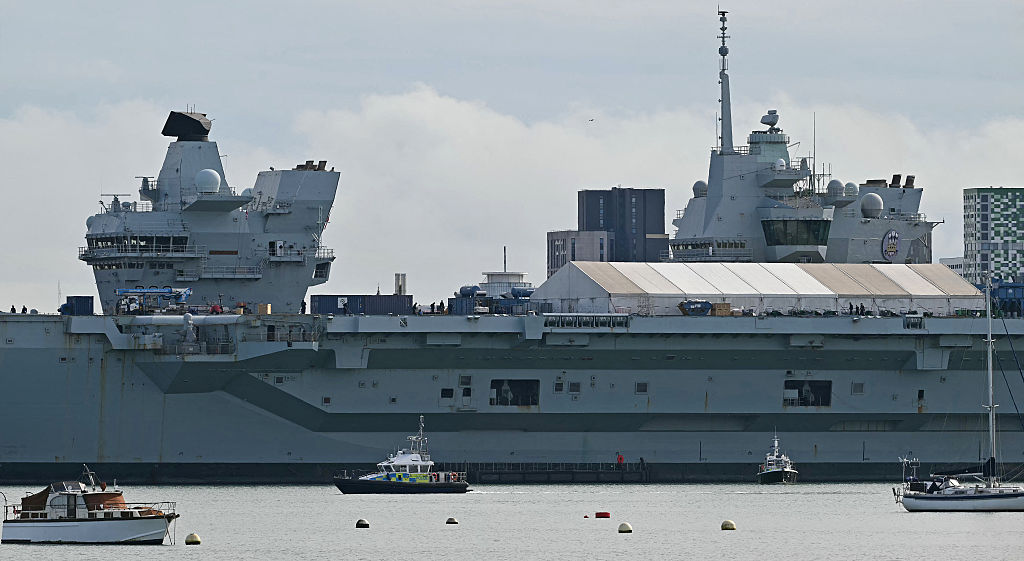
The 400-mile-wide stretch of water between the Svalbard archipelago and the mainland of northern Norway has a nickname: Bear Gap. It is the only way out for Russia’s Northern Fleet warships and submarines from its bases around Murmansk to the deep waters of the Atlantic ocean.
This is only one of a number of scandals that are putting the Royal Navy’s crewmen and women’s lives needlessly at risk
During the Cold War, these waters were the site of a cat-and-mouse game between Russian submarines and Britain’s Royal Navy, whose wartime mission was to close this chokepoint. Now it has become once again one of the most militarised areas on the planet, and tensions are at their highest for 40 years, just as – once again – British Prime Minister Keir Starmer failed to publish his government’s long-awaited Defence Investment Plan (DIP).
Russia has reopened more than 50 Cold War-era military bases in the Arctic. Its army may be weakened by the war in Ukraine, but its navy has deployed a new generation of stealthy, heavily armed and highly sophisticated submarines to confront Nato in these waters.
Norwegian fighters have scrambled 39 times in the first five months of this year to intercept and identify 51 Russian aircraft. This matches the number for the whole of 2025. In April, two Russian strategic bombers flew over the Barents Sea, one carrying a long-range cruise missile under its wing – such fly-overs have increased markedly since the Ukraine invasion.
Yet the real danger that a cold war could quickly become hot, nor his failure – and that of successive governments – to fund the Royal Navy properly, has not stopped British Prime Minister Keir Starmer from ordering HMS Prince of Wales and up to 1,600 crew into the Arctic in what is supposed to be a powerful show of force aimed at deterring Russian aggression. HMS Prince of Wales is one of the Royal Navy’s two vast Queen Elizabeth Class aircraft carriers.

But the Kremlin will assuredly know that the Prince of Wales and its strike force is a paper tiger that is in fact unable to adequately defend itself or take offensive action; and when the illusion of power is suddenly shattered – and it will be at some point now or in the future – its crew will pay the price. The loss of life from a drone, missile or torpedo hit will be horrendous.
It is impossible to see HMS Prince of Wales for the first time and not to feel proud. We are conditioned to expect British decline, and this ship seems to signal the opposite. It is a tremendous feat of British engineering, one of the largest ships ever built for the Royal Navy, and one of the most powerful, with its F-35B Lockheed Lightning II fighters combining stealth with a massive weapons payload and impressive electronic warfare capabilities in one aircraft.
The Prince of Wales is a symbol of the Royal Navy’s glorious past and great future, positively Nelsonian in its ability to project British power worldwide. But the Prince of Wales that recently sailed into the Arctic feels like a far cry from such a vision.
It sailed from Scotland with its state-of-the-art F-35 fighters absent, stripped away due to the need to defend British interests in the Middle East. The respected independent Navy Lookout news site posted that the air power of the 65,000-tonne carrier was restricted to a ‘pocket sized air group’ of around five helicopters. Even the mounts for its four 30mm cannons to shoot down drones and small attack craft – standard kit on other ships – are still empty seven years after the huge ship was commissioned into service.
Then there is our so-called Carrier Strike Group, which barely justifies its name. It should include a number of warships, and different types of them to boot. The group in fact comprises only one Type 45 destroyer and a fuel tanker. Admittedly, the Type 45 is a formidable air defence platform, but there is only one, and it is not the most reliable design. And the group contains no Type 23 frigates, whose job is primarily anti-submarine warfare, perhaps because there are only five frigates left in the whole fleet.
Let’s hope our allies can fill in the gaps.
But this is only one of a number of scandals that are putting the Royal Navy’s crewmen and women’s lives needlessly at risk, from the shrinking of the Royal Navy’s fleet to a historic low and the poor availability of the few ships and submarines it does have, to the failure to order and build replacements in a timely manner, as well as the willingness to sell expensive and hard-to-replace vessels such as landing ships to Brazil and other nations at bargain basement prices, often after expensive refits.
The laying up of the frigate HMS Iron Duke, despite an expensive refit, means that there are only five of these workhorses left in the Royal Navy, which are vital for the defence of HMS Prince of Wales from submarine attack, and if the Royal Navy is to close the Bear Gap.
The F-35B Lightning II isn’t immune to the whiff of scandal. Its technical problems, lack of spare parts, and a lack of ground crew and pilots, meant that a ‘surge’ or ‘maximum effort’ was needed in 2025 to ensure that just 24 F-35Bs out of 48 could be deployed on a carrier at one time.
Over a month since HMS Prince of Wales sailed from Scotland, a rumoured handful of F-35s have belatedly embarked on the carrier. Meanwhile, two ministers have now resigned over the ‘underfunded and outdated DIP.’ By contrast, no serving admirals have resigned over this state of affairs. Admirals, like anyone, are susceptible to spin, and find it easy to convince themselves that rather than speak out the best way to protect the service they love is to do it from the inside. Perhaps they really don’t want to lose the pay and prestige that comes with their role. But it’s time they did so if they want to avoid the loss of HMS Prince of Wales.






Comments