
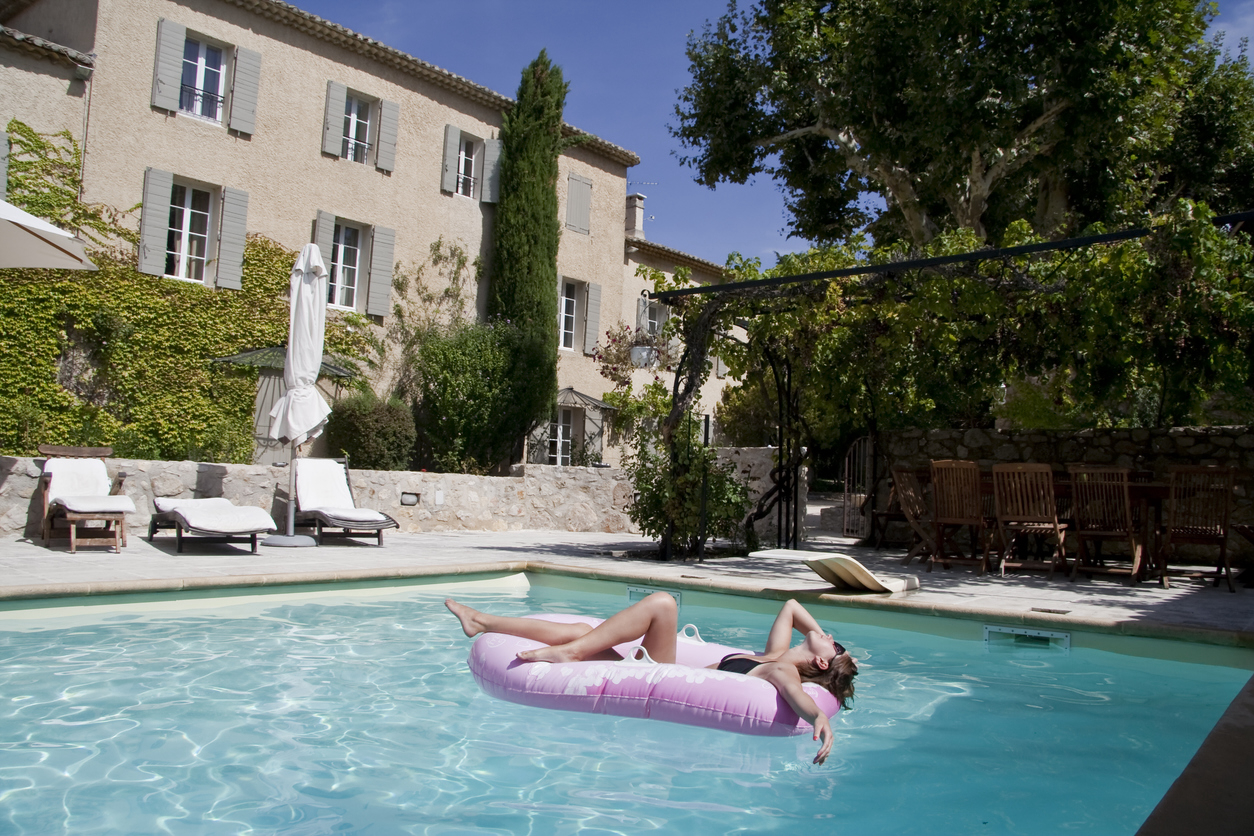
There are those Spectator readers who are fortunate enough to own their own luxurious villas in some suitably picturesque European locale. For the rather less well-heeled remainder of us, the closest that we are going to get to these places is either putting hand in pocket and hiring an Airbnb or, if we are extremely fortunate, being invited to stay with our affluent chums. On paper, at least, it’s a mutually beneficent arrangement. The villa-owners get to be entertained (and entertaining), offering their largesse in exchange for suitable gratitude. Their guests, meanwhile, get a free holiday somewhere wonderful, away from cares and responsibilities, and spending time with dear friends into the bargain. What could possibly go wrong?

Well, bitter experience has taught me, and others, that when the email or WhatsApp message comes in – ‘We were wondering if you might be free to join us for a few days in Provence/Tuscany/Mykonos this August’ – that you might be as wise to write back with fulsome expressions of regret and sorrow that you are unavoidably detained the entire summer as you might be to accept with indecently hasty glee. Anyone who has ever taken another’s hospitality must be mindful of Benjamin Franklin’s adage that ‘guests, like fish, begin to smell after three days.’ If the assembled guests are staying far from their usual haunts, where some may not get on with others with quite the usual bonhomie that they might display when in Blighty, there is the potential for the whole thing to go horribly, comprehensively awry.
Leaving aside the potential difficulties with the accommodation itself – we will assume that the villa is living up to its billing and isn’t the foreign equivalent of a mould-riddled studio flat – then the whole stay is rife with social anxiety from the get-go. Should one expect one’s hosts to pick one up at the airport, full of back-slapping bonhomie? Or would such a thing be regarded as an imposition, necessitating instead the hiring of a car or the booking of a taxi?
And then, of course, there’s the welcome present. Wine is the obvious offering to bring, but if you’re travelling to France or Italy, it’s more likely than not that whatever you’ve brought at the local Waitrose or at duty free isn’t going to cut it compared to what’s available at the nearby corner shop. Yet anything else is similarly rife with difficulty. Turn up with a book and you’re running the risk of insulting the intelligence, or the taste, of your friends (‘oh, the new Charlie Mackesy…how thoughtful’). Clothing is a no-no, naturally, as is jewellery – unless you want to look as if you’re having an affair with one of your hosts, or would like to – which means that, unless you’re so charming that your very presence is enough of a gift in itself, you are going to end up agonising about whatever token of gratitude you’re going to offer as tribute and over-thinking matters horribly.
Things do not get easier from there on in. The length of your stay is usually determined in advance – flights have to be booked after all – but it is perfectly possible to feel both that you have overstayed your welcome after the first night and, conversely, that you are insulting your hosts’ hospitality when you make your excuses and leave after a week. There is the etiquette around mealtimes and what is consumed at these meals, with a list of dietary requirements now being earnestly requested in advance in many cases, as they might be at a restaurant or hotel. And, of course, there is the question of activities. Some hosts might be happy, even expectant, that you will make yourselves scarce from after breakfast until cocktail hour, free to do whatever you wish. Others, meanwhile, will work on the assumption that you will be doing everything together, en famille, which can either be immense fun or overbearingly claustrophobic, depending on the company and situation.
Bathrooms become a particular battleground
The greatest problem about this kind of temporary enforced intimacy is that relatively minor personal quirks and habits, which are easily ignored or never even noticed under normal circumstances, become magnified and thus vastly irritating. Bathrooms become a particular battleground, as does the swimming pool, even down to the kind of chemicals and potential allergies being used in it. Children’s antics can swiftly escalate into open warfare, especially if there is any kind of age gap between them. Political differences, aired late in the evening, are another bone of contention, and it is all too easy to say things that will be noted down and used in evidence against you once back in Blighty.
Even attempts at self-sufficiency can backfire. One friend, invited to a wealthy chum’s Provencal mansion, became frustrated at the relatively late hour at which the first glass of wine was offered, and so went out and bought his own supply. This in turn made him look, in his rueful estimation, less a bon viveur and more like the kind of person who was hiding empty bottles under his bed. A particular low point came when his host’s mother gently asked him whether he had considered seeking help for his addiction. His cries of protest were ignored.
Of course, there are many villa holidays that are a joyous pleasure from start to finish, cementing old friendships and building new ones. (Let’s not get into partner-swapping, though.) But I’ve heard so many horror stories about the crippling, cringe-inducing difficulties that kick in when you’re holidaying with people who you swiftly discover that you don’t know nearly as well as you think that you do that, if and when the invitation to the mansion in the south of France comes my way, it will be the easiest thing to offer a polite but unconditional non, merci.





Comments