I bought my first pint of bitter, in a pub in Slough, in 1972. It cost 12 pence. The Bank of England inflation calculator tells me that is the equivalent of £1.45 today. Yet a pint now sells for £10 in London. What went wrong? Many factors, of which the first was Britain’s entry into the EEC on January 1, 1973. We were eventually made to “harmonize” our alcohol duties with our partners, leading to a drop in the duty on wine and a rise in that on beer, to reflect French cultural preferences. The most recent shock has been Rachel Reeves’s attack on small businesses with employer NI rises, punitive workers’ rights, ever-higher minimum wage etc. In the 1970s, the price of a pint, like the cost of a packet of cigarettes, was a major issue of concern in each year’s Budget. Now it is hardly debated.
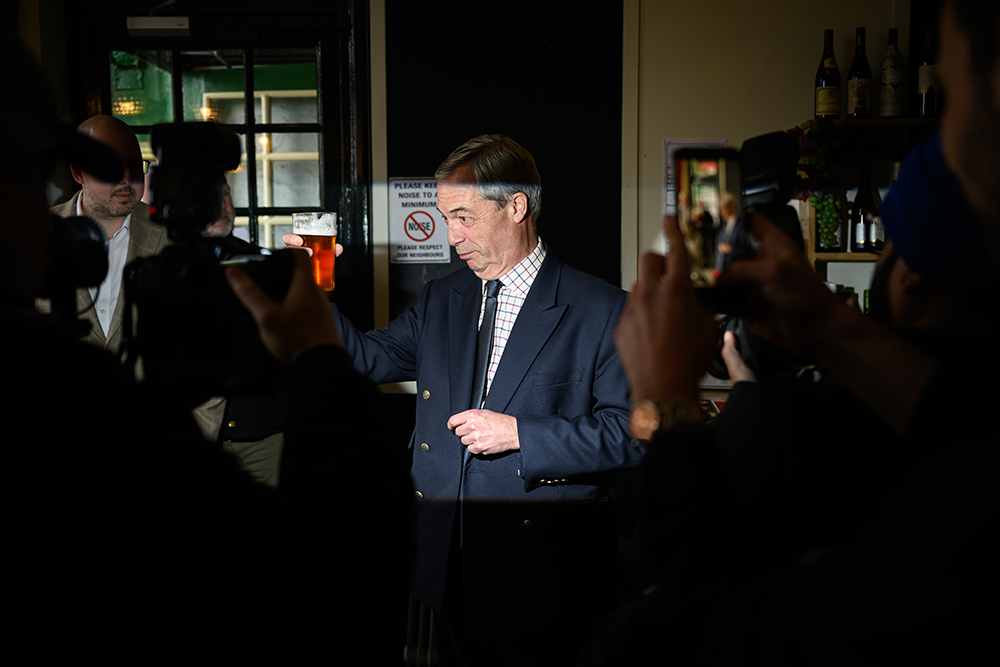
Cumulatively, the changes show how we have moved away from policies designed to please the working man. In those days, the word “man” often just meant person, but in the case of beer it usually meant a man rather than a woman. Women were still a rarity in most pubs; in some, the bar would fall silent if a young woman entered. No women, except perhaps a few old ladies, entered on their own. Few women drank beer, especially bitter. The changes had some good effects – cheaper alcohol in supermarkets with fewer restrictions on when you could buy it, better food (in the 1970s, there was often no cooked food at all) and more comfort in pubs – but their net effect was to stop pleasing the workers who had won the war. That seven-times increase of beer price over inflation in the course of half a century is a rough index of the discontent which fuels Reform and explains why Nigel Farage is so often photographed with a pint of bitter in his hand.
In the same pub in 1972, a pint of mild (now rarely available) cost 11 pence, but its name ensured that its price was less emotive than bitter. As a middle-of-the-road Liberal at that time, I often drank mild-and-bitter.
Thanks to Christopher Harborne, the crypto-king in Thailand, Mr. Farage could now buy 500,000 pints of bitter and still be no poorer than he was before he accepted Mr. Harborne’s donation of £5 million in 2024. There is a danger that his finger, which has for so long been on the pulse of the British worker, will stray towards a bottle of Pétrus. He pleads he needs personal security for the rest of his life. Given how brutal our politics have become, I fear that is true. But it is not true, as Mr. Farage asserts, that his £5 million from Mr. Harborne bears no relation to his purchase of a £1.4 million house in Surrey. No doubt Mr. Harborne’s money was not directly involved, but if you have £5 million in the bank or equivalent thereof (which he did by the time of purchase), you are freed up to spend whatever other savings you possess. We shouldn’t mind that Mr. Farage is rich, or suspect his motives in becoming friendly with billionaire Christopher Harborne, but we might wonder why it annoys him to talk about it and why he did not mention it when it happened. He says it is personal. As we are frequently told, however, the personal is political.
Traditionally, American politicians “ran” for office and British ones only “stood” for it, suggesting a more sedate attitude on this side of the Atlantic. Nowadays, however, literally running is almost compulsory for candidates. Newspapers have shown both Andy Burnham and Wes Streeting in shorts and trainers. Of the two, Mr. Burnham, though older, seemed to be moving faster. Sir Keir Starmer was not pictured running, but hardly a weekend passes without him playing football somewhere. As my AI Overview puts it, Tony Blair was “the first UK prime minister to actively embrace the optics of jogging.” I wonder, though, whether voters like seeing those white knees and sweaty faces. Try to imagine Winston Churchill, Clement Attlee, Harold Macmillan or Margaret Thatcher running, and you can see what a culture change the 21st-century habit represents. I happened to be reading Something Fresh by P.G. Wodehouse at the weekend: “The rules governing exercise in London are clearly defined. You may run, if you are running after a hat or an omnibus; you may jump, if you do so with the idea of avoiding a taxi-cab or because you have stepped on a banana-skin. But, if you run because you wish to develop your lungs or jump because jumping is good for the liver, London punishes you with its mockery. It rallies round and points the finger of scorn.” Those words were published in 1915. But I feel they still contain a wisp of truth.
More attention should be paid to the fact that, in trying to stand as Labour candidate in the Makerfield by-election, Mr Burnham will resign as mayor of Greater Manchester only if he wins both the candidature and the by-election itself. It is an odd maneuver, like crossing the Rubicon with a return ticket.
If you invent a television show called Married at First Sight, in which people who have never met are invited to be filmed going through a pretend marriage ceremony, then moving in together and getting into bed, should you be surprised when there is some recrimination afterwards? Channel 4 says, “The wellbeing of our contributors is always of paramount importance to us.” If it were, they would never have broadcast such a degrading program in the first place.
This column recently listed things that the youngest generation of adults find perplexing. Here is another, sent to me by Justin Webb, star of the BBC Today program. His daughter Martha, on one of those punishing Duke of Edinburgh Award trips, called to say, “Daddy, I’m in a thing called a phone box.”



Comments